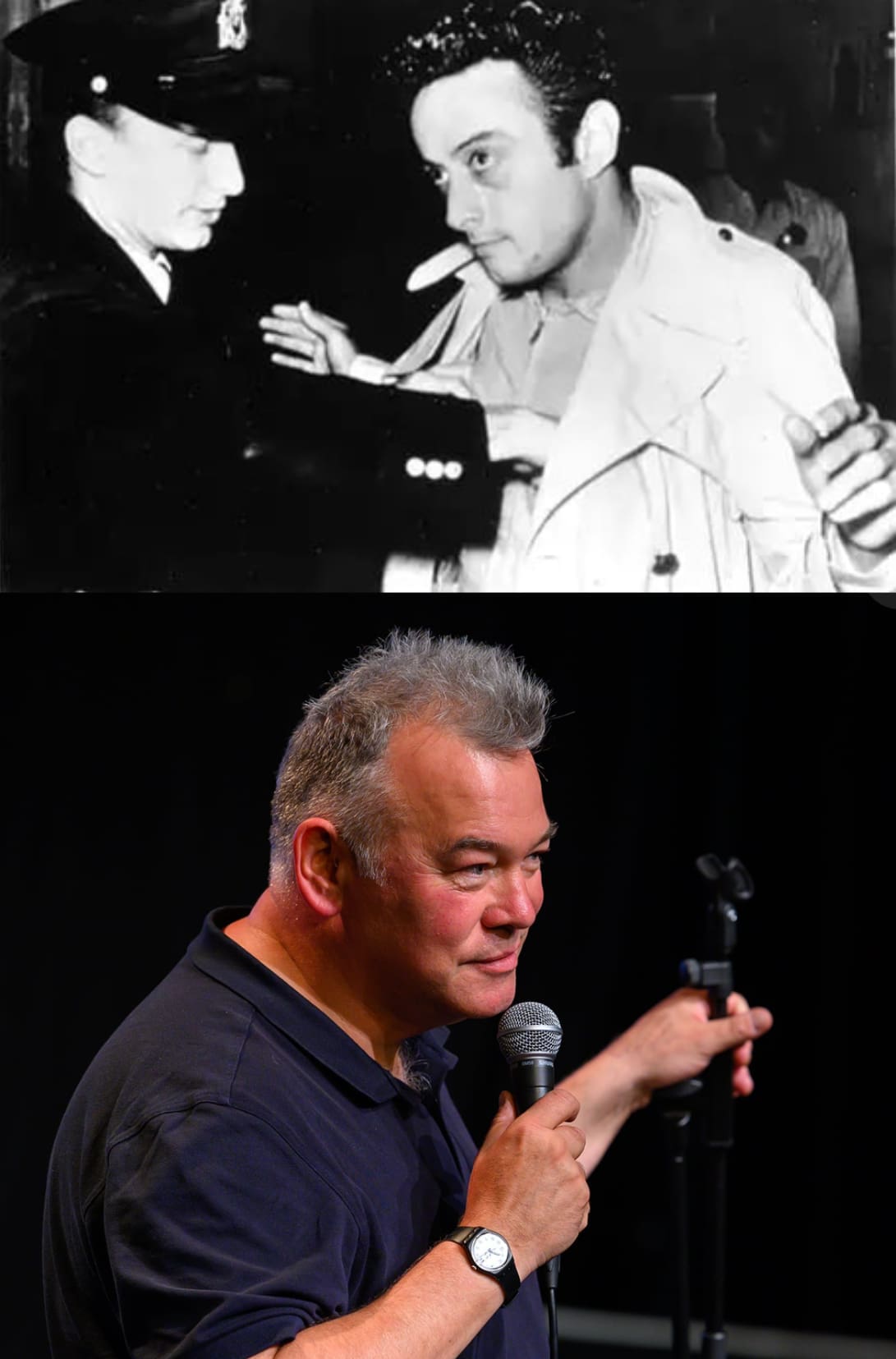
Understanding the comedy of Lenny Bruce, one has to remember that it was a time when people had a reasonable understanding of what truth was. For a comedian, this was vital. To build jokes on a critique of the reality around us enabled audiences to make sense of why they were laughing at something. Perhaps the ridiculousness of it or the impotence or the irrelevance. Now, though, truth and reality have become compromised as people just make things up, and those lies and falsehoods spread like forest fires across large areas, destroying everything in their wake. To make comedy from this new phenomenon is very different.
The following conversation with Stewart Lee about Lenny Bruce and about how things have changed in the current era reveals a very frightening and dangerous shift from what was known as modernism to what is now better known as chaos.
For those who did not know much about Lenny Bruce, please let me try and enlighten.
Lenny Bruce (1925-1966)
Few figures in the history of stand-up comedy have loomed as large or burned as brightly as Lenny Bruce. A man whose name has become synonymous with free speech, rebellion, and the raw edge of truth-telling, Bruce wasn’t merely a comedian — he was a cultural lightning rod. His life, both tragic and triumphant, reads like a parable of mid-20th century America: the artist crushed under the weight of his own convictions and the society he sought to expose.
Born Leonard Alfred Schneider on 13 October 1925 in Mineola, New York, Bruce’s early years were unremarkable, marked by the usual turbulence of Depression-era America. His parents divorced when he was young, and it was his mother, Sally Marr — herself a stage performer and later a comedian — who would shape his fascination with show business. After serving in the U.S. Navy during the Second World War, Bruce drifted through odd jobs and minor gigs before discovering his calling in comedy.
But Bruce was never content to tell simple jokes. Where others aimed for laughter, he aimed for revelation. In an age when American comedy was largely confined to gentle domestic humour and safe one-liners, Bruce charged headlong into the forbidden. He spoke about race, religion, sex, politics, and hypocrisy — the very subjects polite society pretended not to see. His sets were raw and improvisational, tumbling out in a torrent of words and ideas. Audiences often didn’t know whether to laugh, gasp, or walk out.
By the late 1950s, Bruce had become both a cult hero and a marked man. He recorded groundbreaking albums like The Sick Humor of Lenny Bruce and American, which captured his unfiltered wit and biting social commentary. Yet with fame came scrutiny. Police officers and moral crusaders began to attend his shows, not as fans but as enforcers. What began as a few obscenity warnings turned into a campaign of legal persecution that would dominate the final years of his life.
In 1961, Bruce was arrested in San Francisco for using obscene language during a performance. The charges were ultimately dismissed, but the pattern was set. Arrest followed arrest — in Chicago, Los Angeles, and New York — as authorities sought to silence him. His material, once fluid and daring, grew increasingly consumed by the very trials he faced. By the mid-1960s, his act was part comedy, part courtroom transcript; he would read from legal documents on stage, transforming his persecution into performance art.
Behind the controversy, however, was a deeply human struggle. Bruce battled addiction and financial ruin, his career slowly strangled by censorship and legal costs. Once hailed as a prophetic voice of American truth, he became isolated, erratic, and exhausted. On 3 August 1966, Lenny Bruce was found dead in his Hollywood Hills home, the victim of a morphine overdose. He was forty years old.
In death, Bruce achieved the vindication that had eluded him in life. The years that followed saw him recognised not as a corrupter of morals, but as a pioneer of modern satire. The comedians who came after — George Carlin, Richard Pryor, Bill Hicks, and countless others — drew from his defiance and honesty. In 2003, nearly four decades after his death, the governor of New York posthumously pardoned him for his obscenity convictions — a symbolic but powerful gesture that acknowledged how far society had come.
Lenny Bruce’s legacy is not simply one of humour, but of courage. He tore down the polite façades of American culture and demanded that comedy confront reality, not escape it. In doing so, he transformed stand-up into an art form capable of truth-telling, protest, and poetry.
His story remains a warning and an inspiration: that the price of speaking freely can be devastating, but the silence of conformity is far worse.
If Lenny Bruce and Stewart Lee teach us anything, it is that joining a queue just because it is there is the life everyone should avoid.