


The appointment of Peter Mandelson as Britain’s ambassador to the United States was presented as a calculated act of diplomatic pragmatism. In reality, it has come to symbolise something far more troubling: the extent to which British political decisions appear shaped—subtly, structurally, and at times disturbingly—by foreign power centres, particularly the gravitational pull of Washington and the persistent, often opaque, influence networks aligned with Israel.
To understand the significance of Mandelson’s elevation, one must first look at the political climate in which Keir Starmer made his choice. Britain was not merely appointing an ambassador; it was positioning itself in anticipation of a renewed and volatile relationship with a possible second presidency of Donald Trump. That reality alone reshaped the criteria. Gone was the idea of a conventional diplomat. In its place stood a political operator with deep transatlantic connections, a man whose value lay less in neutrality and more in his ability to navigate power, influence, and access within the American elite.
This is where the first layer of foreign influence becomes unmistakable. The United States does not formally appoint British ambassadors, but it retains an unspoken veto. Any nominee must be acceptable to the administration in Washington. The memory of Sir Kim Darroch’s forced resignation after angering Trump still loomed large, acting as a warning shot to any government tempted to assert full independence in its diplomatic choices. In that context, Mandelson was not simply selected; he was pre-approved by a political environment shaped by Trumpism. His past criticisms of Trump softened, recalibrated to meet the demands of access and survival. This was not coincidence; it was adaptation to power.
Yet the American dimension is only part of the story. Running parallel is the quieter, more difficult-to-quantify question of Israeli influence within British political life. There is no single document, no explicit directive linking Israel to Mandelson’s appointment. But to stop there would be to ignore a wider ecosystem of lobbying, advocacy, and strategic alignment that has long operated within Westminster. Former diplomats and investigative reporting have pointed to sustained efforts by pro-Israel networks to shape discourse, policy, and personnel decisions in Britain. These efforts are rarely crude or direct; they function instead through relationships, funding channels and the cultivation of political figures seen as sympathetic or strategically useful.
Mandelson, a figure deeply embedded in global elite networks and a renowned Zionist, fits comfortably within that world. His long-standing connections across business, politics, and international influence circles made him a safe pair of hands not only for managing Washington but also for operating within a broader geopolitical framework in which alignment with US and Israeli interests is often assumed rather than debated. That assumption, rarely acknowledged openly, is itself a form of influence. It narrows the field of acceptable choices before decisions are even made.
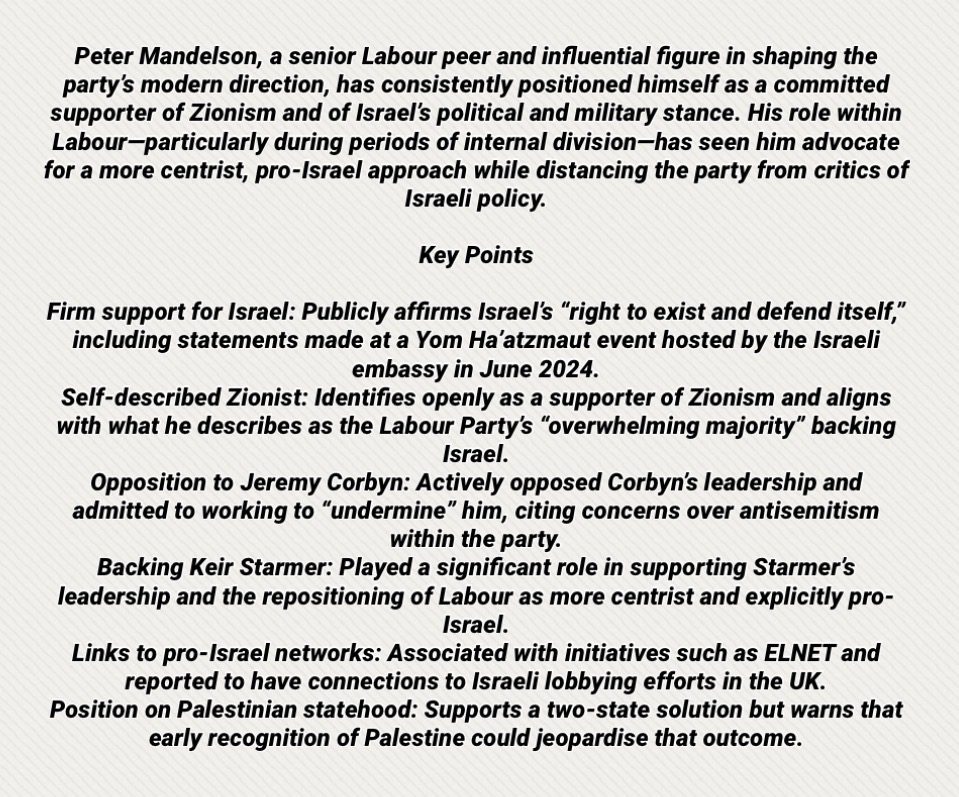
What makes this episode particularly corrosive is not merely that foreign considerations shaped the appointment, but that they appear to have outweighed serious domestic concerns. Chief among these were Mandelson’s documented associations with Jeffrey Epstein, a relationship that continued after Epstein’s conviction. Keir Starmer was not in the dark about these links. They were known, raised, and subjected to scrutiny during the vetting process. And yet Mandelson was appointed regardless.
Here, the defence offered by Downing Street begins to fray. It has been suggested that failures in the vetting process occurred below the level of ministerial oversight, that decisions were made or overridden without full political awareness. That explanation strains credibility. Even if taken at face value, it reveals a government either unwilling or unable to maintain control over one of its most sensitive appointments. If rejected, it leaves a more damaging conclusion: that the risks were understood and consciously set aside.
Either way, transparency was the first casualty. Public assurances that due process had been followed have since been undermined by revelations that Mandelson initially failed security vetting, only for that decision to be overturned. The question is no longer simply why he was appointed, but why the truth about that appointment was obscured. In a democratic system, the appearance of concealment is often as damaging as the act itself.
The deeper issue, however, lies in what this episode reveals about the balance of power. Britain likes to imagine itself as an autonomous actor on the world stage, making sovereign decisions in its own national interest. The Mandelson affair suggests something more constrained. Faced with the realities of American political dominance and the embedded influence of aligned international networks, British governments appear increasingly inclined to select figures who will not disrupt those relationships, even when doing so carries significant reputational and ethical risks at home.
This is not the crude caricature of foreign control sometimes invoked in political rhetoric. It is more subtle and, arguably, more pervasive. Influence operates through anticipation, through the internalisation of external expectations, and through the quiet understanding of what is acceptable to allies and what is not. By the time a decision like Mandelson’s appointment is made, the boundaries have already been drawn.
The result is a form of political self-limitation. Choices are framed not by what is best or safest for the country, but by what will be tolerated or welcomed by powerful partners abroad. In that context, Mandelson’s appointment begins to look less like an isolated misjudgment and more like the logical outcome of a system that prioritises alignment over accountability.
When the scandal finally broke, when the Epstein connections, the vetting failures and the internal warnings came into full view, the damage was swift and severe. Mandelson’s position became untenable, and the government was forced into apology and retreat. But by then, the deeper questions had already been exposed. Who really shapes British decision-making at the highest levels? How much weight is given to foreign approval? And at what point does pragmatism become compromise?
These are not abstract concerns. They go to the heart of democratic accountability. If key appointments can be influenced, directly or indirectly, by external powers and if known risks can be downplayed or concealed in service of those relationships, then the issue is not merely one of political error. It is one of systemic vulnerability.
In the end, the Mandelson affair is not just about one man or one appointment. It is about a political culture that appears increasingly comfortable operating within constraints set beyond its own borders and a leadership that has struggled to be fully honest about the consequences of that reality.







