
I am now half way through Rebecca Gordon Nesbitt’s phenomenal book entitled Killing Corbynism: Zionism’ War on Socialism. Five years in the making and packed with thousands of sources with everything backed up. Incredibly detailed, it represents the extremely troubling behaviour of those responsible for the Israeli/Zionist assault on Jeremy Corbyn and his allies and supporters leading up to and including the years between 2015 and 2020 inclusive. It identifies key figures and organisations that led the attacks and promulgated the lies. It reveals how capitalist Labour members would do anything to rid themselves of a man they saw as a threat to the status quo. Politicians who are now in the present Starmer cabinet who helped lead the assault as well as those that many have never heard of before are exposed as establishment pro-Israel actors in a production directed from distant shores. To do the book justice in one article would be a fool’s errand. Thus, breaking it down into smaller exposés makes much more sense.
This exposition focuses upon Moshe Machover, an Israeli-born socialist, anti-Zionist thinker and founder of the Israeli socialist organisation Matzpen. He wrote an article entitled “Anti-Zionism Does Not Equal Anti-Semitism” which was distributed at Labour’s 2017 conference. The article argued that criticism of Zionism is not inherently antisemitic and that attempts to conflate the two were politically motivated by Zionist forces, some in plain sight and others hiding in the shadows. What the following attempts to do is not just reveal what Machover exposed but also how the Labour Party responded and what happened next. It is the ‘what happened next’ that shapes how we should all see Zionism and their tactics and methodology to control the pro-Israeli agenda.
Let us remember what has happened since before delving into Moshe Matchover.
Moshe Machover: What He Said; How Labour Responded and What Happened Next
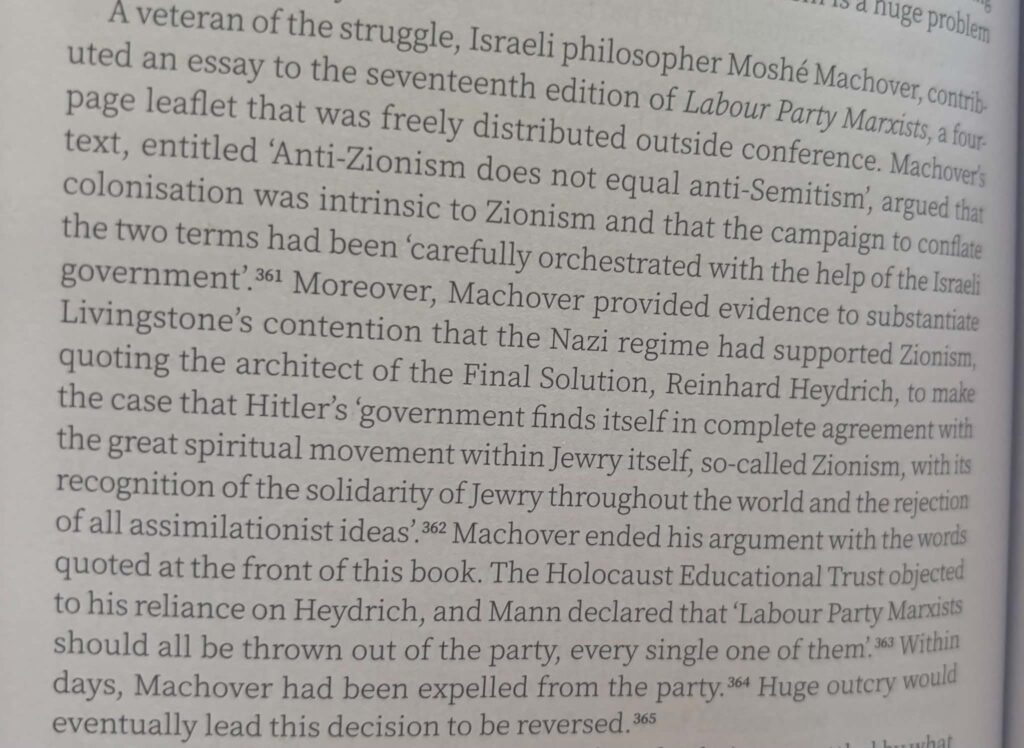
A segment from Killing Corbynism: Zionism’s War on Socialism by Rebecca Gordon-Nesbitt
A key part of Machover’s argument in 2027 concerned the historical relationship between Zionist organisations and Nazi Germany during the early years of Hitler’s rule.
Machover cited a 1935 statement by Reinhard Heydrich, one of the principal architects of the Holocaust, who wrote that the Nazi government viewed Zionism favourably insofar as it encouraged Jewish emigration from Germany and rejected Jewish assimilation into wider European society. The quotation highlighted what Heydrich described as agreement with Zionism’s emphasis on Jewish national separation. Machover used this source to argue that there had been a period during the 1930s when certain Nazi objectives and certain Zionist objectives intersected, despite their fundamentally different motivations.
This argument was not invented by Machover. Historians have long documented the existence of the Haavara (Transfer) Agreement between Nazi Germany and German Zionist organisations, which facilitated Jewish emigration to Palestine before the Holocaust escalated into systematic extermination. The historical existence of those contacts is not controversial among scholars. The controversy lies in how they should be interpreted.
Machover’s broader contention was that Zionist leaders and antisemitic regimes sometimes shared a short-term interest in encouraging Jewish migration to Palestine. According to supporters of Machover, this was essentially the historical point that Ken Livingstone was attempting, albeit perhaps a little clumsily, to make when he referred to contacts between early Nazi authorities and Zionist organisations.
The connection to Ken Livingstone
Livingstone’s comments generated enormous controversy because many people interpreted them as implying support by Hitler for Zionism as a whole.
Machover argued that Livingstone’s underlying historical point had been distorted. According to Machover, the issue was not whether Hitler was a Zionist or whether Nazism and Zionism were equivalent. Rather, it was that sections of the Zionist movement and the Nazi regime had engaged with one another during a specific historical period before the implementation of the Final Solution.
Even critics of Machover generally acknowledged that his article was engaging with real historical documents rather than fabricating evidence. The dispute centred on whether his interpretation was legitimate scholarship or whether it risked minimising Nazi antisemitism.
Why he was expelled
Following publication of the article, Labour officials informed Machover that the piece appeared to breach party rules relating to antisemitism. The expulsion letter referred to language that could be perceived as offensive and cited concerns regarding the article’s content.
The decision immediately generated opposition from a wide range of Zionist Labour members, academics and activists.
One reason the case became so controversial was that Machover was himself Jewish, Israeli-born, a lifelong anti-racist campaigner and a veteran critic of antisemitism. Supporters argued that expelling a Jewish anti-Zionist scholar for discussing documented historical events demonstrated precisely the conflation of anti-Zionism and antisemitism that he had warned against.
Numerous Labour branches passed motions demanding his reinstatement. Critics of the expulsion argued that due process had not been followed and that Labour was effectively punishing discussion of historical evidence because it was politically inconvenient.
Reinstatement and its significance
On 30 October 2017, less than a month after the controversy erupted, Labour reversed the decision and reinstated Machover’s membership. The party accepted that the original exclusion had been made in error. His reinstatement followed substantial pressure from Labour members, constituency parties and Jewish activists who objected to the expulsion.
Supporters of Machover viewed the reversal as a major embarrassment for those who had demanded his expulsion. They argued that the episode demonstrated the weakness of the allegations and strengthened the case that anti-Zionist views were being targeted under the banner of combating antisemitism.
Critics of Labour’s handling of the affair have frequently cited the Machover case as one of the clearest examples of the tensions within the Corbyn-era antisemitism debate. To them, the fact that a Jewish Israeli socialist could be expelled for an article discussing documented historical interactions between Nazi officials and Zionist organisations, only to be reinstated weeks later, raised serious questions about how accusations of antisemitism were being assessed.
What can be stated confidently is that Machover’s article relied on genuine historical sources, including statements by Heydrich; that he was expelled after publishing those arguments; and that Labour subsequently reversed its decision and restored his membership following a significant backlash. Those facts are well documented. Unfortunately, instead of learning from this administrative disaster, Labour adopted it as praxis, which has served the Zionists and Israel very well (so far) in their genocidal campaign in Gaza and Lebanon.