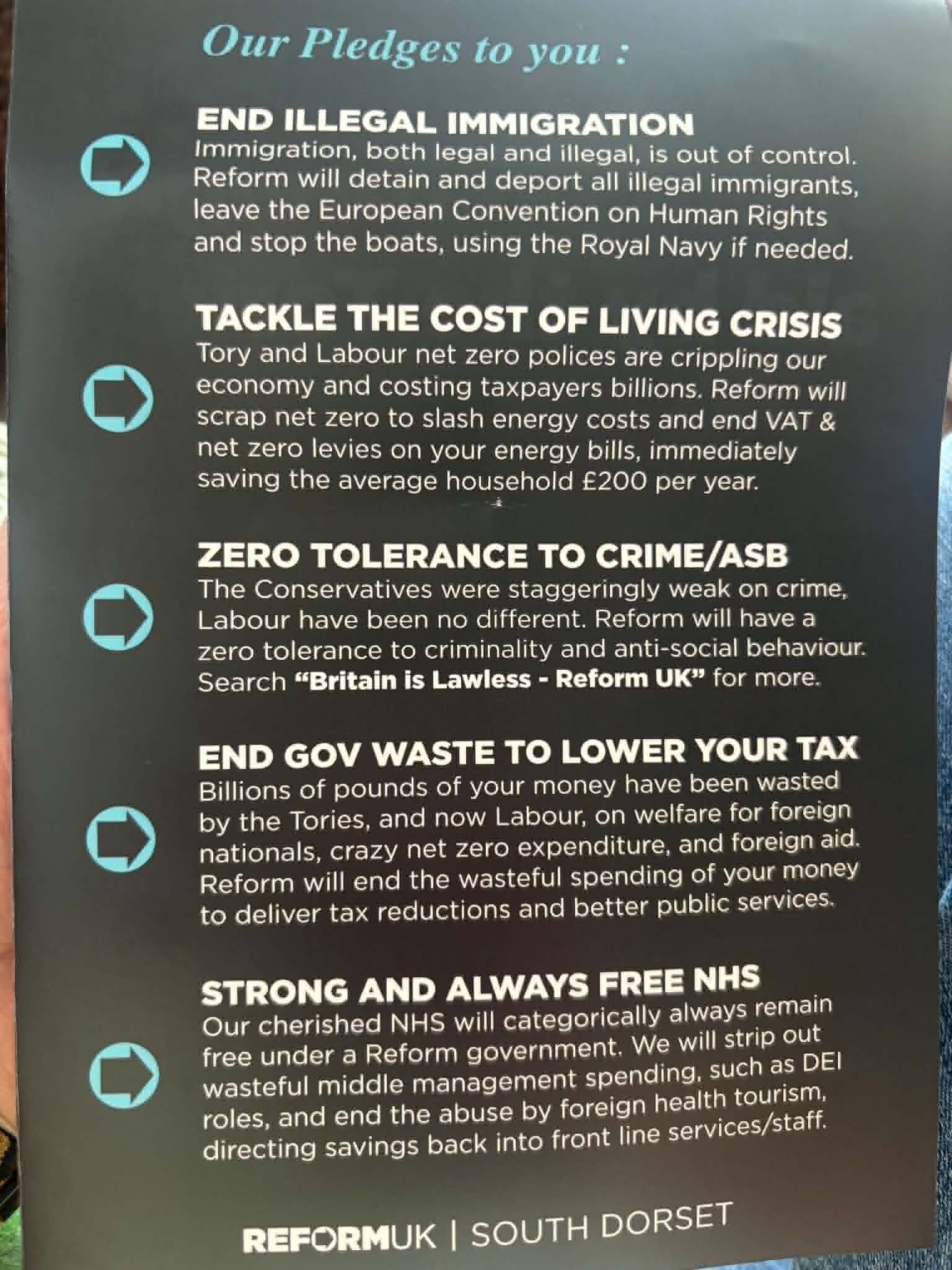
The latest leaflet from Reform UK in South Dorset reads less like a serious governing programme and more like a collection of slogans designed to trigger frustration, anger and resentment. Almost every pledge on the page promises sweeping change through simplistic solutions, yet many of the claims collapse under scrutiny the moment practical reality, economics or the law is taken into account.
The opening pledge to “End Illegal Immigration” is perhaps the clearest example. Reform claims it will “detain and deport all illegal immigrants”, leave the European Convention on Human Rights and “stop the boats, using the Royal Navy if needed.” The rhetoric is forceful, but the logistics are vastly more complicated. Britain already struggles with overcrowded detention centres, lengthy asylum processing backlogs and legal challenges in the courts. Simply declaring mass deportations does not magically create agreements with foreign governments willing to take people back. Leaving the ECHR would also trigger enormous constitutional and diplomatic consequences, damaging Britain’s standing internationally while still not guaranteeing that crossings would stop. Even the previous Conservative government, after years of tough rhetoric and billions spent, failed to “stop the boats.” Reform presents the issue as though there is an easy switch to pull when there plainly is not.
Its attack on net zero policies is similarly shallow. Reform claims scrapping climate measures and removing green levies would save households £200 a year. What the leaflet does not acknowledge is that Britain remains heavily exposed to volatile international fossil fuel prices. Renewable energy investment is partly designed to reduce long-term dependency on imported gas. Scrapping environmental commitments may produce short-term political applause, but it risks higher future energy insecurity, reduced investor confidence and economic isolation as other advanced economies move towards greener industries. The leaflet frames net zero entirely as a burden while ignoring the economic opportunities attached to renewable technology, infrastructure and energy independence.
The promise of “zero tolerance to crime and anti-social behaviour” is another emotionally appealing slogan lacking meaningful detail. Britain has heard “tough on crime” promises from governments for decades, yet crime rates are shaped by deep social, economic and policing factors. Reform offers no serious explanation of how prisons would cope with harsher sentencing, where additional police funding would come from, or how overstretched courts would process cases more quickly. “Zero tolerance” sounds decisive on a leaflet, but in practice it often translates into expensive policies with limited measurable success.
Perhaps the most revealing section is the pledge to “End Government Waste to Lower Your Tax.” This is classic populist politics: identify vague enemies — “foreign nationals”, “foreign aid”, “crazy net zero expenditure” — and imply that removing them will somehow create enough money for both tax cuts and better public services. Modern government spending simply does not work like that. Foreign aid represents a tiny percentage of public expenditure. Welfare spending is overwhelmingly spent on British citizens. Public services from councils to hospitals are already struggling financially after years of austerity and inflation pressures. The leaflet offers the fantasy that Britain can simultaneously cut taxes, increase spending and reduce debt without painful trade-offs.
The NHS pledge follows the same pattern. Reform promises a “strong and always free NHS” while attacking “DEI roles” and “foreign health tourism.” Yet these are marginal issues compared with the actual structural problems facing the health service: staff shortages, ageing infrastructure, growing demand and recruitment crises. Ironically, the NHS is heavily dependent on overseas workers to function. Reform’s broader anti-immigration stance could worsen staffing shortages while pretending to defend the service.
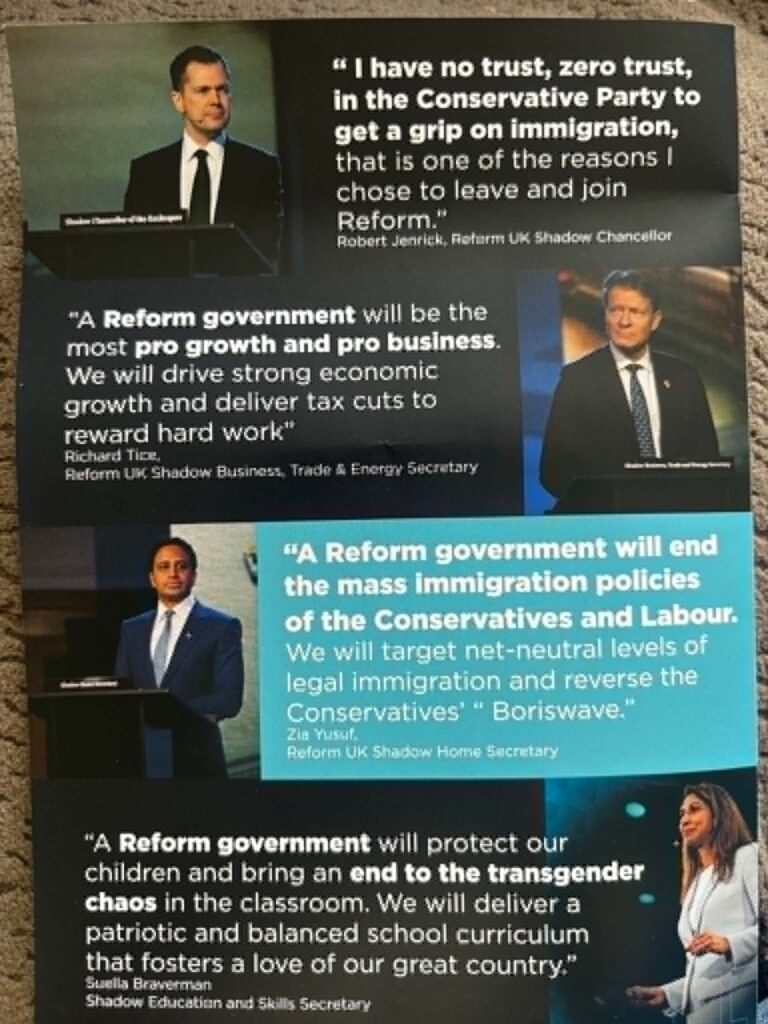
Reform UK’s latest pitch attempts to fuse hardline immigration rhetoric, culture war politics and Thatcherite economics into one neat package. On paper, it is designed to sound bold, decisive and patriotic. In reality, it reads less like a coherent governing programme and more like a collection of applause lines aimed at public frustration. The deeper these claims are examined, the more contradictions and practical impossibilities begin to emerge.
The central promise revolves around ending “mass immigration” while simultaneously creating a “pro growth” economy with tax cuts and expanded business confidence. This is where the entire framework starts to collapse under its own logic. Britain’s economy is deeply dependent on migrant labour across healthcare, agriculture, hospitality, logistics and social care. Employers consistently warn of labour shortages even under current immigration levels. Promising near “net-neutral” migration while also promising rapid economic growth is economically contradictory. Modern economies grow by expanding labour markets, investment and productivity. Reform appears to believe it can dramatically shrink the workforce while increasing output and tax revenues at the same time.
That contradiction becomes even more obvious when paired with promises of tax cuts. Cutting taxes while increasing border enforcement, expanding deportation systems and restructuring immigration controls would require enormous public spending. Britain already struggles to fund basic public services under current fiscal constraints. Unless Reform intends to slash public spending even further, their economic arithmetic simply does not add up. The party talks as though there are limitless savings hidden somewhere in government bureaucracy, but there is little evidence such savings could finance the scale of promises being made.
The rhetoric surrounding immigration also ignores global realities. Britain cannot simply isolate itself from international migration pressures. Wars, climate instability, economic inequality and international labour markets all drive migration flows. No serious government can completely “end” mass migration without causing enormous economic disruption or breaching international agreements. Even Brexit, which was sold partly as a solution to immigration, failed to significantly reduce overall migration numbers because businesses and public services continued needing workers.
Reform’s language on “Boriswave” immigration attempts to place blame entirely on the Conservatives while pretending there are easy solutions available. Yet many of the pressures driving migration existed long before Boris Johnson and will continue long after him. Britain has an ageing population and declining birth rates. Without migration, the tax base shrinks while pension and healthcare costs rise. Reform rarely addresses this demographic reality because it undermines the simplicity of its messaging.
The party’s culture war approach to education is equally vague and politically opportunistic. Phrases like “transgender chaos in the classroom” are designed to provoke emotional reactions rather than describe widespread reality. There is little evidence British schools are collapsing into ideological disorder. Teachers are far more likely to be struggling with underfunding, staff shortages, deteriorating buildings and falling pupil wellbeing than with the exaggerated scenarios often pushed in political rhetoric.
Likewise, calls for a “patriotic and balanced curriculum” sound harmless until one asks who decides what patriotism means. Governments attempting to shape education around national identity often end up politicising history and suppressing uncomfortable truths. A mature education system should encourage critical thinking, not simply reinforce government-approved narratives about the country.
There is also a striking populist contradiction running throughout the messaging. Reform presents itself as anti-establishment while simultaneously promoting highly pro-business economics that overwhelmingly benefit wealthier interests. Tax cuts are repeatedly framed as rewards for “hard work”, yet large tax reductions historically tend to favour corporations and higher earners far more than ordinary workers. Public services, meanwhile, often deteriorate further as government revenues shrink.
Perhaps the biggest weakness is that Reform’s entire platform depends on presenting incredibly complex problems as though they have simple solutions being blocked only by cowardice or incompetence. Immigration, economic stagnation, cultural division and failing public services are all real concerns. But slogans alone cannot solve structural problems decades in the making.
Ultimately, this programme resembles political fantasy more than a serious governing blueprint. It offers anger, certainty and blame in abundance, but far fewer workable solutions. Once stripped of its emotionally charged language, much of it appears economically contradictory, socially divisive and administratively unrealistic.