

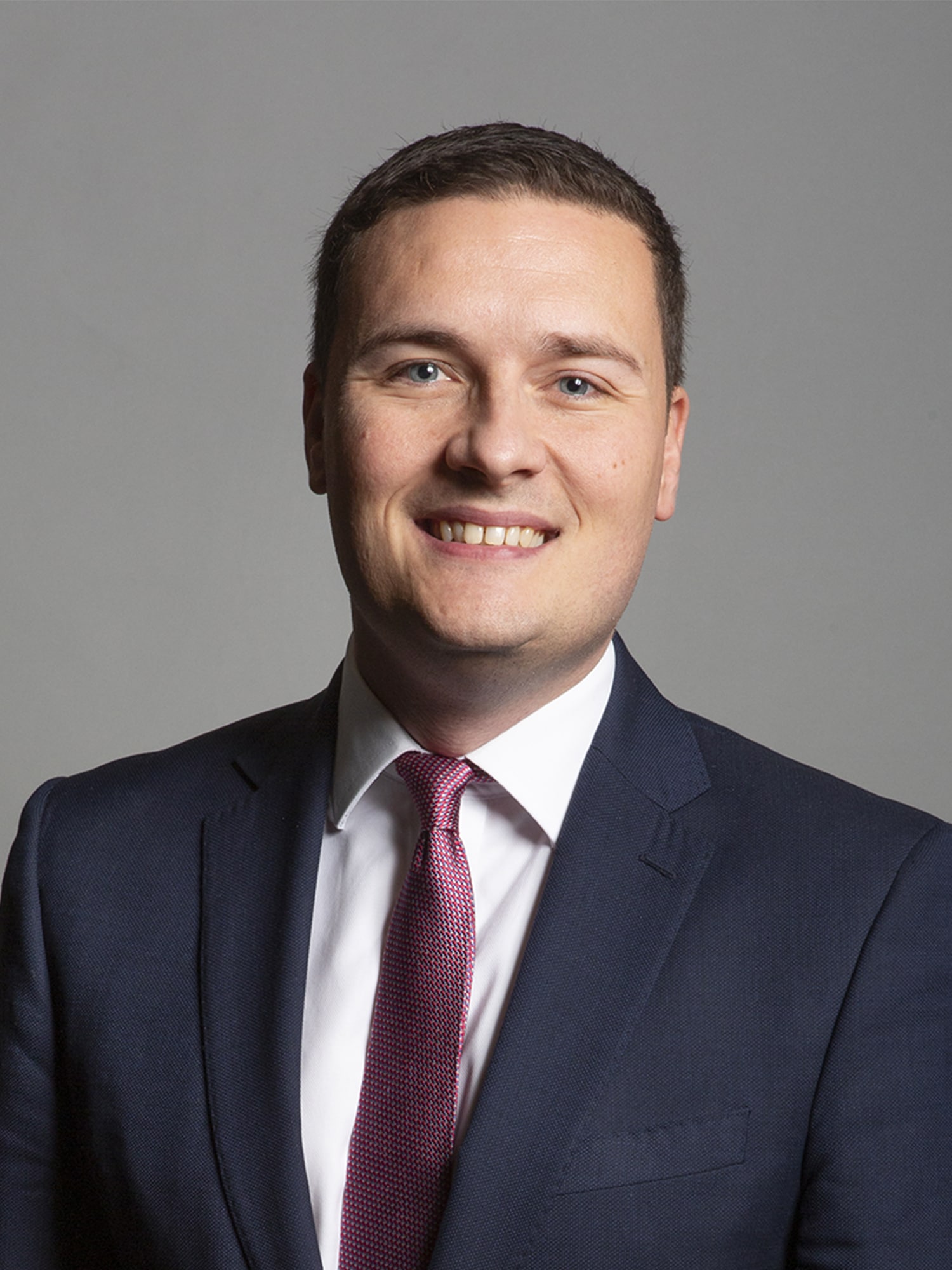
Every time Wes Streeting appears on television to talk about the future of the NHS, the public deserves to ask one simple question: who is he really speaking for?
The patients waiting months for treatment? The exhausted nurses and junior doctors holding together an overstretched health service? Or the private healthcare-linked donors who have poured hundreds of thousands of pounds into his political rise?
These are not fringe questions. They go to the heart of public trust.
According to investigations based on Electoral Commission declarations, more than 60 per cent of the donations accepted by Streeting since entering Parliament have come from people and companies with links to private healthcare.
That should alarm anyone who still believes the NHS must remain a truly public service.
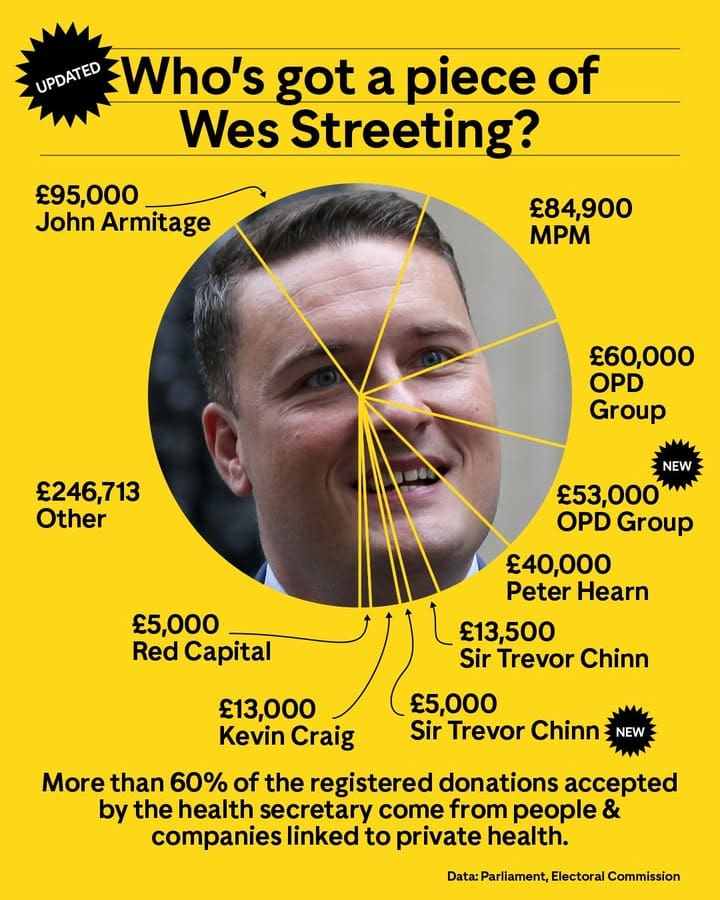
The figures are staggering. Companies linked to recruitment executive Peter Hearn, through OPD Group and MPM Connect, have reportedly given Streeting well over £140,000, with additional personal donations also linked to Hearn. Hedge fund manager John Armitage, who has been reported as holding major interests in US health insurance giant UnitedHealth, has contributed around £95,000. Other figures with links to private health investments have also helped bankroll him.
No one is alleging illegality. These donations are declared.
But legality is not the same as trust.
The British public has lived through years of creeping privatisation, outsourcing and fragmentation of NHS services. Contracts have been handed to private providers, agency staffing firms and consultancy giants while patients face record waiting lists and staff face burnout.
Against that backdrop, Streeting’s repeated defence of greater private sector involvement lands very differently.
It no longer sounds like neutral policy discussion.
It sounds like a politician echoing the interests of those funding him.
If private health-linked donors are giving hundreds of thousands of pounds to the very minister responsible for shaping NHS policy, people are entitled to ask whether this is ideology, influence, or simply access purchased through donations.
Why would wealthy figures connected to private health invest so heavily in one politician unless they believed his vision aligns with their interests?
That is the question broadcasters should be asking every single time he is interviewed.
The problem is not just conflict of interest, it is the appearance of it.
Politics in Britain is suffering from a crisis of faith. People no longer believe decisions are made for them. They believe decisions are made for donors, lobbyists and corporations.
When it comes to the NHS, that distrust cuts even deeper.
This is not just another government department. The NHS is one of the last institutions that still carries an idea of collective care — healthcare free at the point of need, based on dignity rather than wealth.
Any politician proposing reform while heavily funded by private health interests should face the highest level of scrutiny.
Streeting may insist he wants to “save” the NHS.
But save it for whom?
For patients?
Or for the businesses waiting to profit from its continued crisis?
Because history shows that underfunding public services often becomes the argument for opening the door to private providers. First it is “partnership”, then “efficiency”, then “innovation”, and before long core services are being carved up for profit.
People have every right to be suspicious.
Transparency should not be optional.
Any broadcaster airing Streeting on NHS funding should also make clear the scale of the donations he has received from those linked to private healthcare. Context is not bias, it is journalism.
The public cannot make informed judgments if the financial interests behind political messaging remain in the shadows.
The NHS belongs to the public, not donors.
And until Streeting can convincingly separate his policy agenda from the money behind him, the question will remain unavoidable:
Can the man shaping the future of the NHS really be trusted to protect it?







