Don’t let those who spread fake news for their own ends poison the debate or our society
‘That whole Epsom situation is a clusterfuck, and the far right really needs to stop using these sorts of crimes as fuel for public piss-ups and to target brown people and asylum seekers.
I hope the woman who reported it is ok, and I really hope the actions of Fanny Dumbo and the rest of his ilk didn’t jeopardise any investigation. Whether there was an attack or not, I’m not even sure myself, tbh; that’s the main reason I haven’t mentioned anything about it on the page until now.
The comments I’m seeing from dickheads across social media are absolutely insane. Not even a rough description had been released, but of course immigrants were being accused. It’s as if white men in the news daily being sent down for attacking women is not a thing and is being willfully ignored.
Every day, I see a 10/1 White man/immigrant of some description being jailed for some heinous shit, and this is not just UK news; it’s worldwide. Why do white people get so much leeway and little outrage for their crimes and wrongdoings, but when it’s a brown person, the whole community is blamed? All these “black fatigue” comments and shit like that when it’s white people who have been fucking the planet up and ruining everyone’s shit and instigating wars for millennia?
Jokers.’
The rush to judgement following reports of serious crime is as predictable as it is damaging. In the wake of a police investigation in Epsom, where a woman in her 20s alleged she had been raped outside a church, a familiar and troubling pattern has emerged: speculation, rumour, and the rapid targeting of asylum seekers and immigrants as presumed culprits, despite no evidence to support such claims.
Surrey Police have been clear. After reviewing CCTV, interviewing witnesses, and conducting forensic enquiries, officers have stated that they have not found evidence to support the offence as reported. Crucially, they have also explicitly confirmed there is no evidence linking asylum seekers or immigrants to the alleged incident. Yet they say this has not stopped a wave of online misinformation or the mobilisation of protestors driven by little more than suspicion and prejudice.
What unfolded in Epsom this week is not an isolated reaction but part of a broader societal problem. In moments of uncertainty, particularly involving allegations of violent crime, there is a segment of public discourse that defaults to blaming already marginalised groups. This instinct is not rooted in fact but in bias. It reveals how quickly fear can be weaponised and how easily narratives can be shaped by those with ideological agendas rather than evidence.
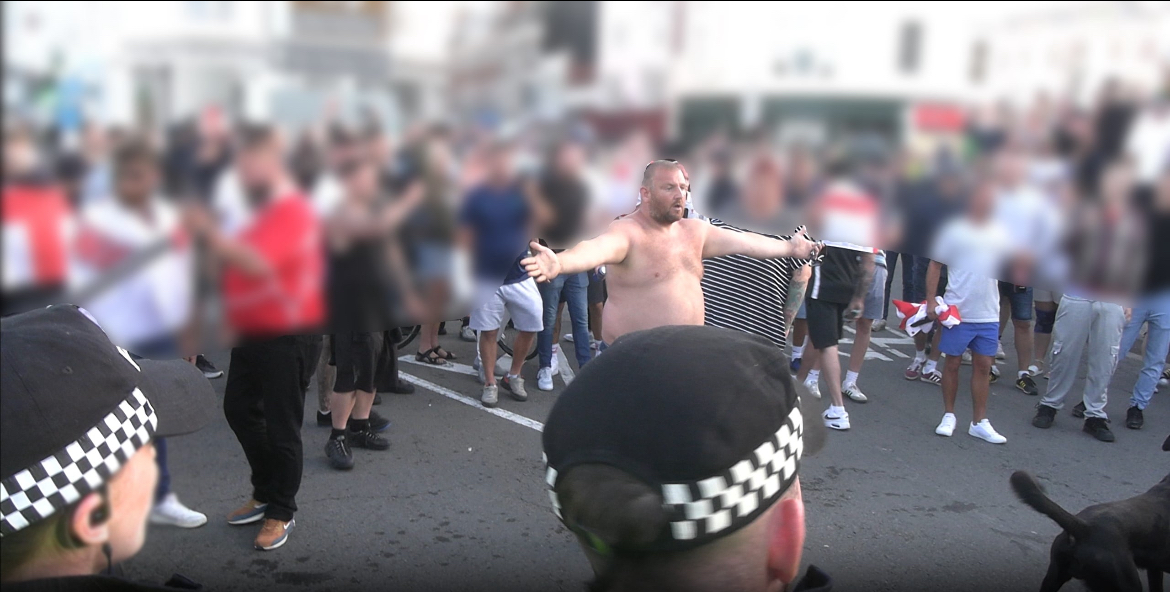
The protest itself, reportedly promoted by figures linked to far-right activism, underscores how these situations are often exploited. Demonstrators gathered, roads were blocked, and tensions escalated—not in response to confirmed details, but to rumours circulating online. The absence of verified information became a vacuum filled by assumption, and that assumption disproportionately targeted migrants. This is not accountability; it is scapegoating.
Such reactions carry real consequences. They deepen divisions within communities, foster hostility, and place innocent people at risk of harassment or worse. Asylum seekers, many of whom have fled violence and persecution, are too often recast as threats based on nothing more than their status or background. When public discourse leaps ahead of facts, it undermines not only those individuals but also the integrity of justice itself.
There is also a broader danger in eroding trust in due process. Police investigations take time, particularly in complex or sensitive cases. The demand for instant answers, coupled with suspicion of official statements, creates fertile ground for misinformation. When people choose to believe speculation over verified updates, it weakens the role of evidence in public life. Justice cannot function in an environment where conclusions are drawn before facts are established.
None of this is to diminish the seriousness of the original allegation. Claims of sexual assault must always be treated with gravity and care. But seriousness also demands responsibility, responsibility in how information is shared, how communities respond, and how narratives are formed. Jumping to racially charged conclusions does nothing to support victims or aid investigations. Instead, it distorts the situation and diverts attention from the truth.
What is needed is restraint, critical thinking, and a commitment to fairness. Waiting for verified information is not weakness; it is the foundation of a just society. Condemning entire groups based on unproven claims is not vigilance; it is prejudice.
The events in Epsom should serve as a stark reminder: when fear overrides fact, the consequences extend far beyond any single incident. If we are serious about justice, we must be equally serious about rejecting the knee-jerk racism that too often accompanies it.
The Top 15 Facts that Anti-Immigration Campaigners Get Wrong:
“Most immigrants are here illegally.”
In reality, the majority of immigrants in the UK arrive through legal routes e.g. work visas, student visas, or humanitarian protections.
“Asylum seekers get luxury treatment.”
Asylum seekers typically receive very basic support, often below the standard welfare level, and are not allowed to work while their claims are processed.
“Immigrants take jobs from locals.”
Evidence generally shows immigration has little to no negative impact on overall employment. In many cases, migrants fill labour shortages.
“Immigration drives down wages.”
Any downward pressure tends to be small and limited to specific low-wage sectors, not the workforce as a whole.
“Immigrants don’t pay taxes.”
Most migrants pay income tax, VAT, and national insurance, contributing significantly to public finances.
“They come just for benefits.”
Studies consistently show that work, safety, and family are the main motivations, not welfare.
“Crime is higher among immigrants.”
There is no consistent evidence that immigrants commit more crime than native-born citizens; in some cases, rates are lower.
“The UK takes more than its fair share of refugees.”
Compared to many countries, especially those bordering conflict zones,
the UK takes a relatively modest number.
“Asylum seekers can choose any country they want.”
In practice, people often have limited choice due to routes, family ties, language, or immediate safety.
“Most asylum claims are fake.”
A significant proportion are accepted at initial decision or on appeal, showing many claims are legitimate.
“Immigrants don’t integrate.”
Over time, most migrants learn English, work, and become part of their communities.
“They strain public services without contributing.”
While population growth does increase demand, migrants also work in and support those same services—especially in healthcare and social care.
“Stopping immigration would fix housing shortages.”
Housing issues are largely driven by supply constraints and policy decisions, not immigration alone.
“Small boat arrivals are the majority of immigrants.”
They make up a small fraction compared to those entering through legal visa routes.
“Immigration is uniquely out of control.”
Migration levels rise and fall over time and are influenced by policy choices, global events, and economic needs—not simply a lack of control.