

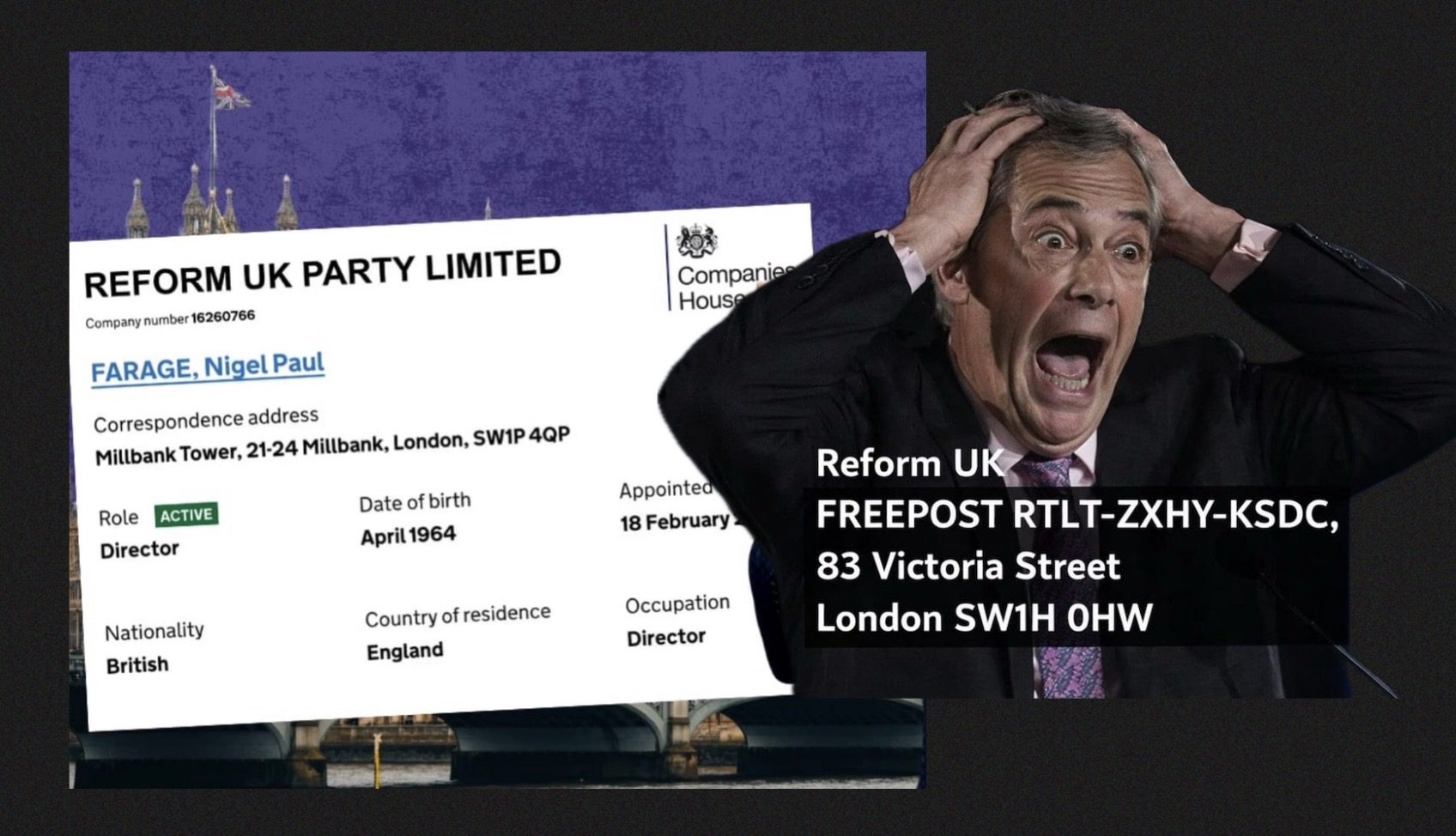
It has come to a time when Reform UK Ltd is exposing itself so frequently and the billionaire corporate media is doing its best to hide it from the public that the independent media has to lead the way in exposing them. Many individual articles have been published over the last few of years, but we believe that a more aggregated response is required. Hence, Reform UK Ltd Unmasked starts today.
The individual articles will continue, but each week needs a presentation to the public of exactly what type of people represent Reform UK Ltd and what exactly they are up to. After all, if the public chooses to put them in power, then they must not be able to claim they were ignorant when everything spectacularly falls apart. And it will.
We also need your help. We only have a comparatively small number of pairs of eyes and ears. Whereas the public have 70 million between them, of which just over 50 million are adults. The latest polling suggests less than a quarter are considering voting for Reform UK Ltd., which means three quarters of the voting age population does not want them.
Therefore, please send anything you want published to us at [email protected] and help us to unmask a party set up and funded by billionaires, many of whom are based in other countries.
Let’s start with a biggy from last month:
- Convicted Paedophile Was Chosen as a Parliamentary Candidate by Reform UK
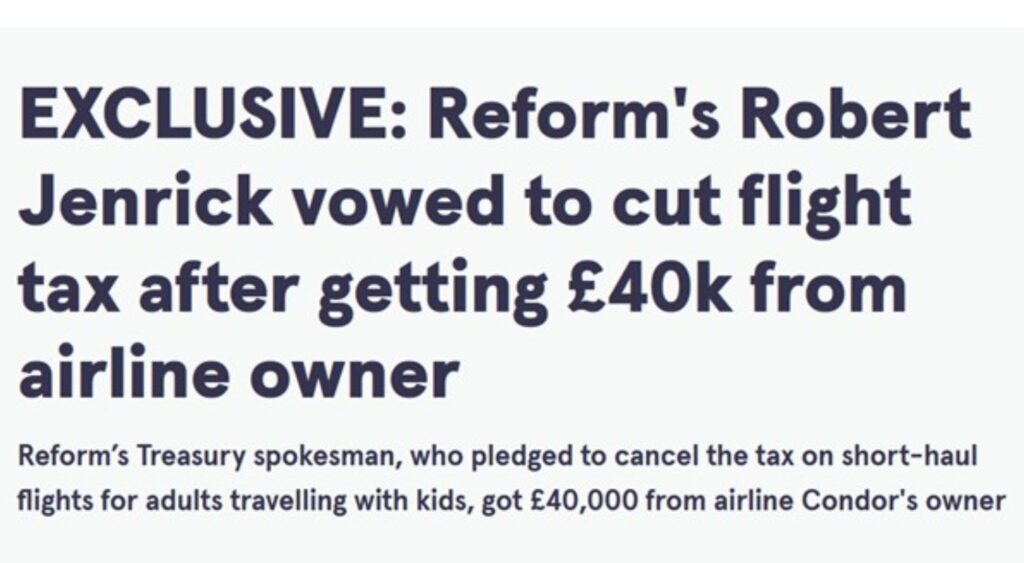
2. Who is Robert Jenrick really working for?
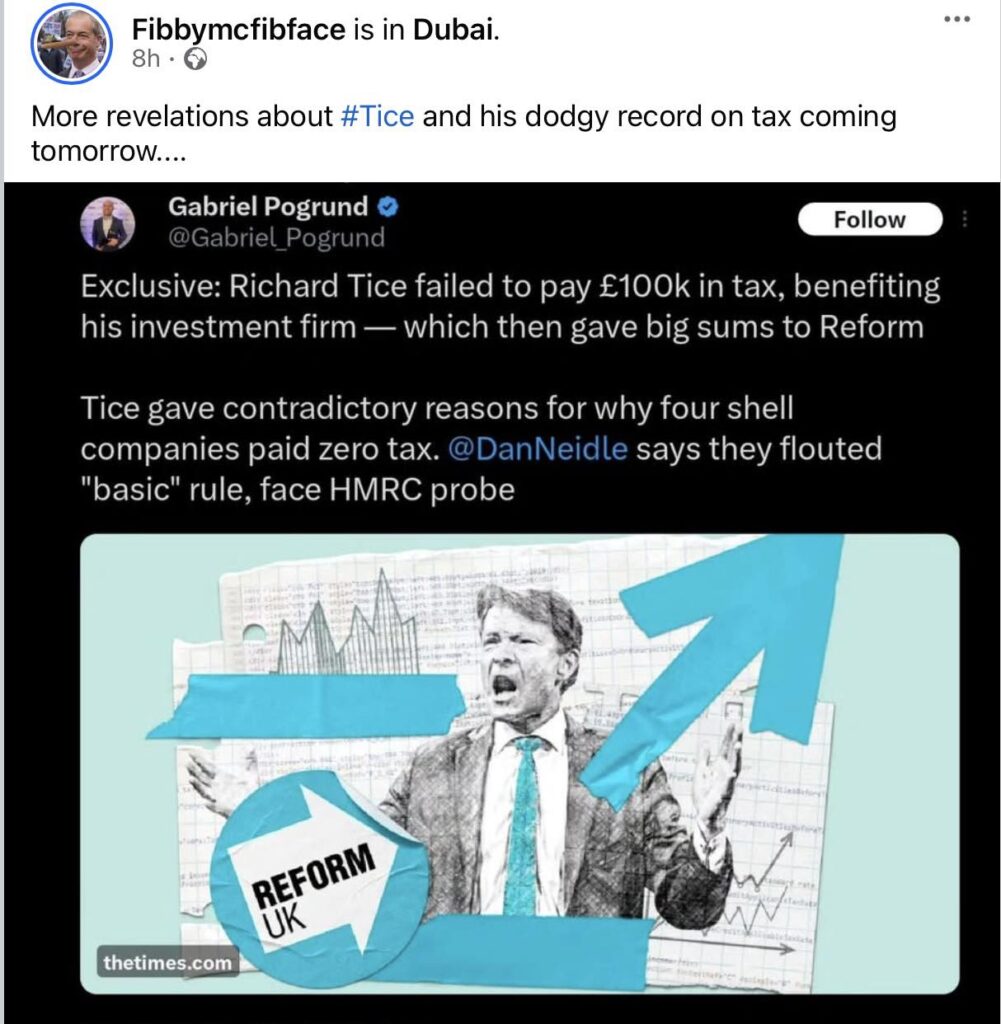
3. Richard Tice and the ‘missing’ £100,000 in corporation tax.
Morning all
— Alethea Bernard (@Tush27J) April 19, 2026
Richard Tice and his taxes again. How many times is this now- 3?
Just like Nigel Farage, Tice is a con man in an expensive suit. He preys on ignorance, manipulates and deceives whilst mocking the rules we have to obey.
HE SHOULD RESIGN #BBCLauraK #BBCBreakfast #HMRC pic.twitter.com/7jv4UIELQm
4. How any person with their cerebral cortex attached should respond to Reform UK canvasser
Hi, just checking if you are thinking of voting Reform UK at all?
No, I would rather w**k with a razor.
5. Reform UK promised not to raise council taxes and then raised council taxes
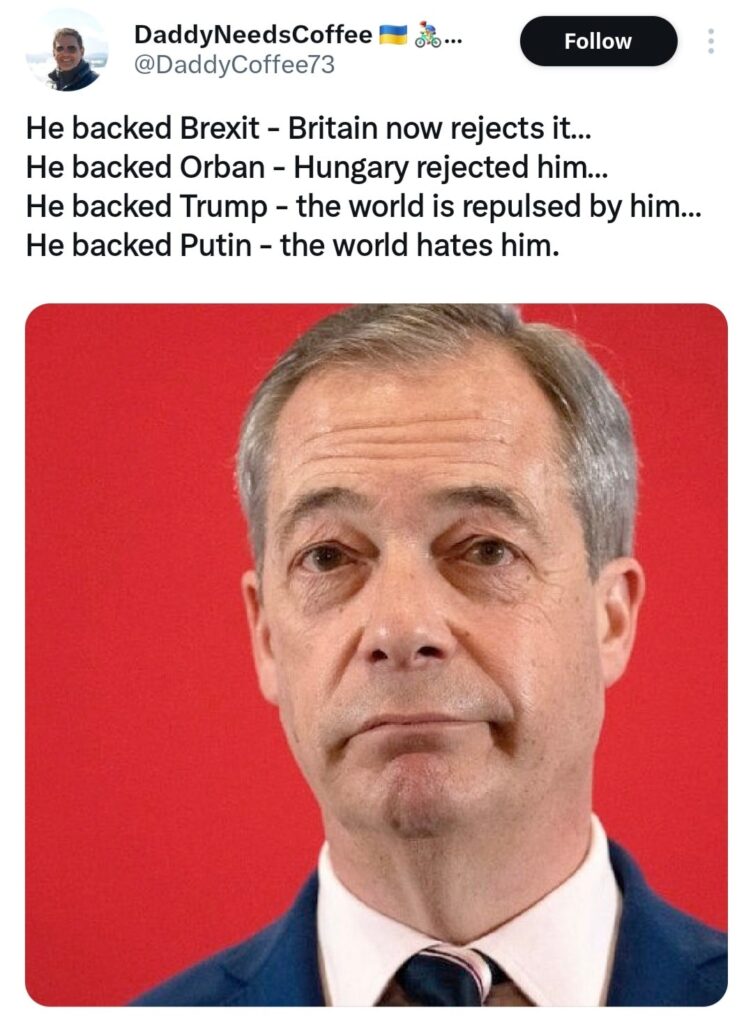
6. Following the Hungarian elections and national and international polling those who Reform UK are parrotting and supported by have and will be exposed and kicked out….
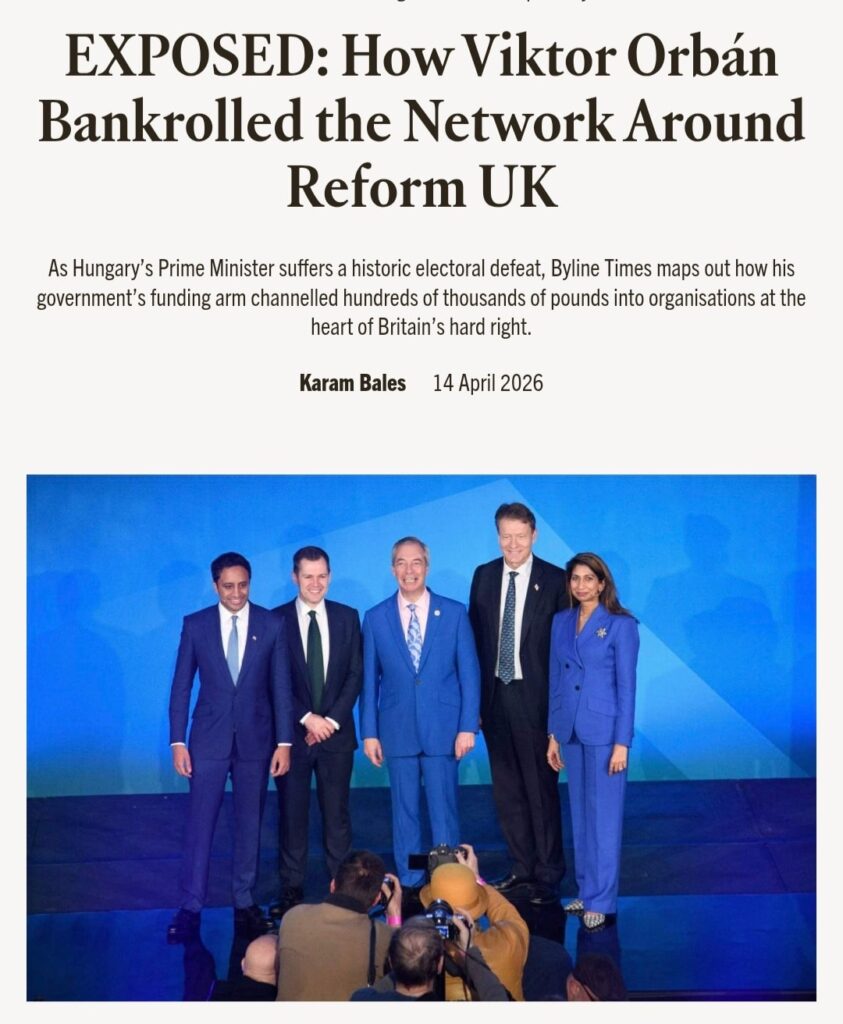
Viktor Orbán’s government pumped hundreds of thousands of pounds into a network of organisations intimately connected to Reform UK’s senior figures. The Hungarian prime minister, who just suffered a historic electoral defeat, used his state‑funded Mathias Corvinus Collegium to channel more than £512,000 into the Roger Scruton Legacy Foundation, where Reform’s head of policy James Orr is a trustee. That money accounted for over 90 percent of the foundation’s total funding.
Orr also chairs the Edmund Burke Foundation, which runs the National Conservatism conferences that have repeatedly held up Orbán’s illiberal regime as a model for British conservatives. The same network overlaps with the Free Speech Union, the Academy of Ideas, and a roster of figures who now populate Reform UK’s shadow cabinet. Toby Young, Douglas Murray, Matthew Goodwin, Suella Braverman, Michael Gove. All have spoken at NatCon. All orbit the same Orbán‑backed infrastructure.
This is not a conspiracy theory. It is a mapped network of financial flows and personal connections, laid out in Byline Times. And it raises a simple question. When Nigel Farage rails against foreign interference, why is his party’s policy chief sitting at the heart of a web woven by a foreign autocrat? The answer is not complicated. The network does not care about national sovereignty. It cares about power. And it has been buying influence in Britain for years.
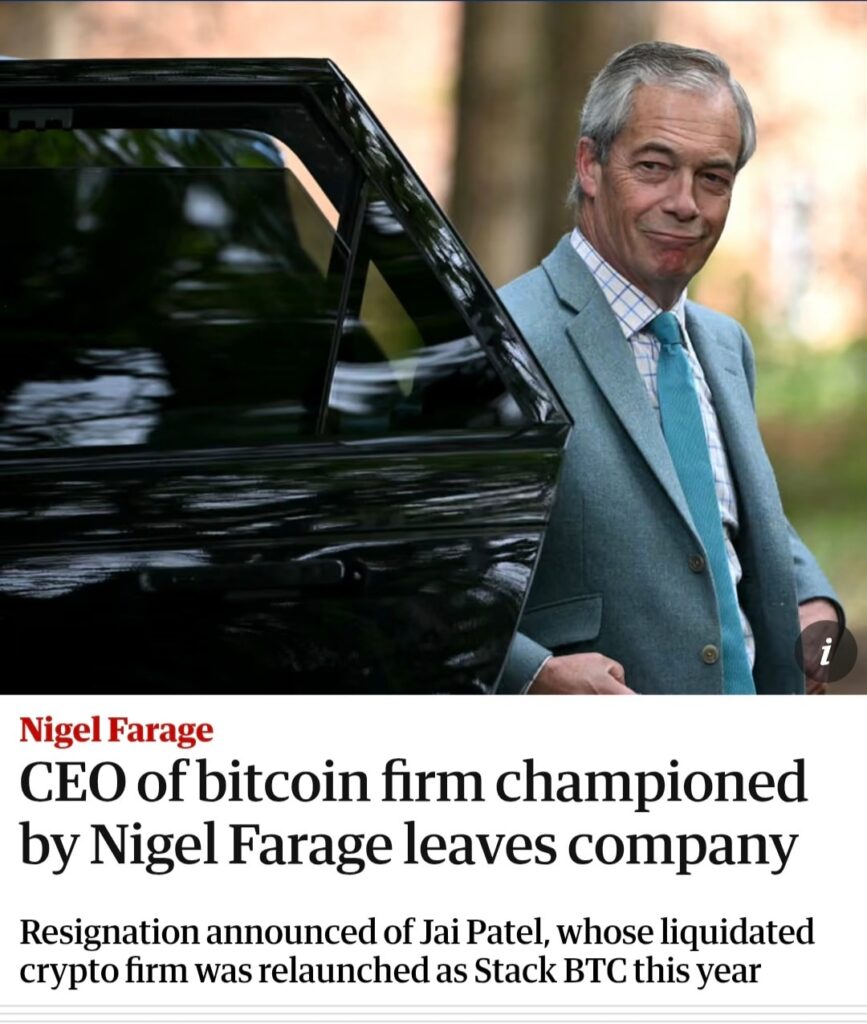
7. The chief executive of Nigel Farage’s pet bitcoin company has quit.
Stack BTC, the crypto venture that Farage and Kwasi Kwarteng launched with great fanfare just last month, is already haemorrhaging credibility. The company’s previous iteration, Kasei Investment Holdings, was liquidated last year after burning through millions of investors’ cash. Now its founder and CEO, Jai Patel, has walked away. The renamed venture promises “long‑term value”. The evidence suggests otherwise.
Farage invested £215,000 and has already seen a paper gain of more than £200,000. That is the beauty of crypto. You do not need to build anything. You just need to persuade enough people to buy in before you cash out. The company’s new CEO is a former real estate executive with no obvious crypto expertise. The old CEO has been shuffled off but remains a “significant shareholder”. The whole thing has the unmistakable whiff of a PR stunt dressed up as a business plan.
One industry expert put it bluntly. “The fact it’s got Kwasi and Farage tells people like me: ‘Don’t invest in it.’” Another noted that Farage is simply following the Trump playbook, using crypto to court donors while pretending to be a champion of innovation. The only thing missing is a branded hat and a promise to make everyone a millionaire. But give it time. The grift is still young.
8. Nigel Farage seems to think he can just say “I didn’t say that”, even when there’s video of him saying it, and people will forget.
The NHS isn’t safe in Reform UK hands.
9. Reform UK’s purpose is merely to harvest anger and convert it into donations
Forget the Country Needs a Reform. Reform UK Is the One That Needs Fixing
Let us get one thing straight from the outset. The slogan “Reform Will Fix It” is one of the most unintentionally hilarious pieces of political marketing since someone decided that “Strong and Stable” sounded like a description of a garden shed rather than a prospective prime minister. Because here is the thing. The country might need reform. It probably does. But Reform UK, the party of Nigel Farage, the vessel for every disgruntled pub bore and online conspiracy theorist from Clacton to Carlisle, is not the vehicle to deliver it. Reform UK itself is the project that needs fixing. It is a leaking, spluttering, backfiring banger of a political movement held together with duct tape, optimism, and the desperate hope that nobody looks too closely at the accounts.
The Man at the Top
Let us start with the obvious. The party is led by Nigel Farage, a man who has been a professional politician for over two decades but still somehow manages to present himself as an anti establishment outsider. This is the political equivalent of a man who has spent thirty years working for the railway company complaining that the trains are always late while standing on the platform in full uniform holding a season ticket. Farage has been an MEP, a GB News presenter, a reality TV contestant, and now an MP. He has drawn a salary from the European Parliament, a salary from a television channel, and donations from mysterious offshore billionaires. He is not a revolutionary. He is a career politician who has simply found a more lucrative niche than the one he started in.
And his record on actually fixing things is, shall we say, unimpressive. He spent years campaigning for Brexit, got it, and then promptly disappeared to appear on I’m A Celebrity, leaving the rest of us to deal with the consequences. He has been trying to become an MP since 1997. He finally succeeded in Clacton, a seat that was previously held by a UKIP MP who defected from the Conservatives, which tells you everything you need to know about the calibre of the competition. He is the human equivalent of a timeshare salesman. Charismatic, plausible, and absolutely not someone you want to be left alone with your savings.
The Membership
Then there is the membership. Reform UK has successfully positioned itself as the party of the angry, the disenfranchised, and the vaguely racist. But a quick glance at its internal workings reveals a party that is less a serious political force and more a fan club for one man. Farage owns the company behind the party. He is not just the leader. He is effectively the sole shareholder. The party has no real internal democracy. Dissent is not tolerated. Anyone who steps out of line is either purged or resigns in a huff, usually taking their grievances to the press, where they are greeted with the same level of interest as a mildly damp firework.
The membership numbers, while impressive on paper, are notoriously flaky. Many of the party’s supposed supporters are actually disaffected Tories who have temporarily parked their loyalty elsewhere. They are not true believers. They are voters who are cross about the state of the NHS and the cost of living and have decided that the answer is to vote for the man who spent years telling them that the European Union was the source of all their problems. The moment the Conservatives get their act together, or the moment Farage says something particularly indefensible, these voters will drift back. They are not a movement. They are a weather vane.
The Policies
What does Reform UK actually stand for? This is a harder question to answer than it should be. The party’s manifesto, such as it is, reads like it was written by a committee of people who have just discovered the internet. There is a lot about cutting taxes, a lot about stopping the boats, a lot about taking back control. There is very little about how any of this will be achieved without bankrupting the country or violating international law. The party’s economic policies have been described by credible economists as “a lottery ticket masquerading as a savings account”. Its immigration policies are unworkable. Its foreign policy seems to consist of being friends with Donald Trump and Vladimir Putin simultaneously, which is a bit like trying to be friends with both the Hells Angels and the police.
The party’s flagship slogan, “Reform Will Fix It”, is so vague that it could be applied to absolutely anything. Broken toaster? Reform will fix it. Leaky tap? Reform will fix it. Existential dread about the state of modern politics? Reform will definitely, absolutely, without a shadow of a doubt fix it. The slogan is a masterpiece of empty branding, the political equivalent of a shampoo bottle that promises “volume and shine” without explaining how. It means nothing. That is its genius. It cannot be disproven because it makes no testable claims.
The Scandals
And then there are the scandals. No self respecting populist party is complete without a few scandals, and Reform UK has delivered in spades. There was the candidate who had to be disowned after it emerged he had made a string of offensive comments online. There was the donor who turned out to be a mysterious offshore billionaire with a changed name and a fondness for cryptocurrency. There was the councillor in Worcestershire who had to apologise after it emerged that the party’s tax cutting promise had somehow resulted in the largest council tax rise in the area. It is almost as if populism is easier to promise than to deliver. Who could have guessed?
The party’s relationship with the truth is, shall we say, flexible. Farage has spent years railing against the “fake news” media while simultaneously building a media empire of his own on GB News, a channel that makes the Daily Express look like the Economist. The party’s social media presence is a swamp of conspiracy theories, misleading statistics, and outrage bait. It is a machine designed not to inform, but to enrage. And it works. Anger is addictive. Outrage is profitable. Reform UK has built a business model on the back of other people’s misery. It is not a political party. It is a content farm with a mailing list.
The Verdict
So here is the truth that nobody at Reform UK wants to hear. The country does not need Reform. Reform UK needs reform. It needs a leader who has not spent three decades in the political establishment pretending to be an outsider. It needs a membership that is more than just a collection of temporarily embarrassed Tories. It needs policies that go beyond slogans and vibes. It needs to stop treating its donors like ATMs and its supporters like fools. It needs to grow up. It needs to get serious. It needs to realise that running a country is not the same as winning an argument in a pub.
But of course, that is not going to happen. Because Reform UK is not designed to fix anything. It is designed to complain. It is designed to oppose. It is designed to harvest anger and convert it into donations. The moment it actually had to govern, to make difficult choices, to balance budgets and negotiate treaties and deal with the messy reality of running a modern nation state, the whole thing would collapse. It would be like asking a TikTok influencer to perform open heart surgery. The results would be entertaining, briefly, and then catastrophic.
So by all means, vote Reform if you want to make a point. If you want to stick it to the establishment. If you want to feel, just for a moment, that your anger has found a home. But do not expect them to fix anything. Because the only thing that needs fixing is them. And frankly, that is a job for a much better class of mechanic.
10. Exposing 30p Lee Anderson on a walkabout
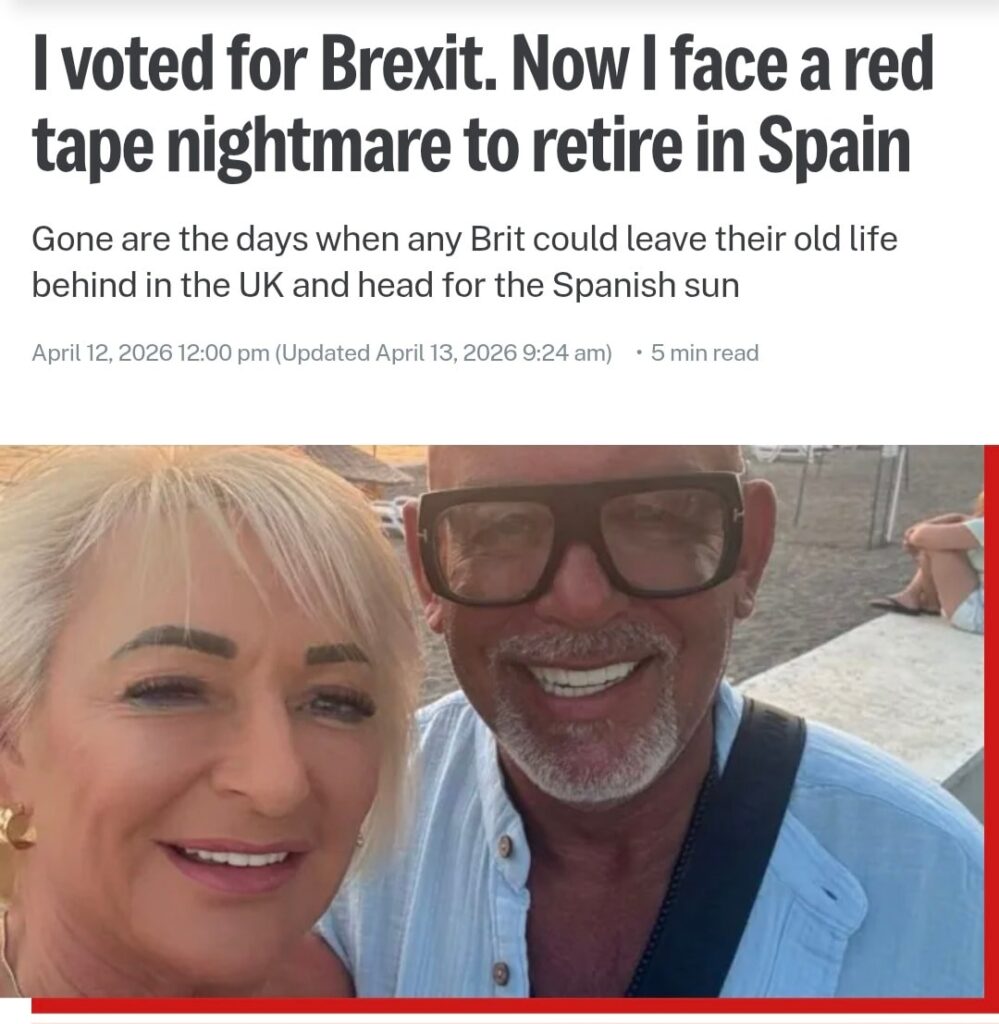
11. The Brexit nightmare Reform UK will not admit to
Neil Harrington voted for Brexit. Nearly a decade later, he is approaching retirement and hoping to spend it in Spain. His father did exactly that in the late 1990s, selling his house and moving to a new home the next day, no forms, no visas, no fuss. Neil now faces a bureaucratic nightmare that did not exist when he cast his vote. The 90‑day limit, the €500 visa fee, the €28,800 income requirement, the private health insurance, the criminal record check, the WHO disease screening. The dream of retiring to the sun is now reserved for the wealthy.
Harrington admits responsibility. “It is what it is,” he says, with a resignation that will sound familiar to millions who believed that leaving the European Union would simplify their lives. Instead, the red tape has multiplied. The freedom of movement that once allowed any Brit to pack up and go has been replaced by a system that filters by income and luck. The irony could not be sharper. The man who voted to take back control has discovered that control now belongs to the Spanish visa office. And the country he wanted to free from Brussels has left him trapped in paperwork.
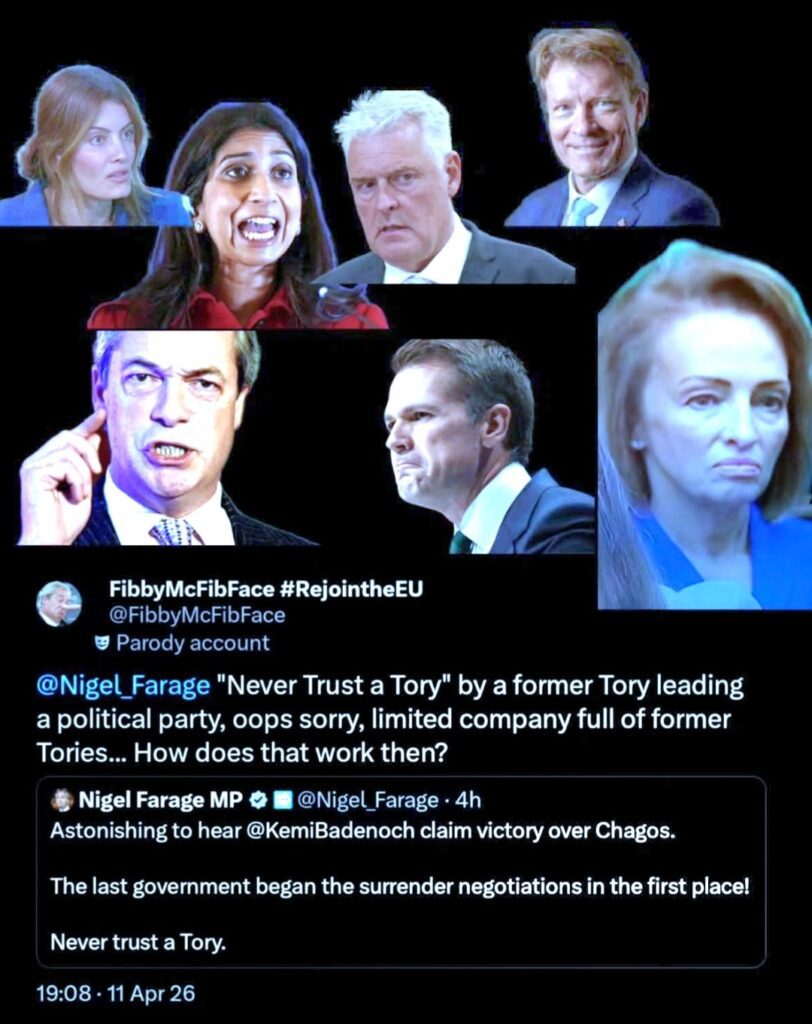
12. Apart from Farage, all apart from one were in the last government and supported the deal
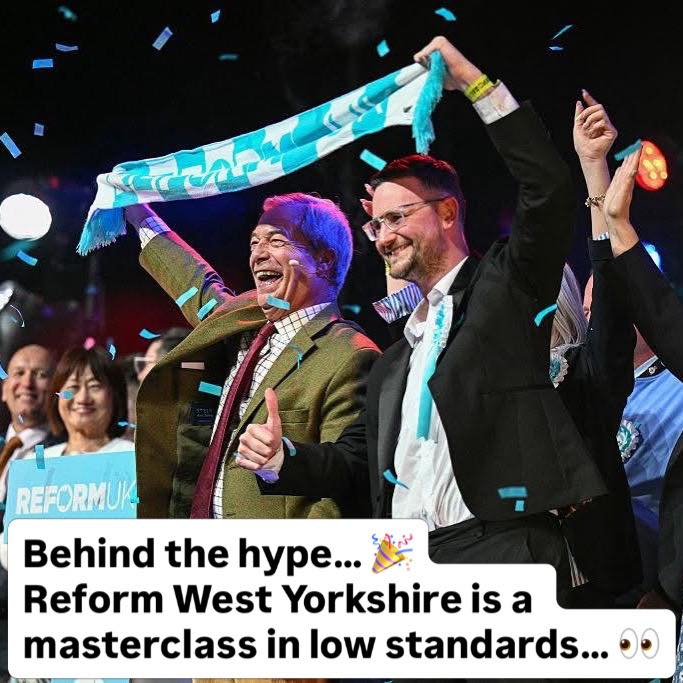
13. Reform UK are a masterclass in low standards
Reform rolled into Leeds recently claiming they’re inevitable, unstoppable, the future of Yorkshire politics.
Sounds great on stage. Reality looks very different.
Let’s start with vetting, because it’s clearly not working.
Reform have a candidate in Middleton Park – James Kendall – who is currently facing an individual voluntary arrangement for insolvency. That raises a simple question: how can someone be trusted to make decisions about public finances when they can’t manage their own? It’s not personal, it’s about judgment and responsibility.
And it’s not just one case.
In Bradford, candidate Daniel Devaney has faced backlash over past posts, including comments about “blasting” followers of Islam and calling Muslims offensive names. That’s exactly the kind of thing proper vetting should catch.
Then there’s what’s happening behind the scenes…
Insiders tell us they have raised repeated concerns about how Reform is being run in West Yorkshire, describing a dysfunctional operation with allegations of bullying, toxic culture, lack of transparency, and people acting without accountability.
These concerns were escalated. More than once.
And seemingly ignored.
Worse still, there are claims some individuals were shielded from scrutiny, whilst those who spoke up? They’re no longer around. 
If that sounds familiar, it’s because former Reform members in other branches have described the same pattern.
So while Reform talks about momentum in Leeds, serious questions remain about standards, accountability, and integrity.
Reform can sell the story. But buyer beware.
14. Don’t earn more money by going to university says Reform UK’s Suella Braverman
Suella Braverman doesn’t think university is for everyone. Fair enough, that’s a debate worth having.
But it’s a bit rich coming from someone who went from an elite private school to Queens’ College, Cambridge, then on to Panthéon-Sorbonne University. That’s not just “went to uni”, that’s the gold-plated academic route
And now the message is that maybe university isn’t the right path for most people. Of course not.
Except on average, men who go to university are expected to be £130,000 better off, and women £100,000 better off over their working lives, after taxes and student loan repayments.
There is a real conversation to be had about apprenticeships, skills, and alternatives, but it only works if those routes are properly funded and treated as equal, not quietly positioned as second best.
Otherwise it starts to feel like the classic ladder-pulling move. Get to the top, then tell everyone else to aim a bit lower
So when the leaders of parties like Reform UK say they’re on your side, it’s worth asking a simple question…
Are they actually expanding your options, or just narrowing them while dressing it up as “common sense”?

See you next week.







