4.9 C
Dorset
Tuesday, April 21, 2026
Home Blog

Fear, grievance and hate: How a community became radicalised

This article was originally published on August 11, 2023.

Legal experts have assessed the content and are now pursuing legal action against a number of parties. The article that is the catalyst for at least two ongoing documentaries and a series of national and international articles can now return.

Weymouth & Portland is a community with a proud armed forces tradition – not least in relation to our role in defeating the Nazis in WWII.  So how is it that a section of our community has been radicalised into racism and hatred?  How is it that so many people have been persuaded to hate a group of people they’ve never met?  And how is it that people have aligned themselves with exactly the kind of Far Right ideology that their brave forebearers fought against?

Here, we try to answer those questions and, in doing so, expose how three key elements – fear, grievance and racist hatred – have been utilised.  For the first time, we will publish people’s own words – including many appalling examples of racism – and document some of the key actors in a sorry campaign of hatred.

Some Background

On 5th April, 2023, the Home Office confirmed plans to house 506 people seeking asylum (safety) in the UK on a barge, the Bibby Stockholm, at Portland Port.  The privately-owned Portland Port had agreed to a lucrative contract with the government to house the barge without undertaking any public consultation.  Because y’know….. capitalism.  Money (for the few) talks and human rights walk – as do the feelings of local people. 

The Langham family who owns the Port made 19 donations to UKIP totalling over £70,000 and have connections to this Conservative government.  Former investment banker Jill May, sister of the late John Langham, was re-appointed to the BoE’s Prudential Regulation Committee in 2021 by Rishi Sunak. She is currently listed as owning 11.68% shares in Langham Industries Ltd.  As expected, May and Langham family members own the majority of shares.  The deal to house the barge is worth a reported £2.5 Million.

The barge itself has been modified to change its capacity from 220 people to 506 plus up to 40 staff!  The refugees will share small rooms with bunk beds.  The government ordered the small TV screens to be disconnected.  Held in a secure port, the barge is, without doubt, a quasi-prison. It was even described as such by South Dorset MP Richard Drax whose family made their own fortune from the slave trade.  Drax had very little warning from his own Party about the barge – perhaps indicating the contempt they have, even for their own MPs – and his protestations have been ineffectual.

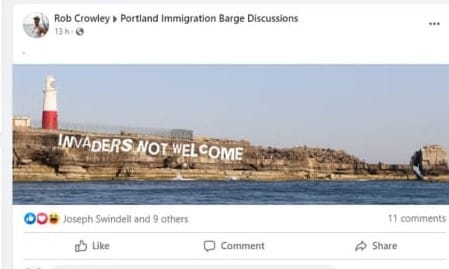
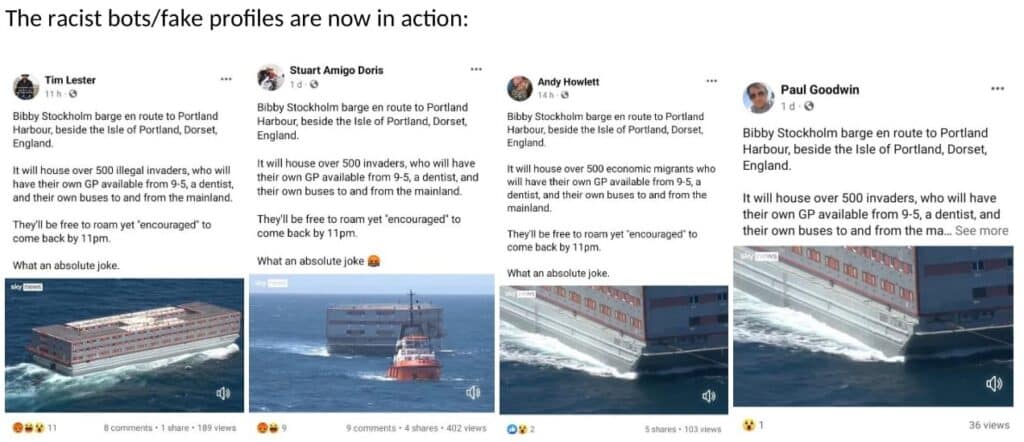
It seems everyone is against the barge!  Local MPs, Dorset and Portland Councils and Councillors, human rights groups and anti-racist groups such as Stand Up To Racism Dorset, and a campaign now known as ‘No To The Barge’.  The NTTB campaign began as a Facebook group named ‘Portland Immigration Barge Discussions (aka Barge Bitchin)’.  Later, the ‘Barge Bitchin’ was dropped and, in mid-June it was changed to ‘No To The Barge’.  It is this Facebook group (and its associated real-life campaign) that has been home to appalling levels of racism and Far Right activity. 

Fear

The initial and abiding reaction of people on the NTTB group is based upon fear and the spreading of fear.  Some of that fear is based upon a lack of experience of diversity: Portland is a small community of 13,500 people, 96.5% of whom are white.  The Muslim population is just below 1%.  It is in this environment that people on the NTTB group have spread disinformation and fear. 

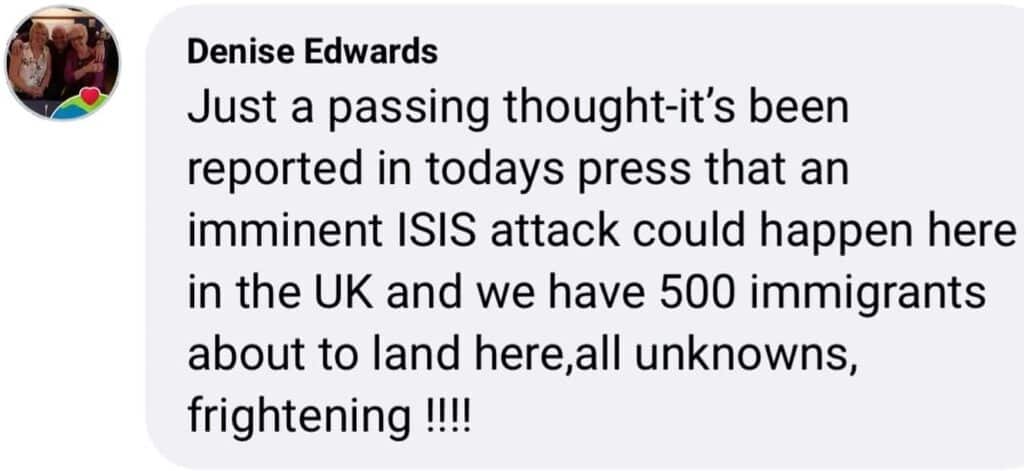
Most of that scaremongering is based around the notion that people seeking asylum are all (or mostly) criminals, rapists and murderers.  The idea that those to be housed on the barge pose a particular threat to women and children is highly prevalent. “Lock your daughters up” was the early cry!  As more and more Far Right supporters from around the UK have joined the group, the comments are increasingly about how Muslims are preparing to start a ‘religious war’ and will slaughter us all.  There has been a continual avalanche of posts and comments which have whipped up the fear to frenzied levels.

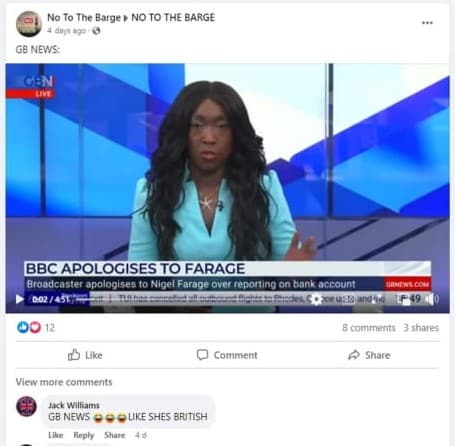
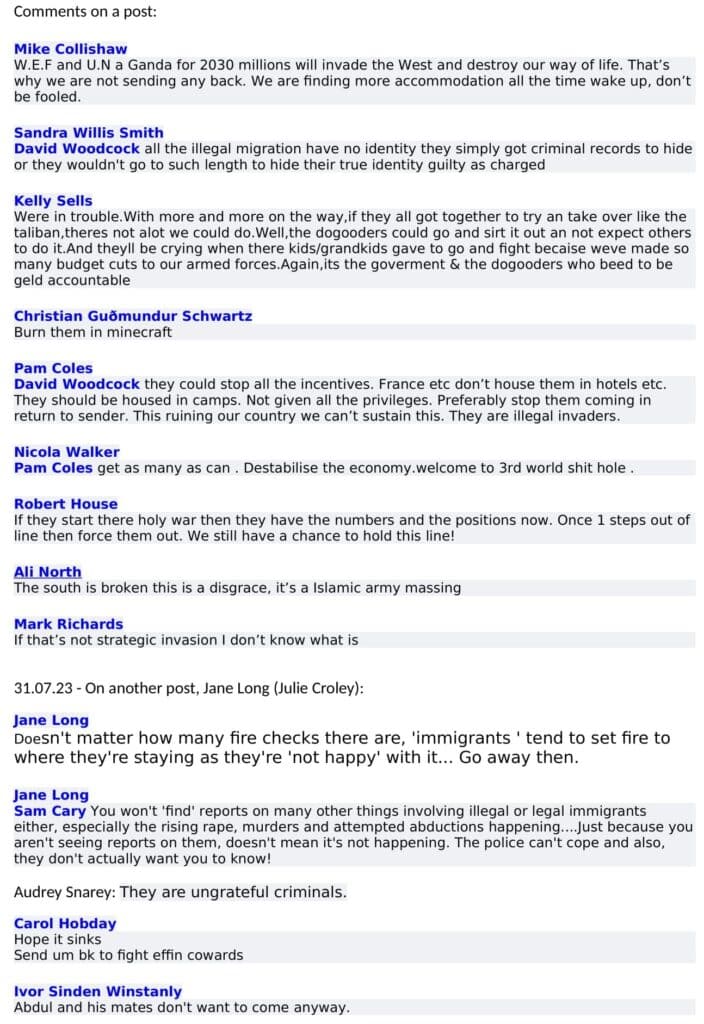
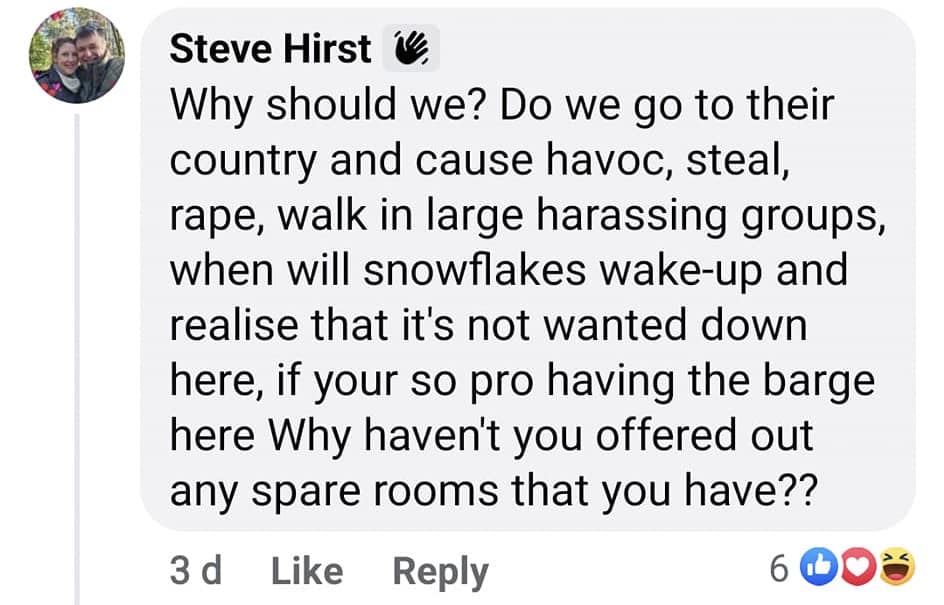
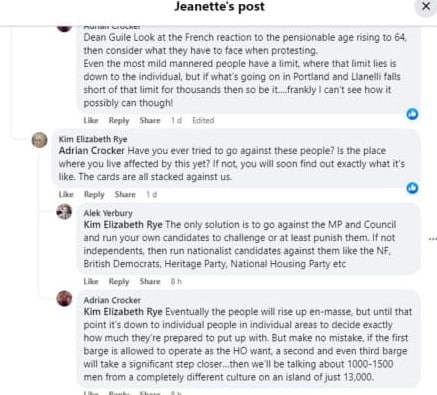
Here are some examples from the NTTB group (all quotes as written):

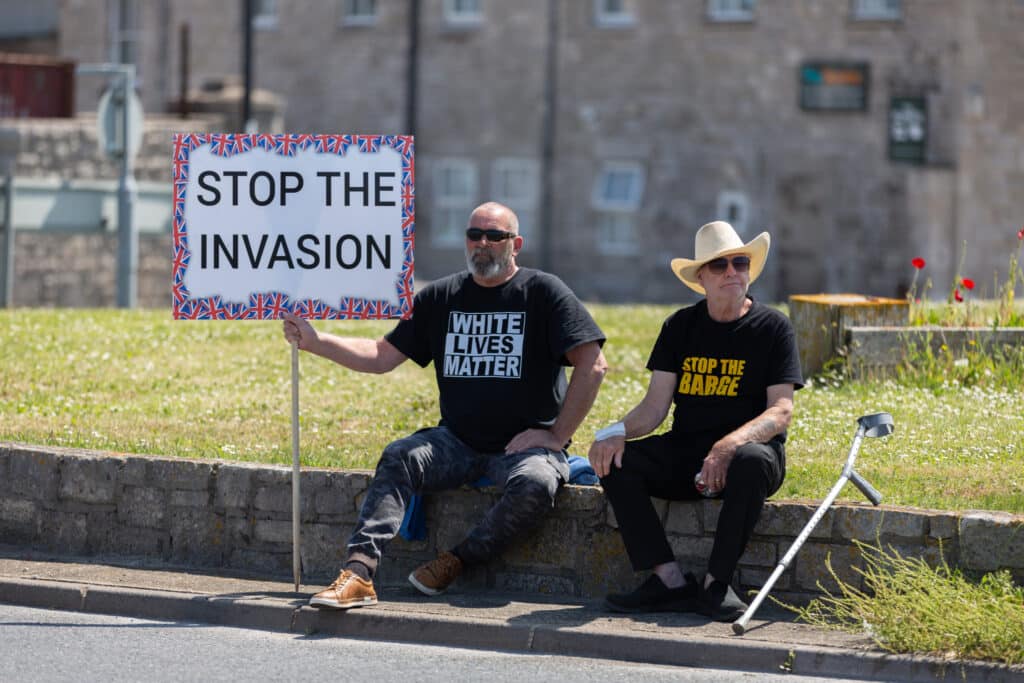
Julie Croley (who carried a ‘Stop The Invasion’ placard at the campaign’s events and whose husband Mike Croley regularly wears a ‘White Lives Matter’ T-shirt) talks of impending “sexual harassment, attacks and rapes”, of an “Islamic invasion” and states “We’re being turned into an Islamic country”

Bert Travers: “take lots of photos/videos of any potentially dangerous looking situations (chatting young girls up, near schools, causing trouble etc etc”)

Karen Lewis: “get CCTV on your bodies”

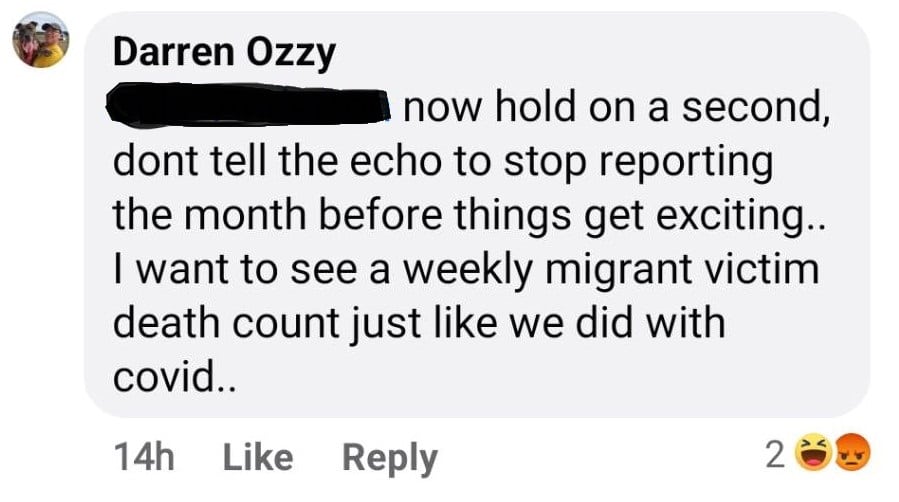
Darren Ozzy: “I want to see a weekly migrant victim death count just like we did with covid” and asks “What are the shops going to do when the attacks, rapes and murders begin?”

Stuart Chiswelstaff Breckell: “Would you put 506 wolves in a field with 13,535 sheep and hope for a happy ending”

Portia Duvall warns of “the violent sexual assaults on women and children on the streets”

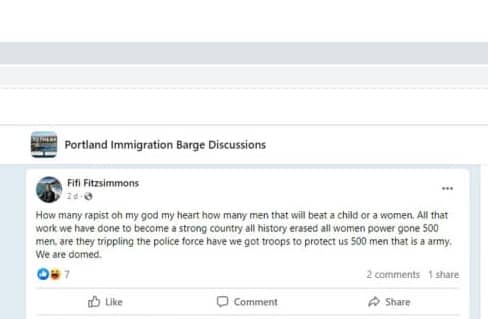
Fifi Fitzsimmons posts about “rapists” and “men that will beat a child or a woman” and adds “We are doomed”

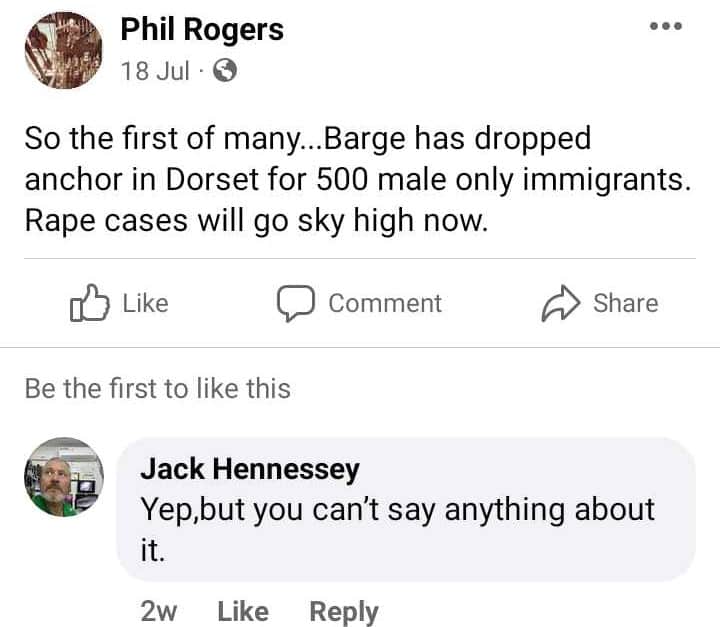
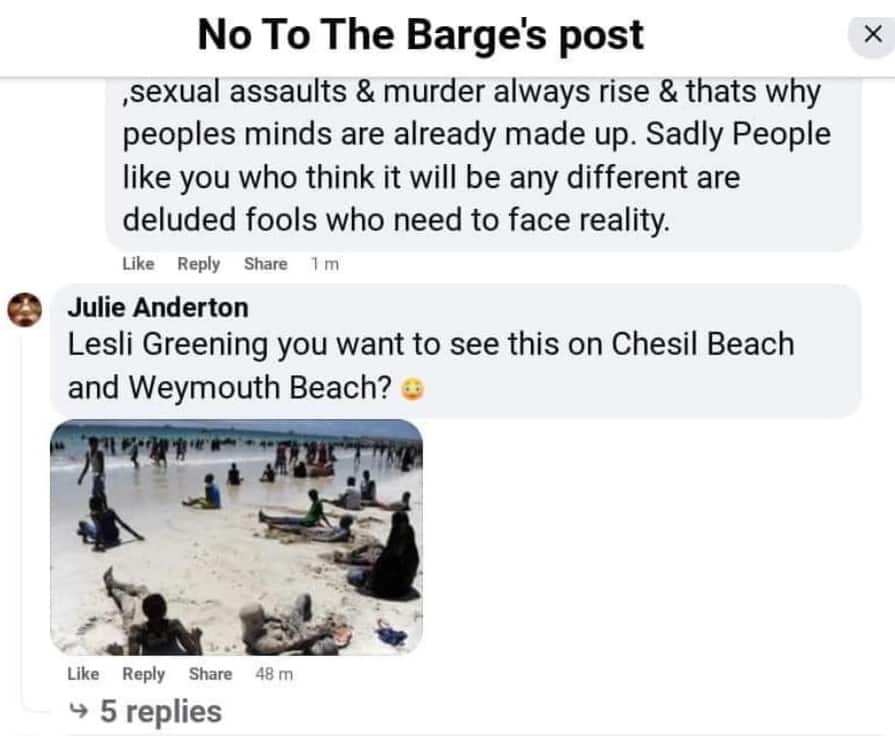
Julie Anderton: “There will be murders, rape and pillage!” “These 500 men will require 500 young, local ladies. They will take by force.” “Local lads will start fights with them but these migrants use knives.” “They will force their lifestyle on us including their religion. They hate us! THEY HATE US!”

Michelle Varney warns of “muggings” and Michael Mccarthy talks of “rape, robbery, muggings, attacks”

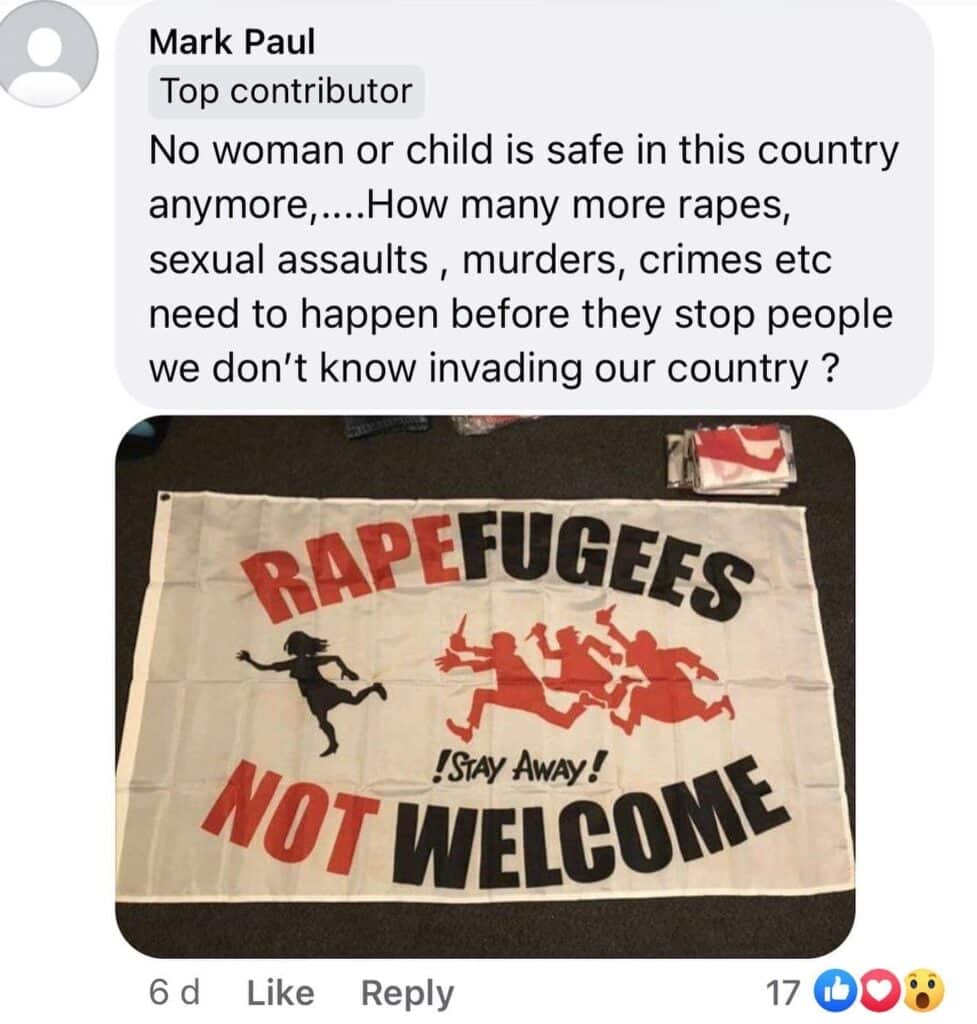
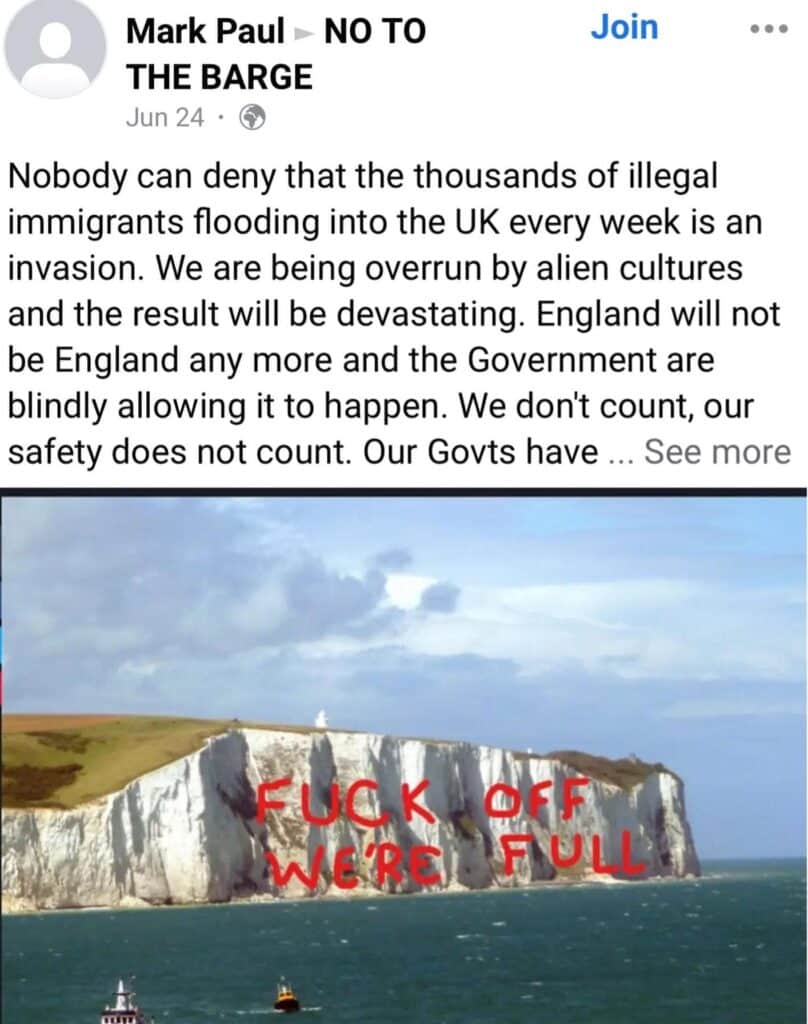
Mark Paul: “How many rapes, sexual assaults and murders need to happen?”

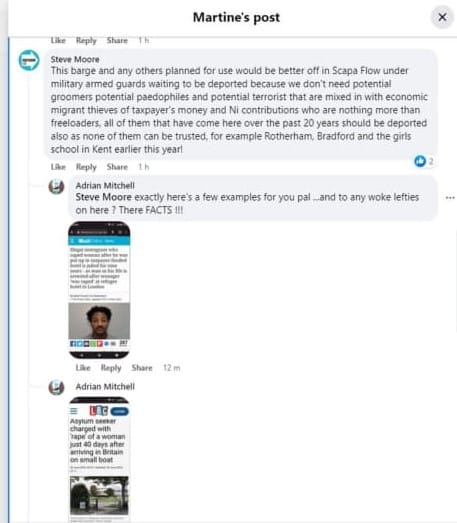
Steve Moore: “A high percentage will be potential groomers….. paedophile migrants. Keep your kids SAFE”

Lee Calvert: “What these retards don’t understand is we have 500 men! Coming from rapey stabby countries”

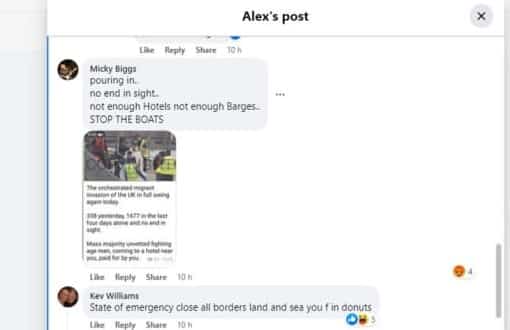
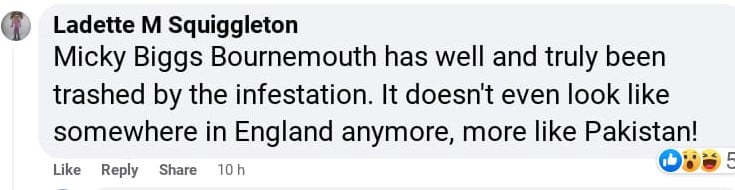
Micky Biggs: “These are pouring into Europe every day thousands of them not a woman or child in sight. Mostly ex prisoners and criminal economic migrants”

Elaine Bearne (as Fanny Adams): “The illegals steal pets”

Chaz Charlton: “heard they are putting a temporary musque in the bowl up the grove”

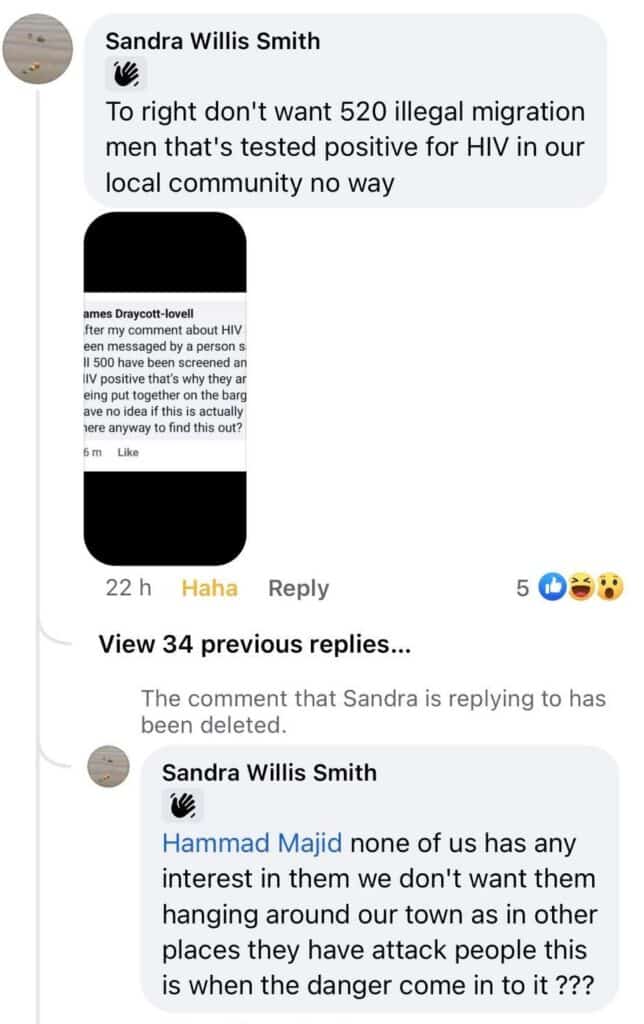
Sandra Willis Smith declares there are “no go zones for white people happening up and down the country” and that the asylum seekers “have all tested positive for HIV”

Margit Cotton: “We’re being invaded,” “50 years from now we’ll be a Muslim country”

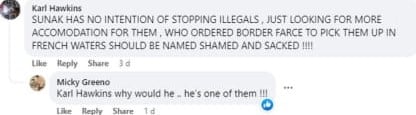
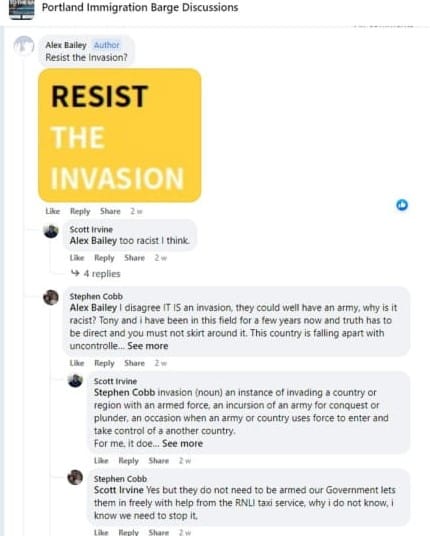
Micky Greeno: “This country has to stop this onslaught and invasion”

Phillip Davies declares we are being “Invaded by a Muslim army”

Chris Leggy Legg: “This is an army of fighting aged men”

Jackie Teague: “These men are gathering an army under the guise of asylum”

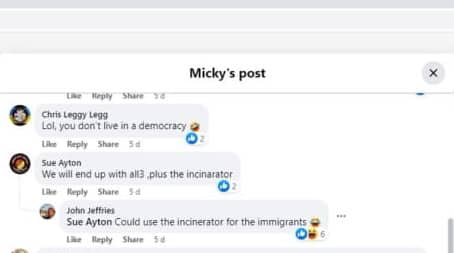
Sue Ayton warns we will be “killed off by these illegals”

Darren Jenkins: “For all we know they could have been chopping off heads a few months ago”

Allen Varney: “All ready for when they take over…. Only a matter of time”

Ally Carroll: “We have a religious war brewing,” “these illegals, 606,000 in UK up to last year, are part of a global organised invasion,” “certainly a move to destroy against the indigenous peoples of GB”

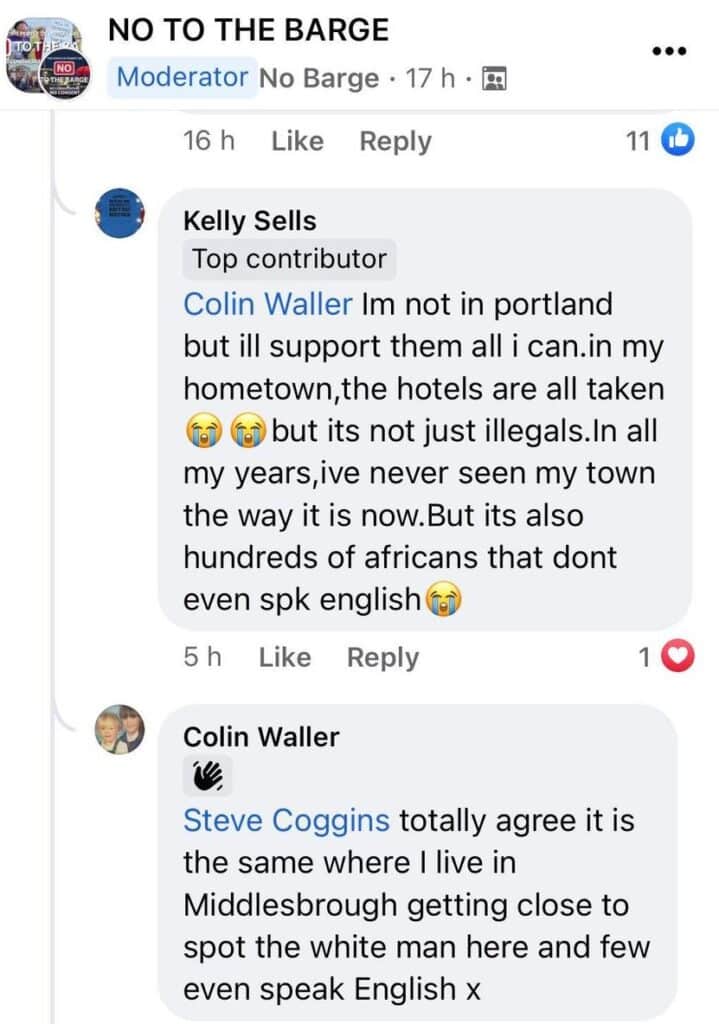
Colin Waller: “They are foot soldiers waiting for the call from Islam”

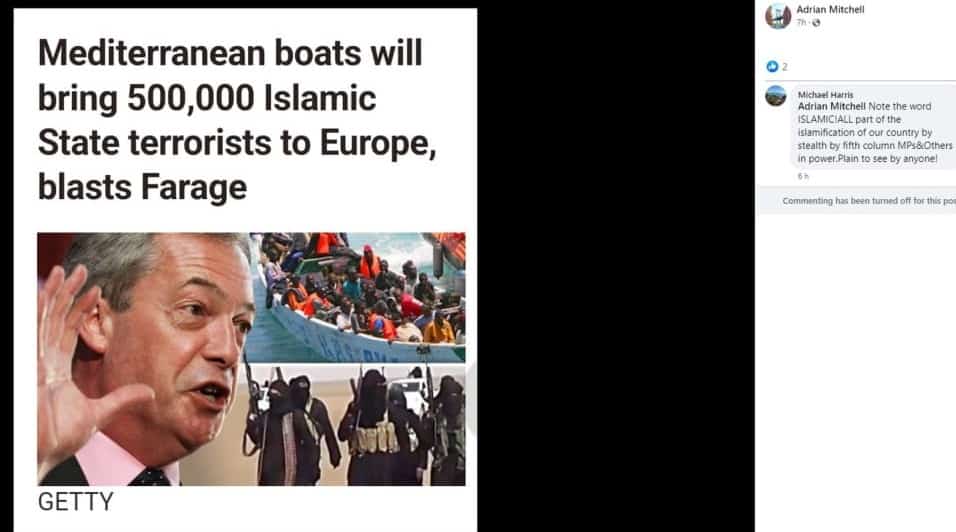
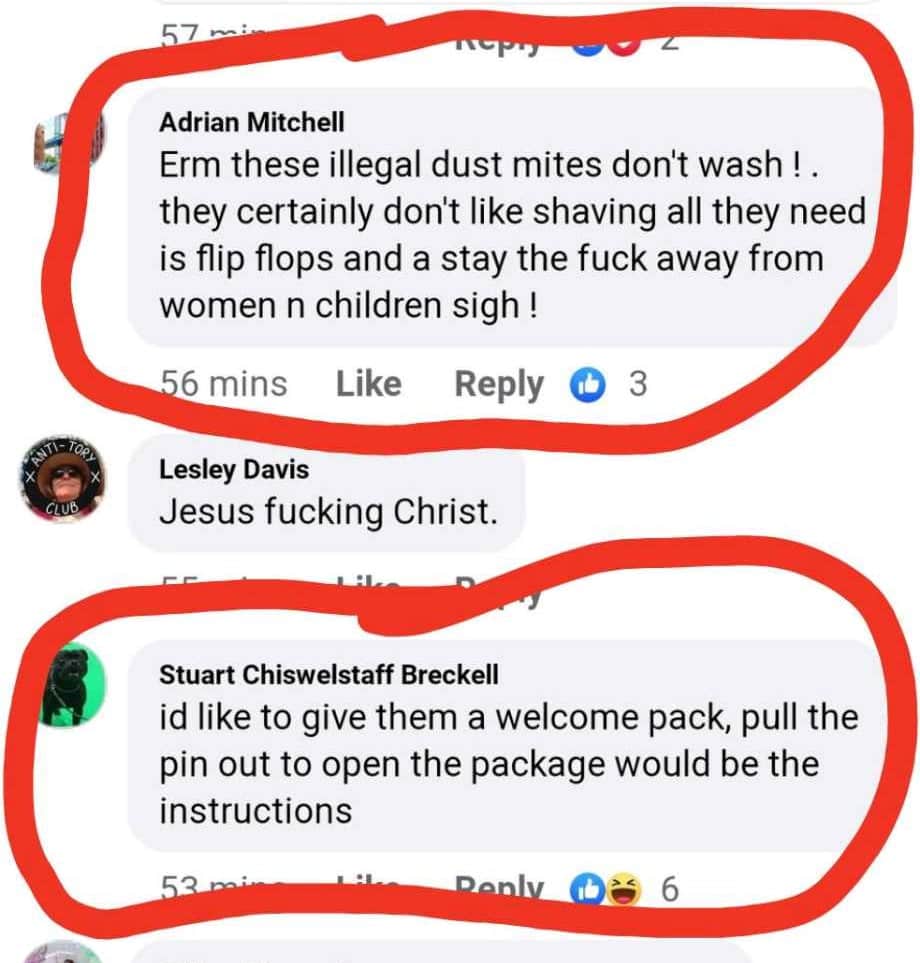
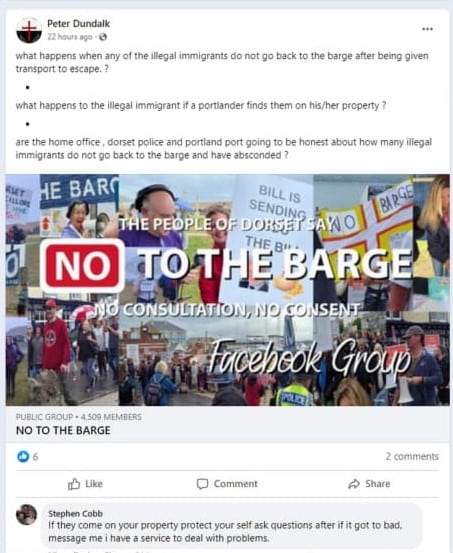
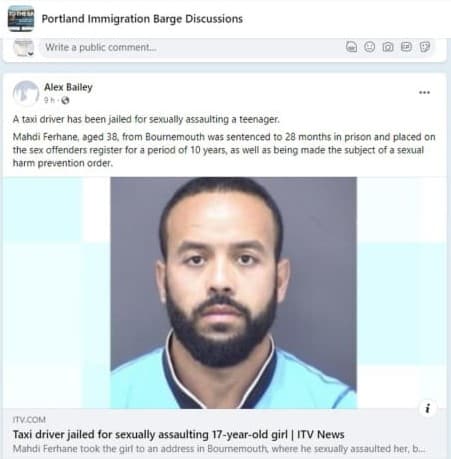
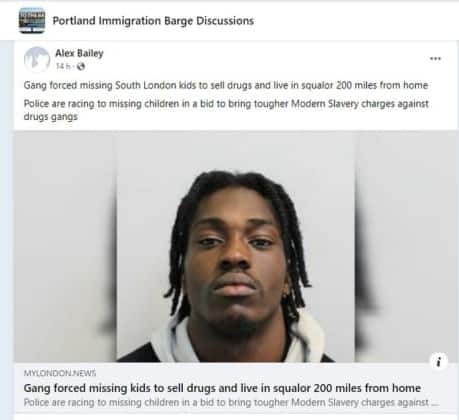
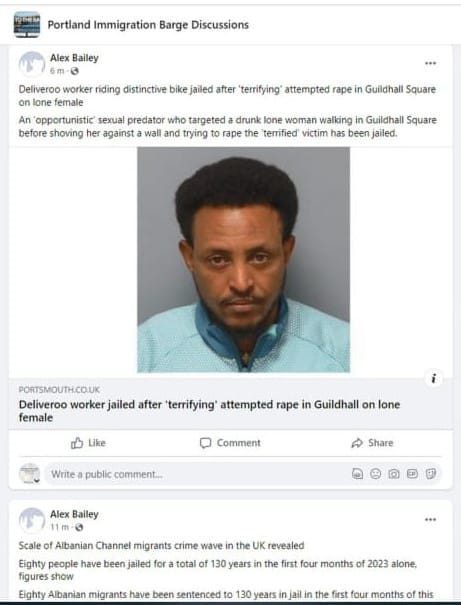
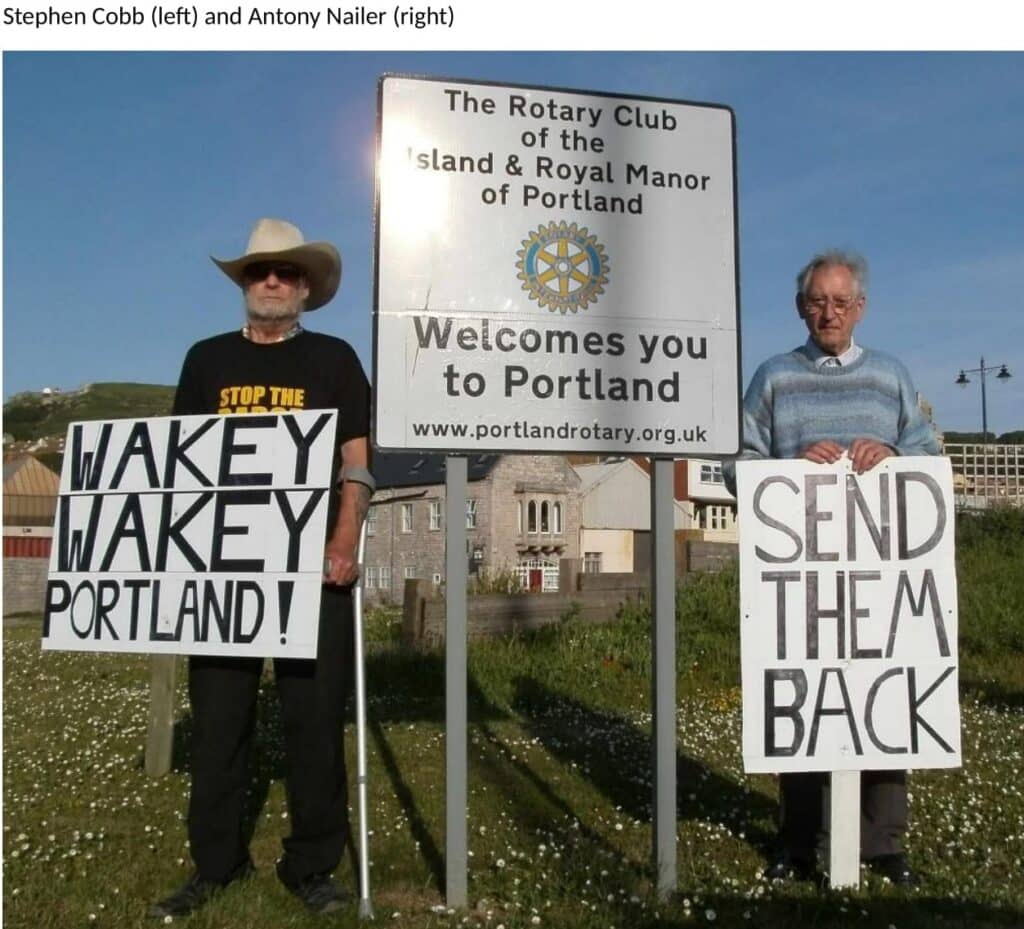
The fearmongering is amplified by numerous people including Adrian Mitchell, Stephen Cobb and campaign leader Alex Bailey posting a litany of screenshots of articles about non-white people committing crime, especially sexual crime.  Mitchell posts the same 6 screenshots repeatedly.  Of course, they never post any reports of white people committing the same crimes.

At one point, regular group contributors Stuart Chiswelstaff Breckell and Darren Ozzy even discuss how the recent Bournemouth beach tragedy was “almost certainly a migrant attack” and that the media and government are suppressing it!

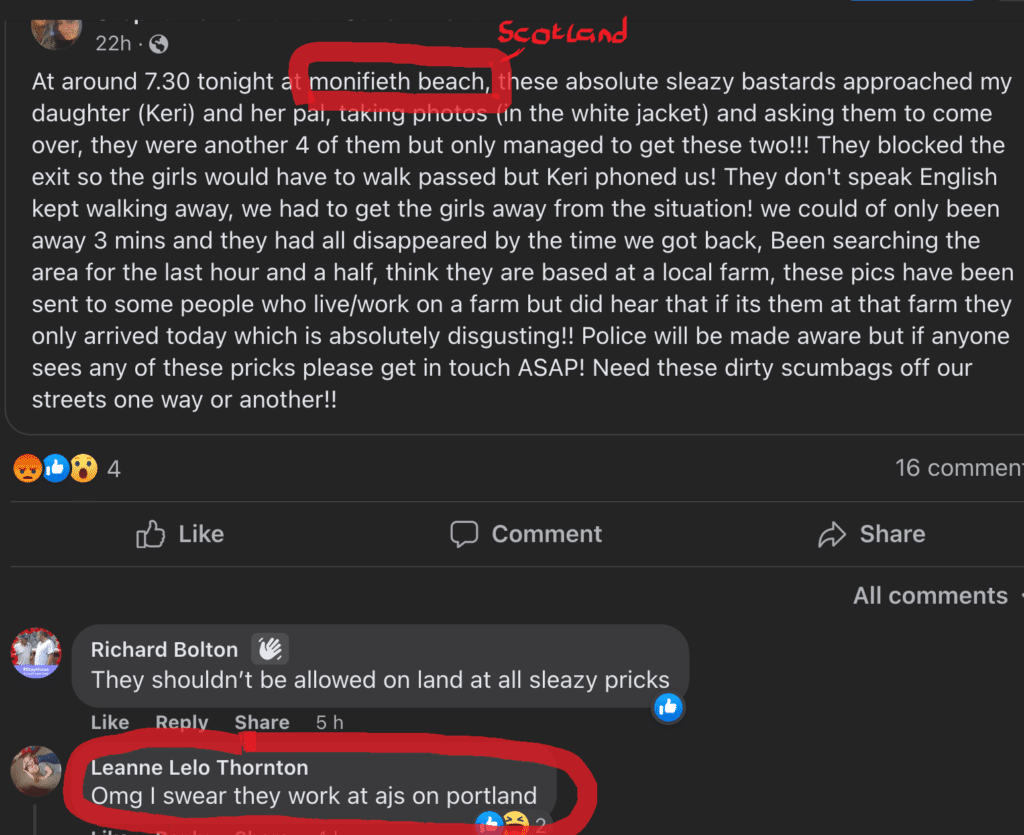
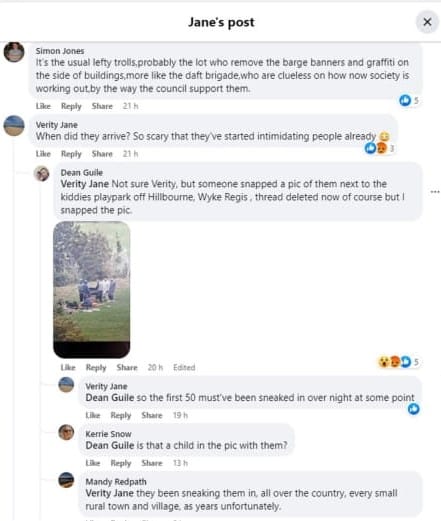
Shockingly, Asian holidaymakers have been followed and photographed with people stating that ‘they’re here already and staying in B&B’s!’  Bert Travers, sitting at home watching a webcam positioned on Weymouth seafront, posted a photo of Asian men using the toilets! He claimed that one of them didn’t come out and that young girls went in the same cubicle!  In the comments, people asked if it was people from the barge!

He posted a screenshot of the two men, which included several children in swim wear!

Gallery 1:
Grievance

Much as it was used by the Nazis in 1930s Germany, the second crucial element of this hate campaign is the fostering of a sense of grievance and resentment – in this instance, towards the asylum seekers. 

Weymouth & Portland is suffering.  13 years of Tory austerity has hit hard.  Several wards are in the top 10% or top 20% of multiple deprivation.  Wages are low and housing and other costs are high.  Council tax is one of the highest in the country and families are suffering with the ‘cost of the one-percent’s greed’ crisis.  Public services have been slashed and NHS services withdrawn or inaccessible.  Portland Hospital has been downgraded, losing its beds, its X-ray department and then its Minor Injuries Unit.

Clearly none of that is the fault of refugees!  Those things are the result of government policy: the actions of an authoritarian right-wing government who prioritise only the wealth of their rich friends and donors – increasingly through cronyism and fraud.

This is a government who have neglected its people and, locally, the effects are stark.  So, we must ask the question: why is it that the places where the government have chosen to place large asylum detention centres are mostly white, working-class areas where people are suffering from their neglect?  Clearly, with a lot of help from their friends in the media – especially the tabloid rags – and with the Home Secretary herself claiming that this is an ‘invasion’ of people coming here ‘illegally’, this putrid government knows it can shift blame from themselves to some ‘poor brown-skinned people’.

And so it is that the NTTB group has been filled with resentment.  This resentment often takes the form of outrage ‘no matter what’.  There are numerous examples of people being up-in-arms about one thing and when that thing is shown not be true, they are equally outraged by the alternative.

“They’ll get appointments with our already stretched GPs!”  *No, GP services to the barge are being provided by a specialist surgery from Bournemouth*  “Oh right, so they get specialist GP services on tap!”

“They’ll have nothing to do and will therefore commit crime!”  *No, a range of activities will be provided through the voluntary sector*  “Oh right, they get free activities. Our children don’t get free activities!”  

“They’ll be hanging around at bus stops on Portland. They’ll be attacking our women and children there!”  *No, there will be special buses which will take them from the Port*  “Oh right, they get a free taxi service, do they?!”

“They get £20-a-day of taxpayers money!”  *No, they get £9.58 per week (around £1.37-a-day) and it comes from the Foreign Aid budget*  “Oh right, if that’s all they get, they’ll be committing lots of crime!”

“Lots of them can’t even speak English!”  *Well, for those who don’t, English lessons are available*  “Oh right, they get free lessons. You can’t make it up!”

There are many more examples of this outrage no matter what.  And there’s even denial…..

“They’ll commit loads of crime!”  *Crime statistics show that asylum seekers commit crimes at a considerably lower rate than the general population*  “That’s because the police and the government cover it up!”  And then Adrain Mitchell will post the 6 screenshots for the hundredth time!

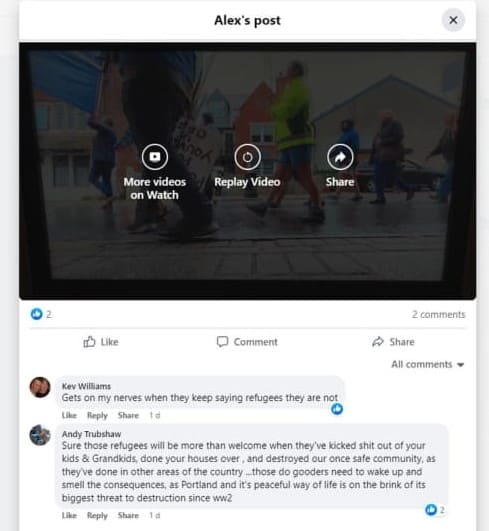
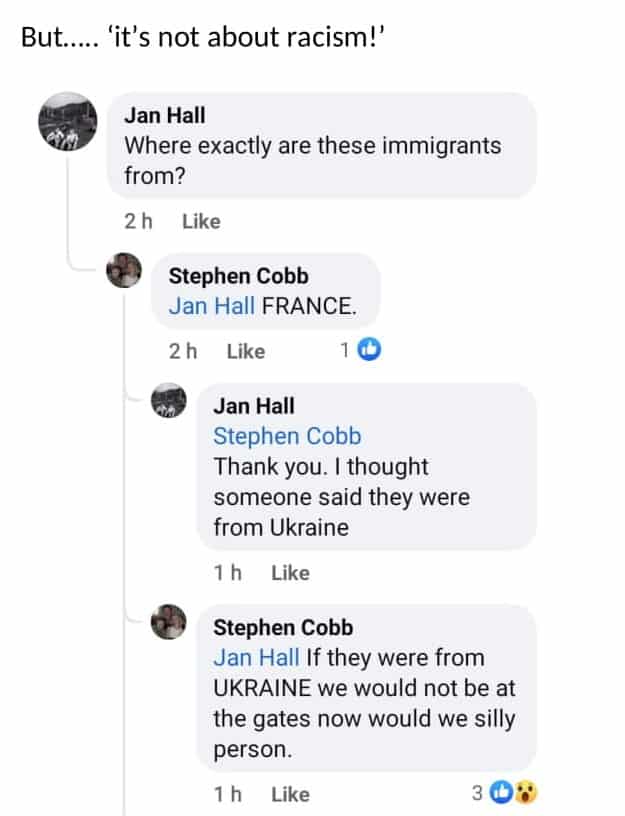
NTTB campaigners constantly say it’s not about racism; it’s about concern over public services, like the NHS.  However, when campaigner Sammy Wallace was interviewed by the BBC, the conversation went like this:

SW: We’ve not got enough NHS, dentists, doctors: we just haven’t got it, so we’re all struggling

Reporter: If those services were improved, would it be alright?

SW: (wry smile) No…. no…. no

Reporter: So it’s about something else?

SW: It’s about the men

It cut off there, but presumably the next question was: “The area has thousands of holidaymakers descending here every summer and cruise ships regularly dock at Portland Port carrying several thousand at a time.  What is it about *these* men?

Concerns about affordable housing, low wages, disappearing local services and the state of the NHS are entirely legitimate.  Blaming refugees is not.

Racism

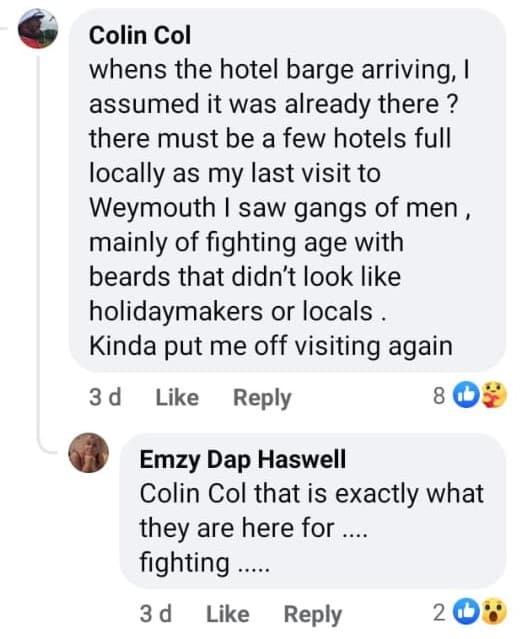
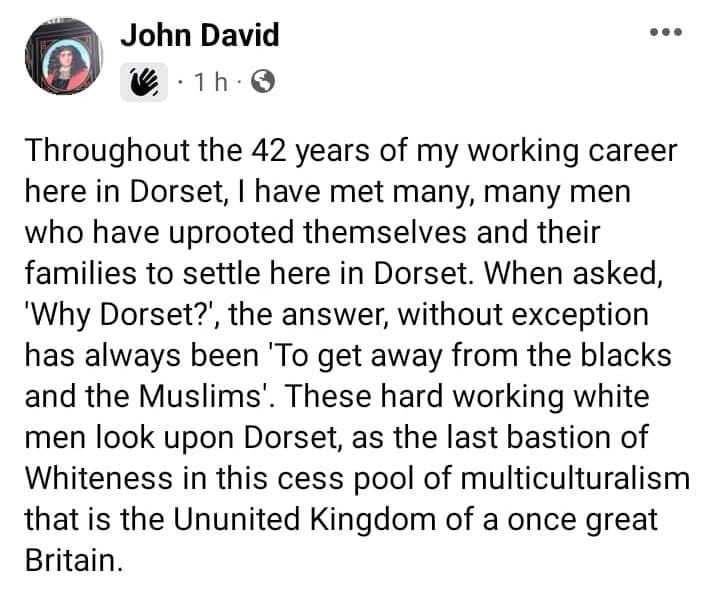
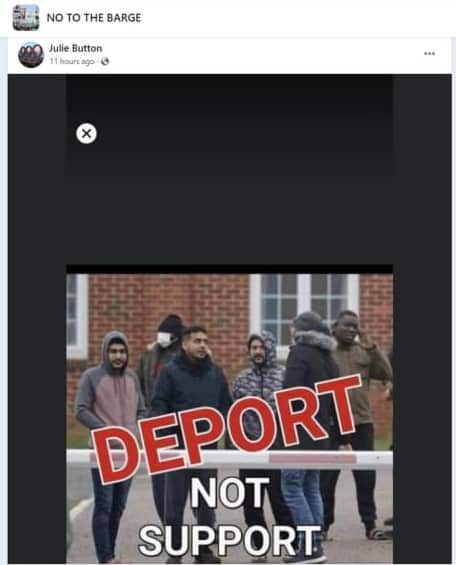
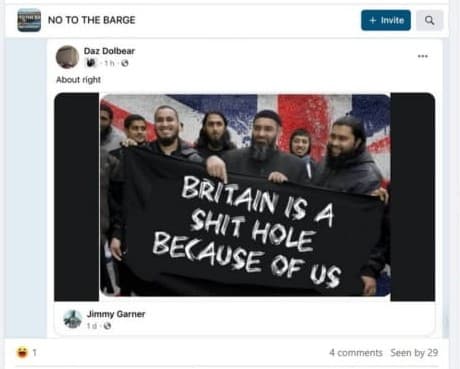
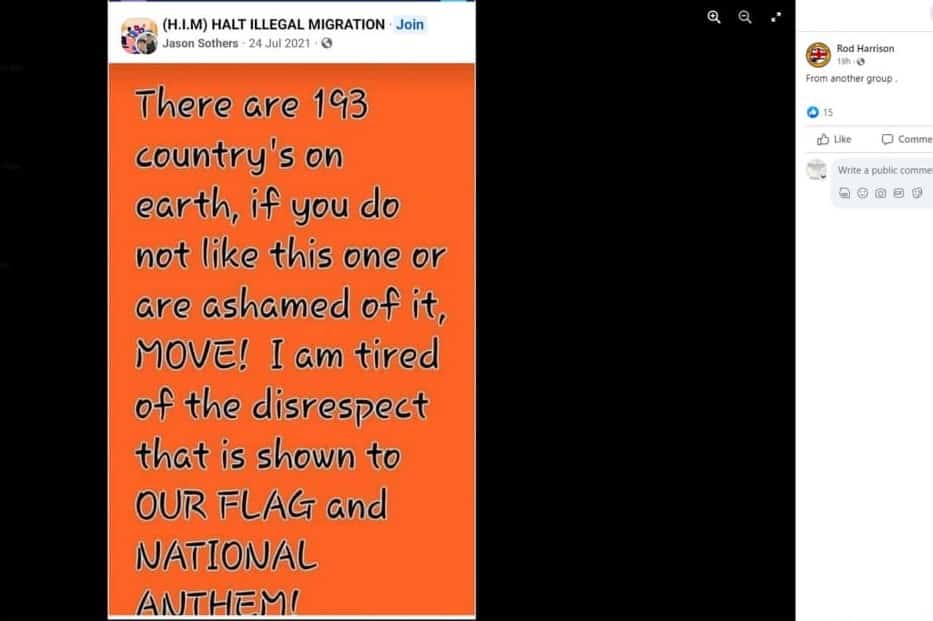
Members of the group are forever claiming there is no racism in the group and it’s not about racism.  They are lying and they know it.  There are literally thousands of examples of racism in the group, so I’ll merely share a small percentage and let the reader decide.

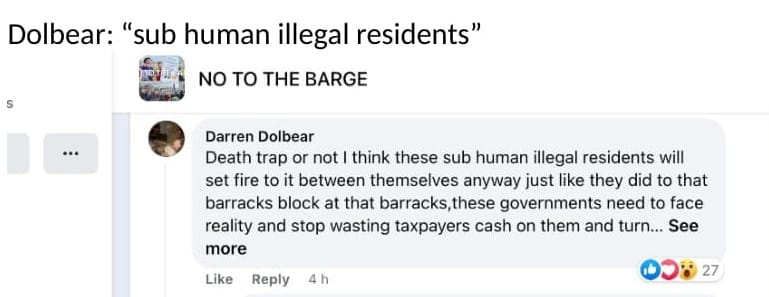
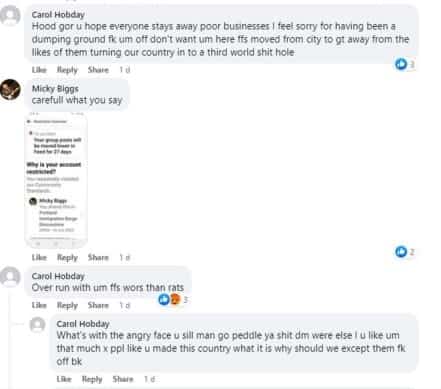
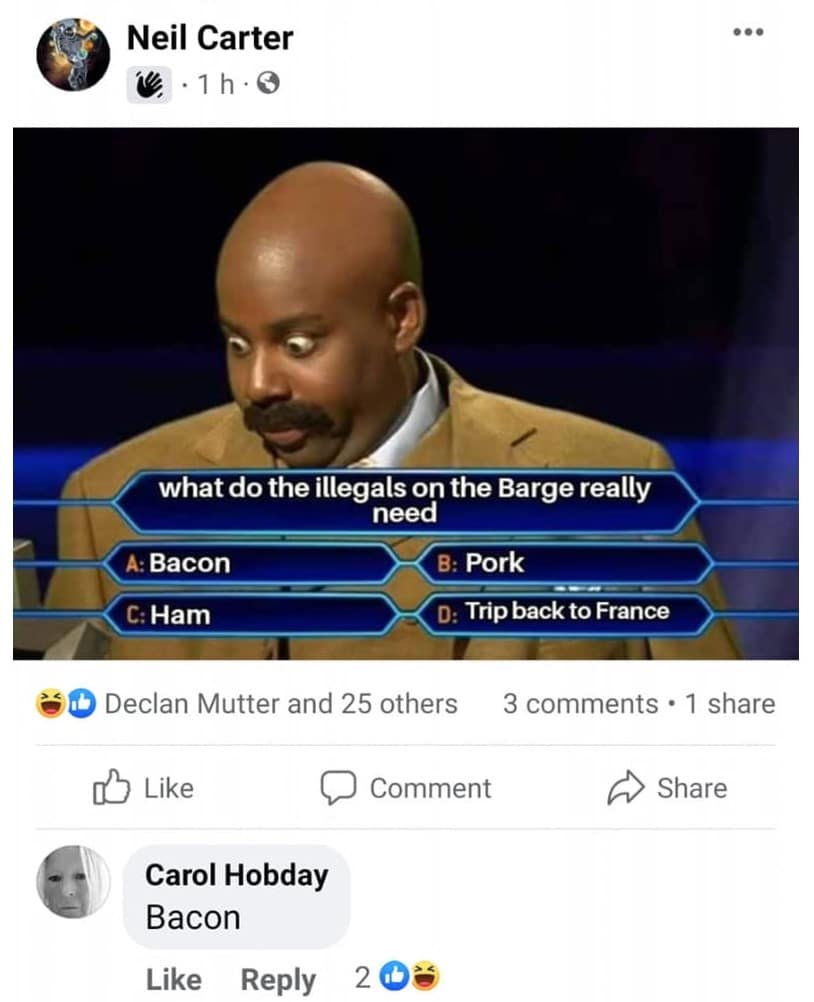
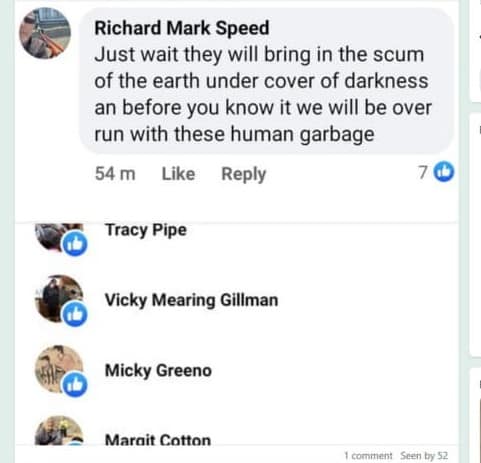
Beforehand, it’s worth noting that the default name in the NTTB group for the people seeking asylum is ‘illegals’.  That’s when they’re not being called ‘economic migrants’, ‘gimmegrants’, ‘criminals’, ‘enemy invaders’, ‘things’, ‘rapists and paedophiles’, ‘rapefugees’, ‘scum’, ‘vermin’, ‘channel rats’, ‘sub-human’ and even ‘uncivilised, sub human channel rats!’ 

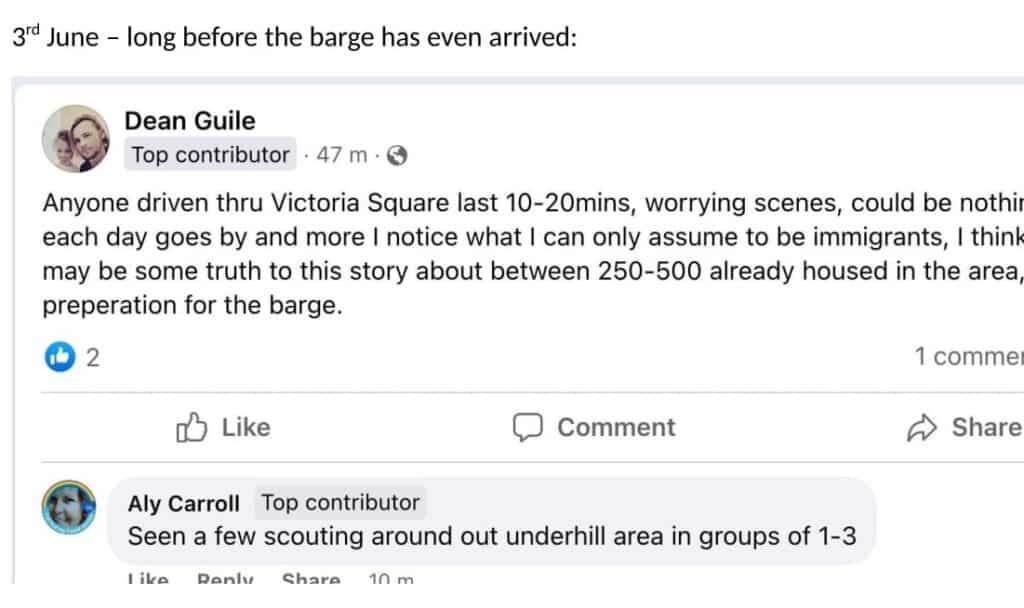
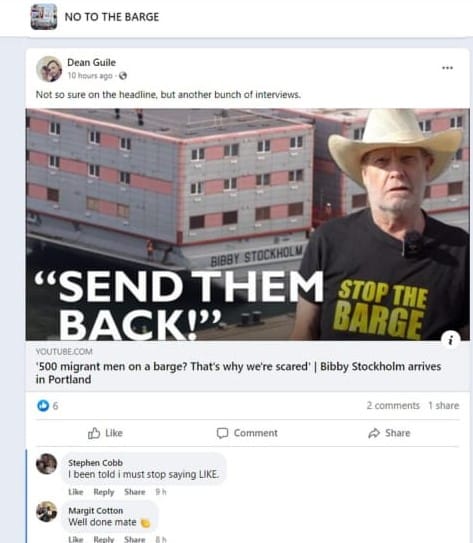
But yeah, Alex Bailey and Dean Guile have declared there’s no racism here, so…..

Alex Bailey: “500 plus fighting age men of unknown origin and criminal past” (alongside a Far Right Britain First video he posted!)

Adrain Mitchell: “Illegal dust mites”

Gary Knight: “Dirty lowlife scum.  Terrorists, rapists, murderers, pedo’s the fucking lot of them. Dirty cuntz. Send the fuckers back”

Ladette M Squiggleton: “infestation”

Mark Paul: “Illegal migrants flooding into the UK”, “being over-run by alien cultures”

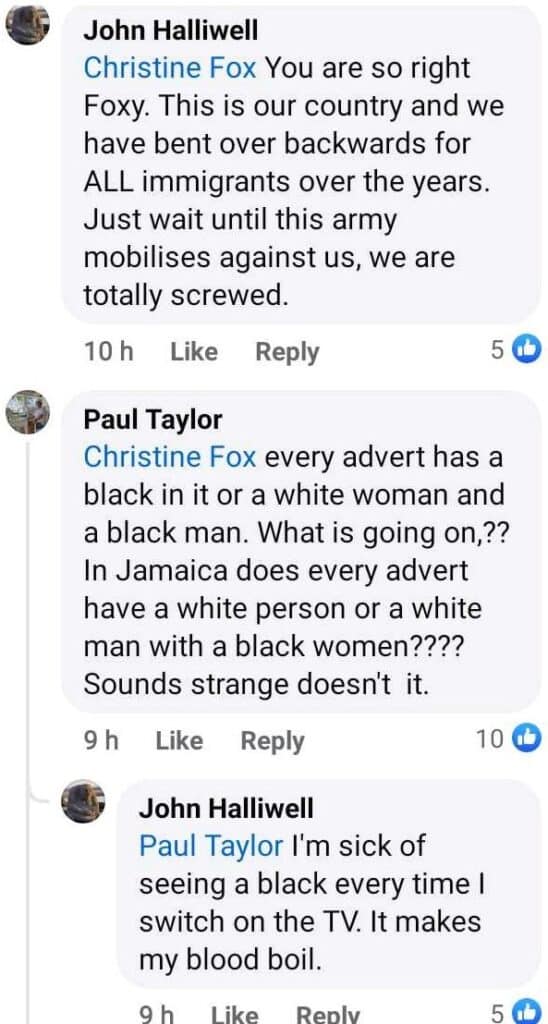
Paul Taylor: “every advert has a black in it or a white woman and a black man. What is going on??”

John Haliwell (in response): “I’m sick of seeing a black every time I switch on the TV. It makes my blood boil.”

(Then Dean Guile states that the ‘racism card’ is so over-used that racism doesn’t mean anything anymore!)

Michelle Varney: “They’re all fighting-aged Asian men”

Mark Paul: “Rapefugees”

Connor Spencer: “Rapists and pedophiles”

Stephen Redpath: “scrounging freeloading invaders”

Micky Greeno: “Freeloading scrounging benefit seeking chancers” (and then he called Rishi Sunak a ‘foreigner’). When Far Right activist Rod Harrison attacks Rishi Sunak, Greeno responds “He’s one of them”.

Graeme Kershaw: “vermin”

Gary C Hazel: “Ukrainians/Russians are evolved humans unlike the barge peeps”

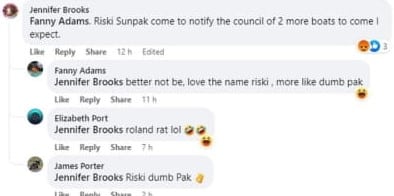
Elaine Bearne (as Fanny Adams) calls Rishi Sunak “Dumb Pak”, “The govt being Muslim are part of whats going on”

Micky Biggs: “Economic gimmegrants”. 

Richard Mark Speed: “Scum of the earth”, “human garbage”

(Then Alex Bailey is asked by his mate Jeff Moody on GBeebies about accusations of racism and he responds: “Those words, those terminologies, are never on my mind”)

Britishoscar JJ: “500 plus males with 3rd world brains”

Roger Forbes: “this scum”

Holty Bfc: “I would rather house 500 stray dogs than them”

Jay Capaldi: posts a video of a sickeningly racist song

Mark Pickering: “Paedophiles”

Aly Carroll: “Boat illegals”, “freeloading illegal gimmegrants”

Joe Kelly: “Stealth invasion”, “invading army”, “scum” and “fucking gimmegrants”

Jon Burt: “My daughter was seeing a Nigerian and yeah I gave it the ‘Here boy go dig the garden will ya’ and so on which was having a bit of a giggle with him (now deemed really racist)”

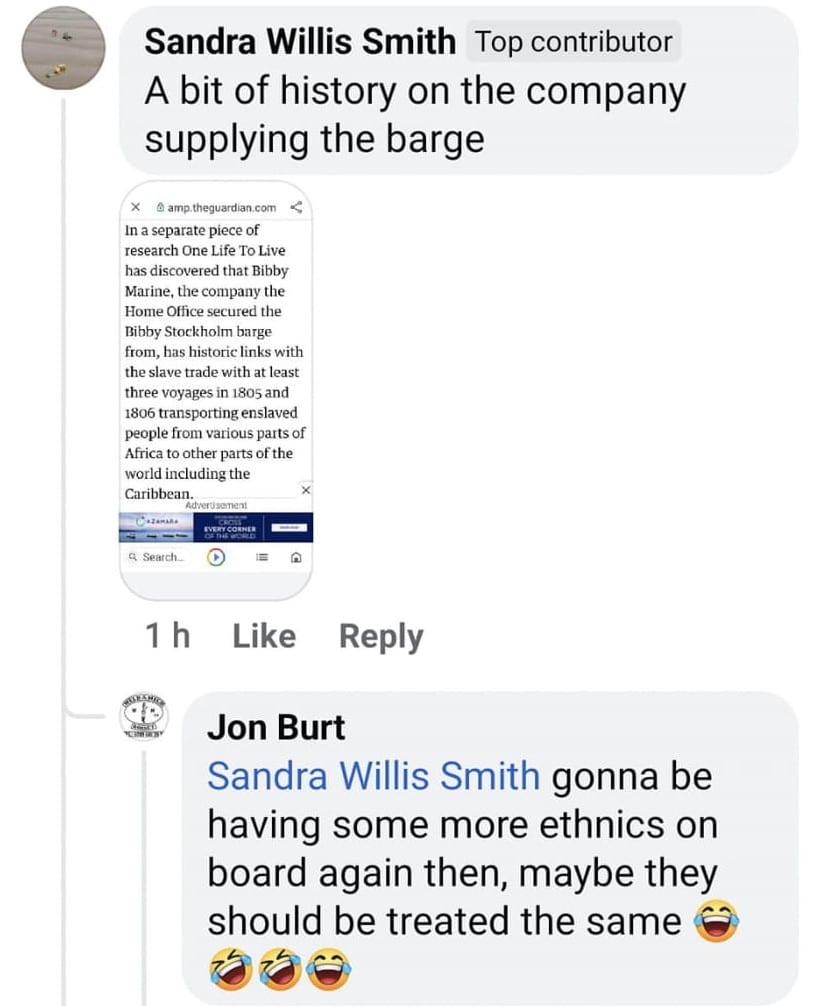
John Burt (again): When someone posts about the company the Home Office secured the barge from having historic links to the slave trade, Burt responds “gonna be having some more ethnics on board again then, maybe they should be treated the same.”

(Then Dean Guile insists racism is not a thing any more….. again)

Alan Croley (on a post about sewerage): “Serve it to them at dinner time”

Tracie Hobden: “When are the things actually arriving”

Beverly Ann Gardiner: “I don’t want the things in this country at all”

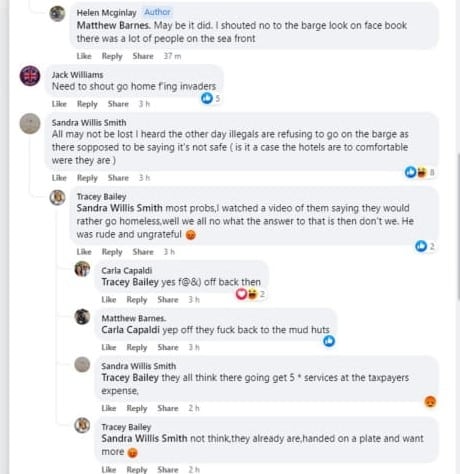
Jack Williams: “Need to shout go home f’ing invaders”

Carla Capaldi: “Yes f@&) off back then”

Mathew Barnes: “Yup off they fuck back to the mud huts”

Tracey Bailey: “Who the hell do they think they are in our country”

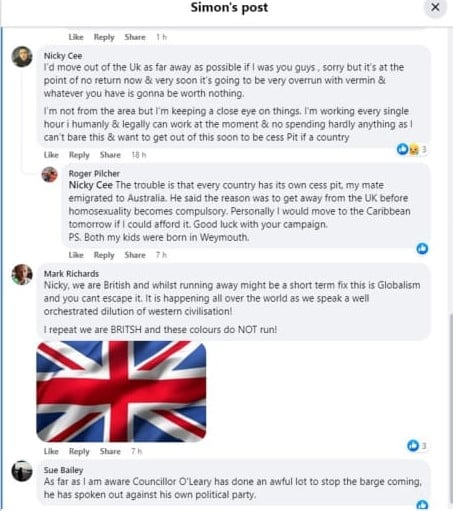
Nicky Cee: “very soon it’s going to be overrun with vermin”

Terry Topper Brown (on a post about fire regulations): “Let em burn”

(Then Alex Bailey and the other campaign leaders all say ‘there’s no racism here’)

Sue Bailey (Alex’s mother): “the gov’t will go down in history as the murderers of the GB race”

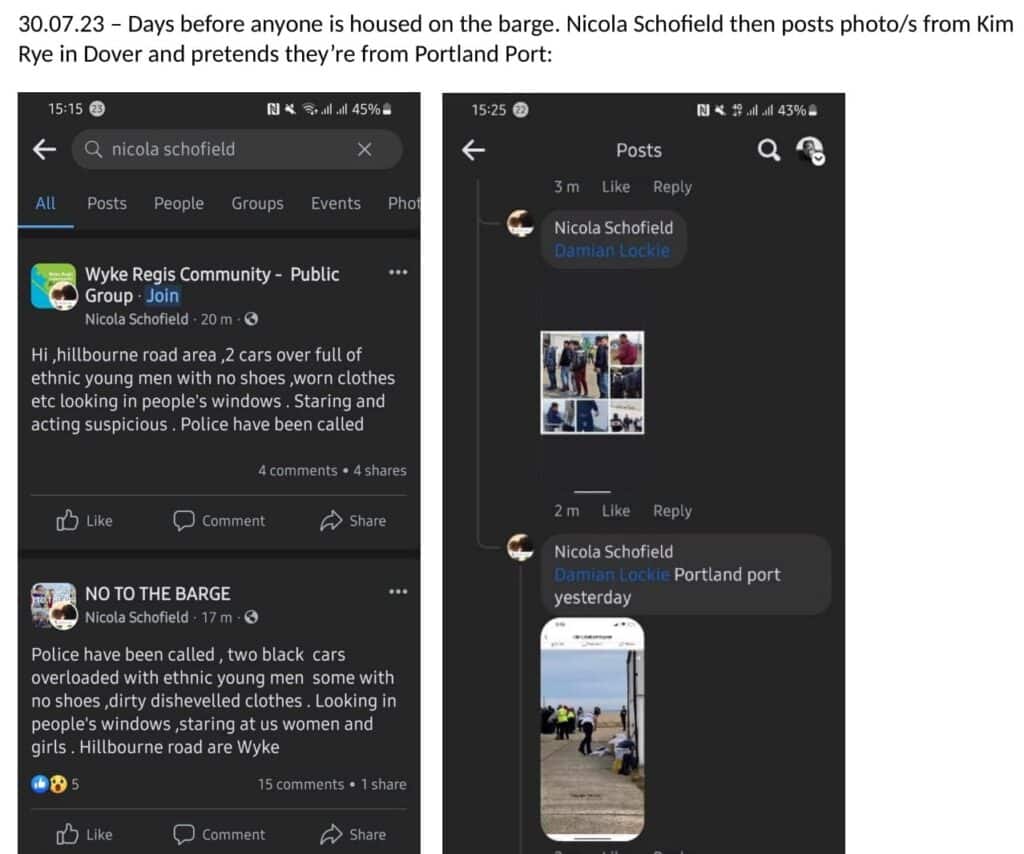
Kim Elizabeth Rye: “a bunch of scrounging chancers who are not refugees”, “foreign criminals”

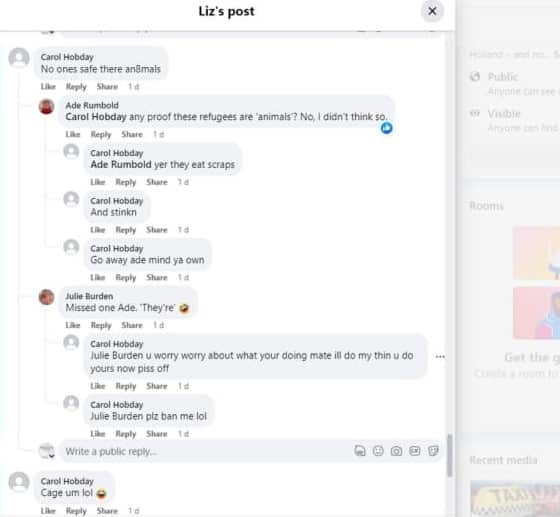
Cindy Lou: “these animals”

Helen Mcginlay: “That’s what they do live in the fields and make a fire kill some animals and cook them”

Stuart Chiswelstaff Breckell: “channel rats”

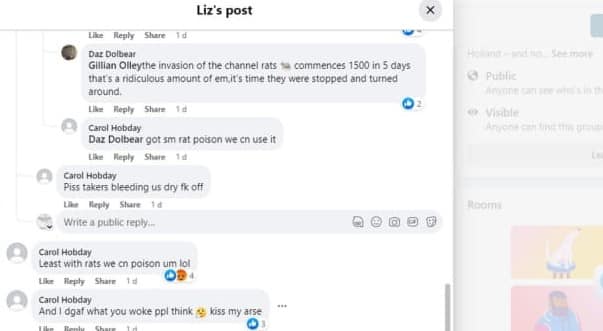
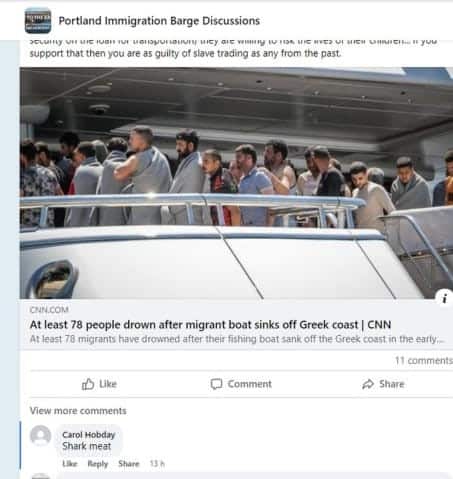
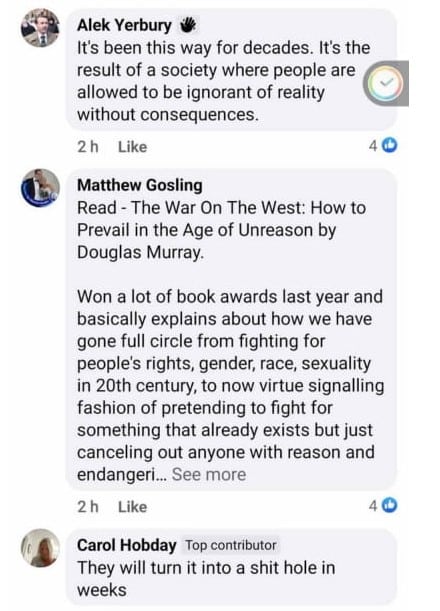
Carol Hobday: “They shit on pavment”, “wors than rats”, “animals”, “stink” and “eat scraps”

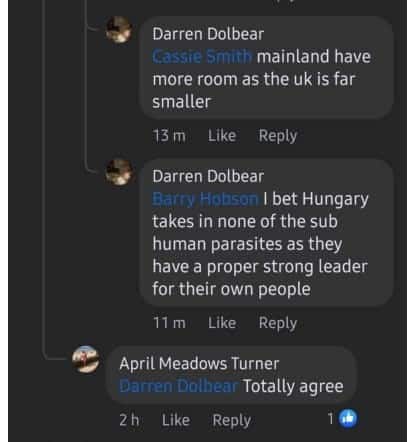
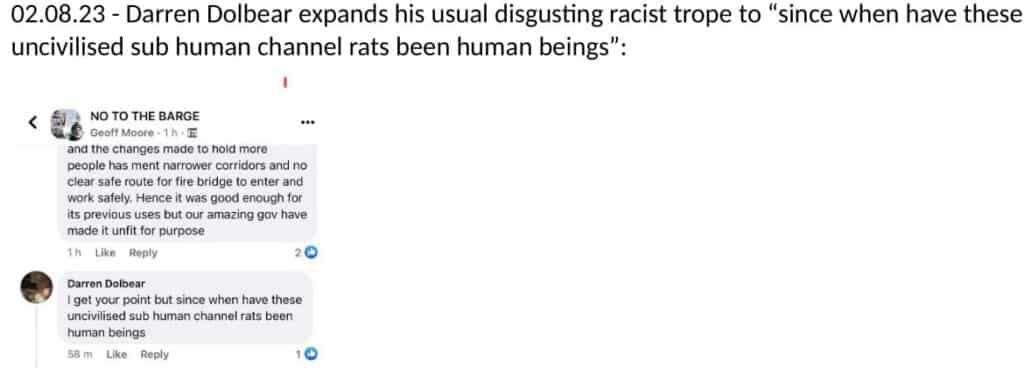
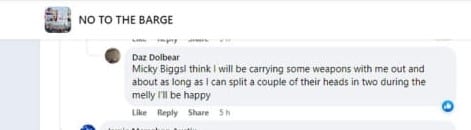
Daz Dolbear: “channel rats” (at least 20 times, usually with a rat cartoon/emoji), “uncivilised channel rats”, “dangerous channel rats”, “sub human channel rats” and eventually “Since when have these uncivilised subhuman channel rats been human beings”

Readers may well know the effects of such dehumanising language:

“Remember, it didn’t start with gas chambers. It started with politicians dividing the people with ‘us vs. them.’ It started with intolerance and hate speech, and when people stopped caring, became desensitized, and turned a blind eye, it became a slippery slope to genocide”.
(Auschwitz-Birkenau Memorial and Museum)

The NTTB campaign leaders – including Alex Bailey, Kate Robson, Steve Coggins, Stephen Cobb and Susan Pheonix – claim it’s not about racism and protest that there’s no racism to be seen.  They know full well that their group is an absolute cesspit of racism (and increasingly, Far Right engagement), and they have, essentially, done nothing to stop it.  They are complicit!

Shame on them!  They bring shame to our island!

Gallery 2:
Threats

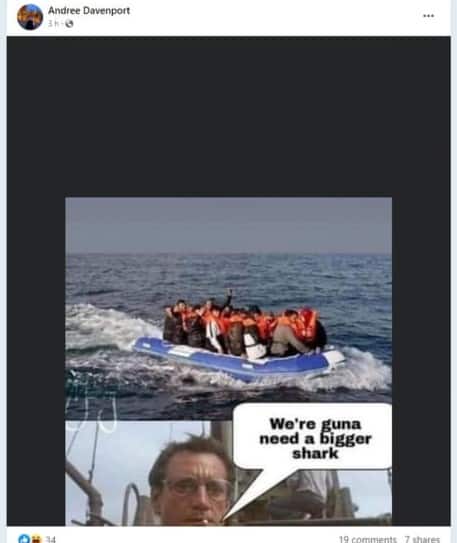
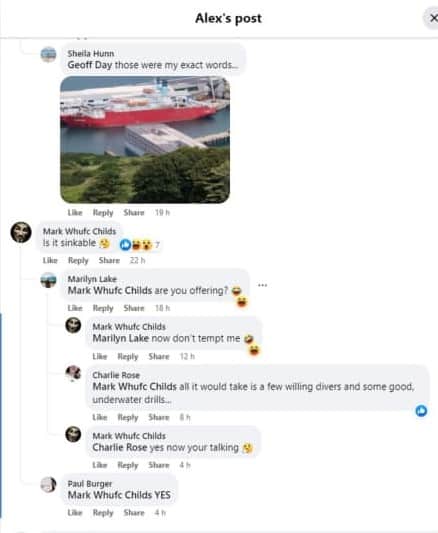
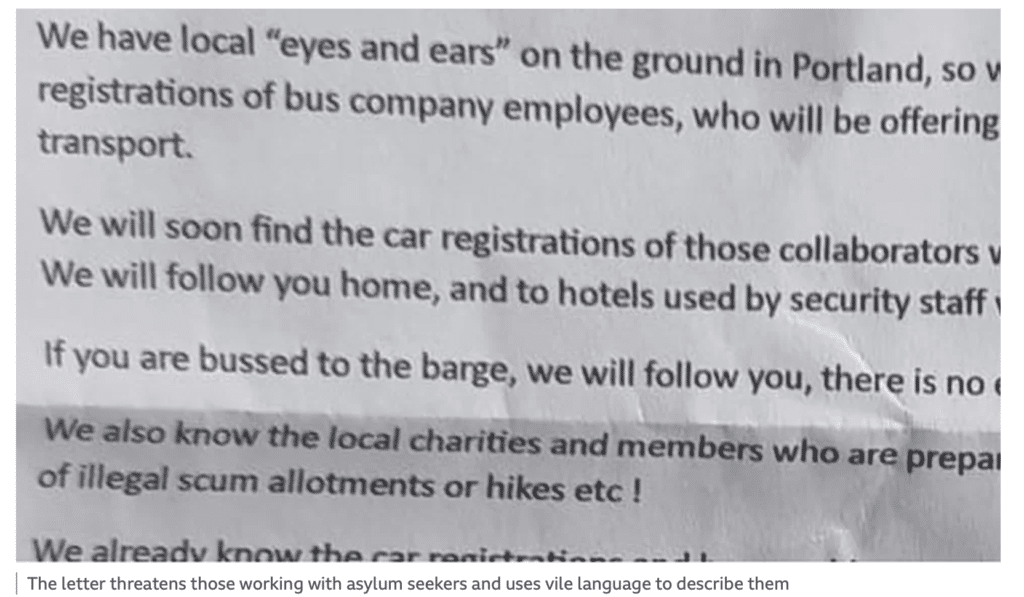
A consistent feature of the NTTB campaign group is the threats made in relation to the barge and its inhabitants.  Some may say that such threats are meant as ‘jokes’ but they add to the environment of hatred and animosity.

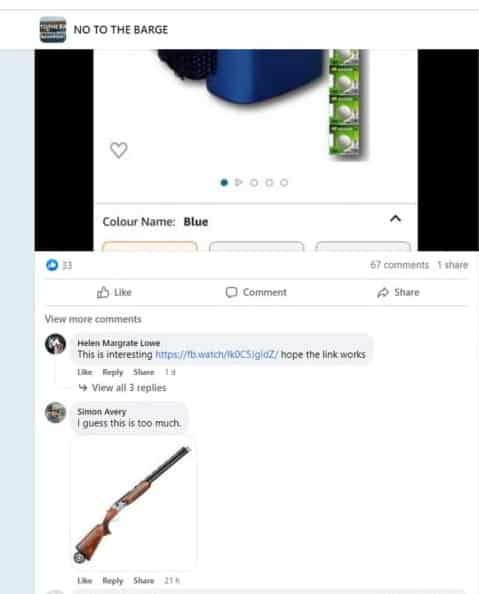
Stuart Chiswelstaff Breckell and Peter White both suggest adding a hand grenade to the refugee ‘welcome packs’ being made by locals.

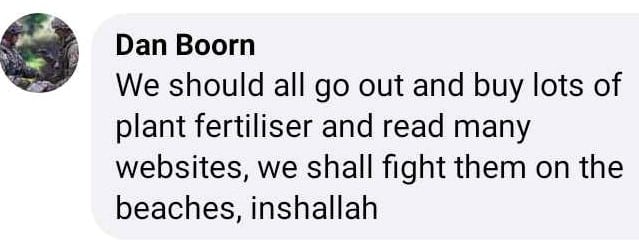
Dan Boorn suggests buying “lots of plant fertiliser and reading many websites” adding “We shall fight them on the beaches, inshallah”

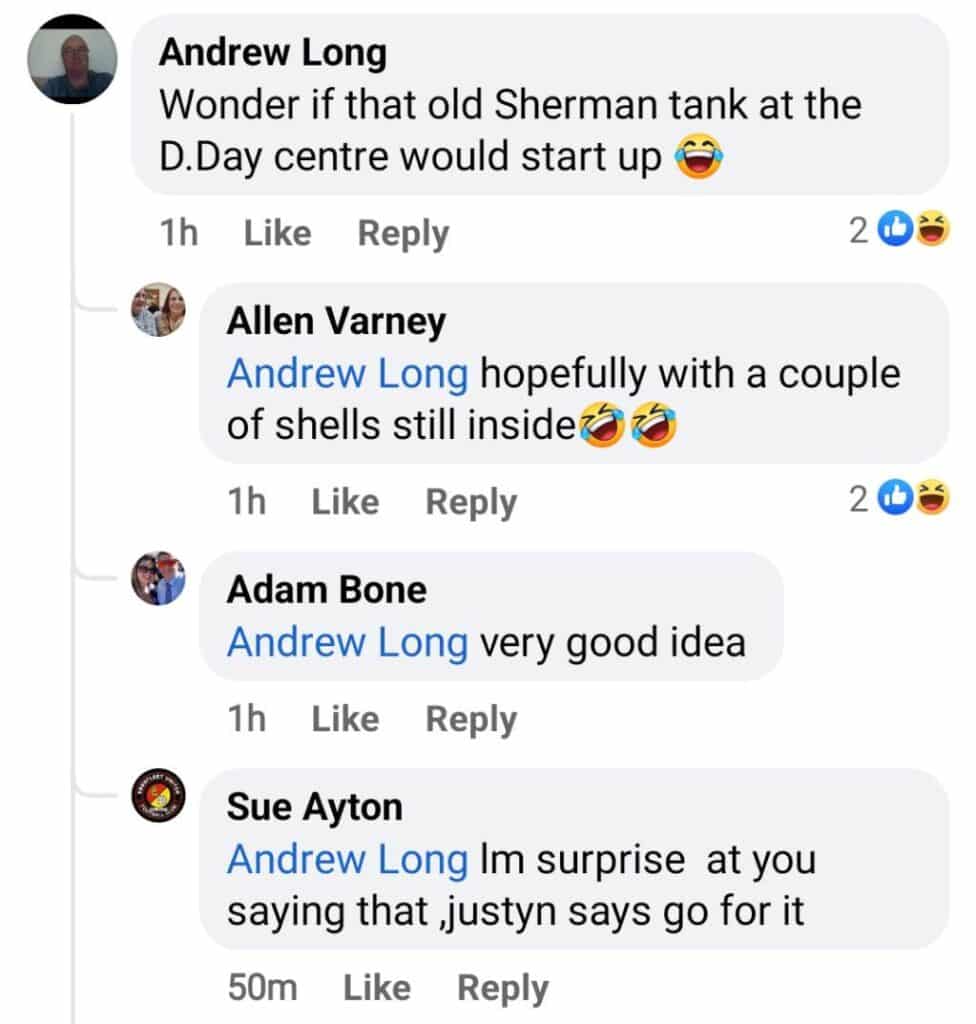
Andrew Long: “Wonder if that old Sherman tank at the D Day centre would start up” to which Allen Varney responds “hopefully with a couple of shells inside”

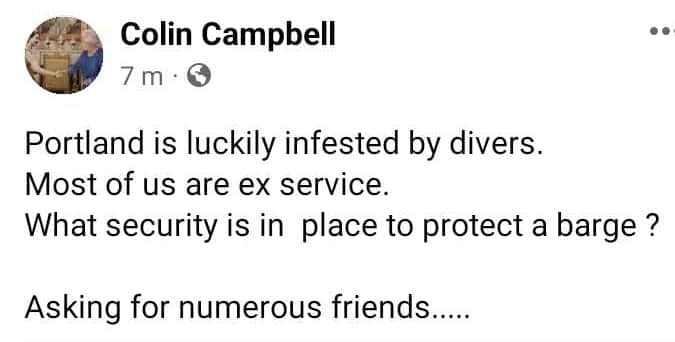
Colin Campbell: “Portland is luckily infested by divers. Most of us are ex-service. What security is in place to protect the barge. Asking for numerous friends….”

Sue Ayton declares that she’s “not worried about the barge going up in smoke with them on it”

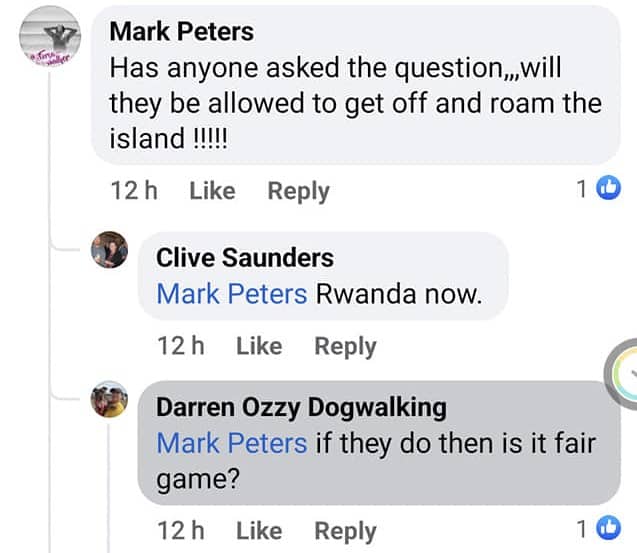
When Mark Peters asks “Will they be allowed to get off and roam the island!!!!” Darren Ozzy replies “If they do then it is fair game”

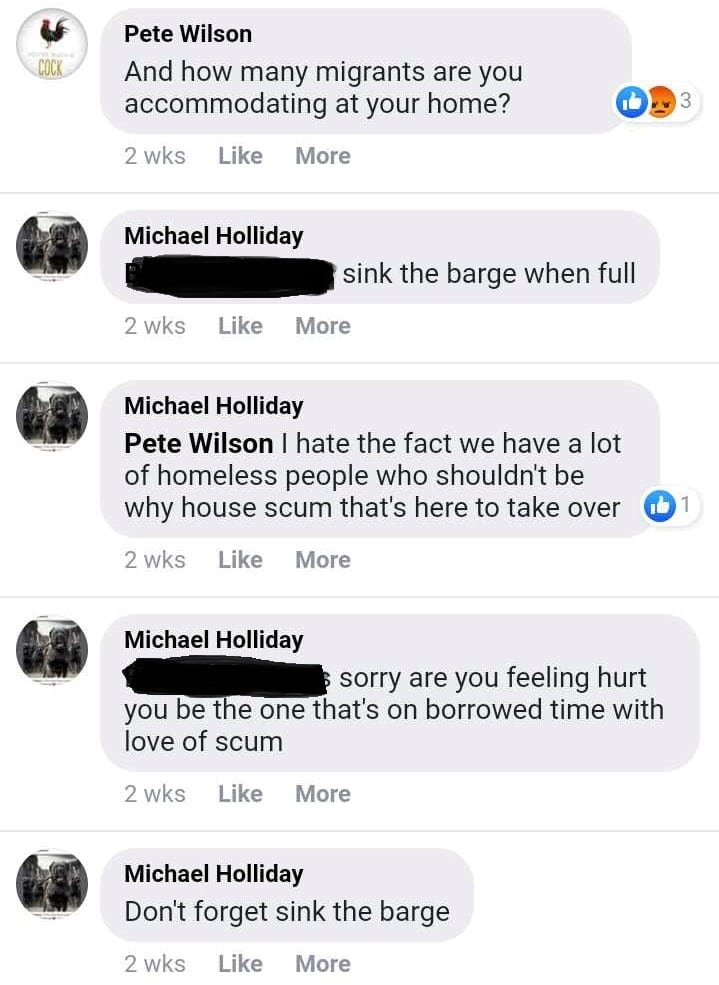
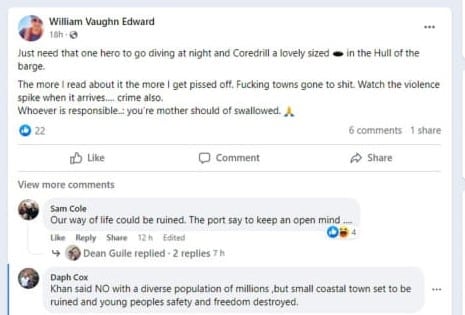
Mark Loader suggests sinking the barge (when it’s full) and Stepehen Guest suggests towing the barge to Lulworth ranges.

Jennifer Brookes: “Anybody got a speedboat and a Molotov cocktail. On a dark night.”

Richard J Taylor: “Anybody got the Royal Navy’s phone number maybe they can sink the damn thing”

Sandra Willis Smith: “Just cut the holdings let it float out to sea if we’re lucky the winter storms will do the rest for us”

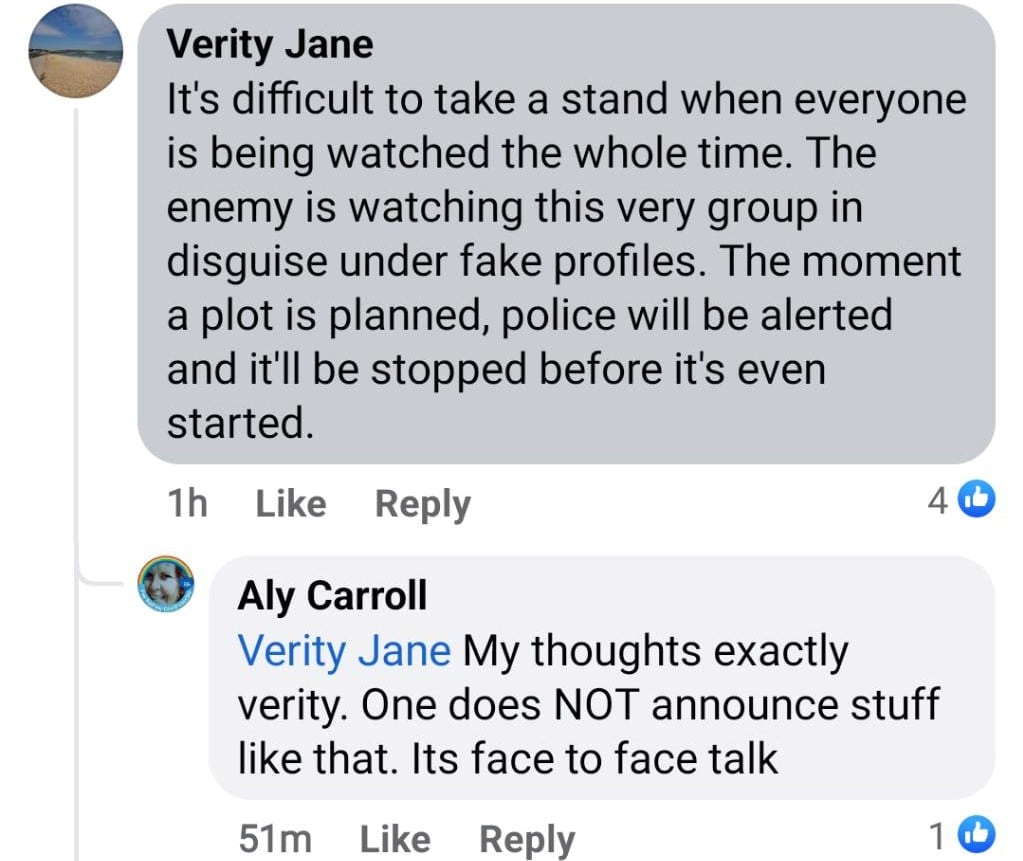
Verity Jane and Aly Carroll discuss how plans and plots should be discussed in person, rather than online where there are ‘spies’ and ‘police’.

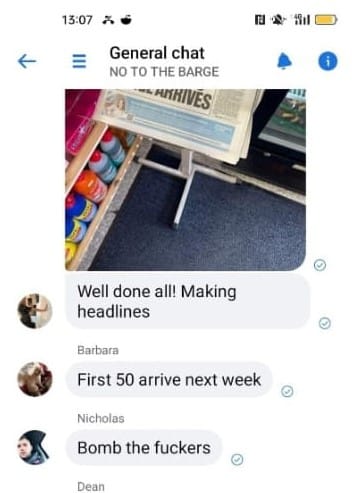
Nicholas Hough: “Bomb the fuckers”

Daz Dolbear: “I think I will be carrying some weapons with me out and about as long as I can split a couple of their heads in two during the melly I’ll be happy”

John Jeffries (on a post about the proposed waste incinerator): “Could use the incinerator for the immigrants”

I’ll just repeat that for anyone that missed it……

“Could use the incinerator for the immigrants”

The threats haven’t stopped at the asylum seekers.  Abuse and veiled threats have been hurled at anyone who dares to challenge their racism as well as local anti-racists and Councillors. 

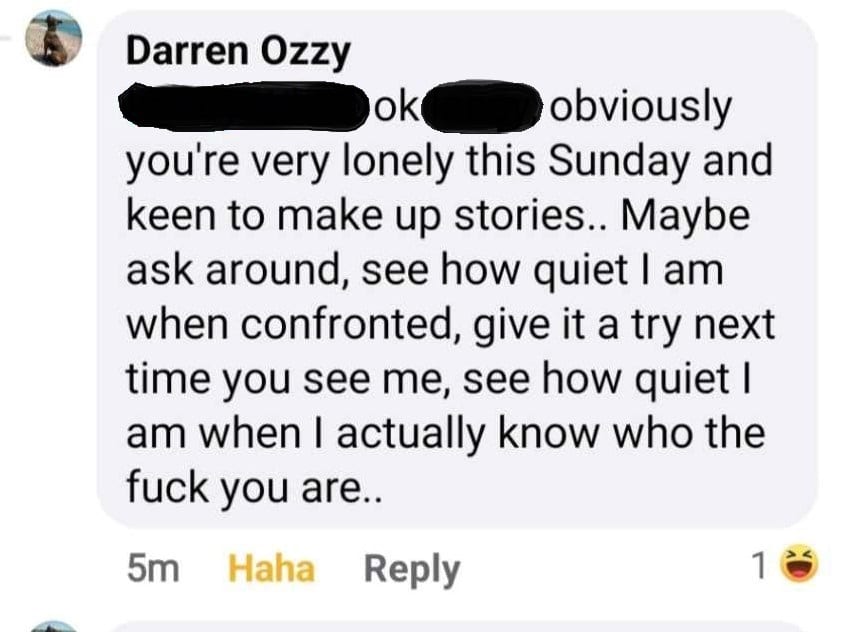
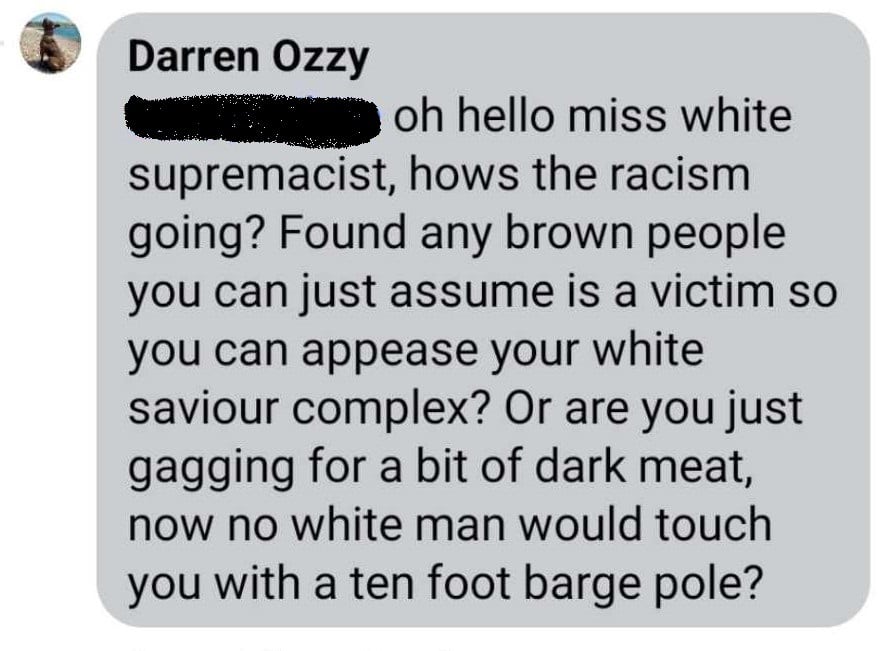
Darren Ozzy (real name Darren Johnston) and Micky Greeno have been particularly abusive to several local women, sometimes in public, sometimes sending vile private messages and saying they know where someone works.

Micky Greeno: “That (woman’s name) freak gets her moneys worth out of that Primark dress she wears”

Darren Ozzy (Johnston): who shared screenshots of people he states are “in favour of the barge” alongside veiled threats and sent this: “Maybe ask around, see how quiet I am when confronted, give it a try next time you see me, see how quiet I am when I actually know who the fuck you are”, “Can’t farm Facebook likes when you’ve been raped and killed” and “Are you just gagging for a bit of dark meat now no white man would touch you with a ten foot barge pole?”

Chris Leggy Legg named two Portland women in a false and antagonistic diatribe about Stand Up To Racism Dorset.

Toby Carter: “Where do you live, Traitor?”

Paul Wagstaff: “You are a traitor to your country and it’s people”

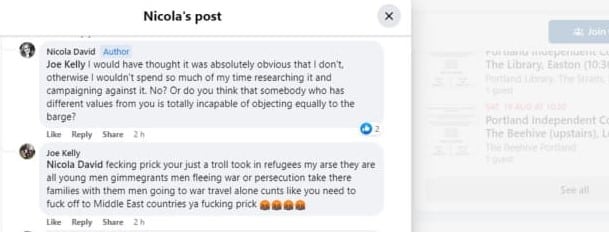
Joe Kelly: “Cunts like you need to fuck off to Middle East countries ya fucking prick”

There have been disgusting and ill-informed attacks on Councils, individual Councillors and Stand Up To Racism Dorset members – in many cases, the very people who have, over many years, campaigned to save Portland Hospital, oppose the proposed waste incinerator, prevent public service cuts and keep affordable and social housing for local people.

Anyone challenging the racism online gets instantly labelled a ‘troll’, ridiculed, abused and, very often, removed from the group by that bastion of free speech Alex Bailey!  I myself was removed by Bailey some time ago for daring to speak out.

Most worryingly, a local 15-year-old girl has recently been called the ‘n-word’ on snapchat and, on the bus, a woman looked at her and said: “bet you’re from the barge!”

Gallery 3:
No To The Barge and The Far Right

The first six weeks of the NTTB’s existence saw predominantly local people join the group, albeit that links to, and videos from, Far Right groups were sometimes posted.  The last eight weeks has seen a considerable increase in people joining from around the UK, many of whom are also in various Far Right groups.  It has also been noticeable that many of the most vocal group members have moved to the area from elsewhere in the UK, including Alex Bailey who moved to Weymouth from Dover last year.  Many of these prominent members have stated that they moved here “to get away from them” as one person put it!

In June, Hope Not Hate published their latest exposé on ‘self-proclaimed migrant hunters’: 

https://hopenothate.org.uk/wp-content/uploads/2023/06/Migrant-hunters-resource-final-version-updated-June-23.pdf

It’s worth noting that:

Page 2 – Patriotic Alternative – leafleted Weymouth in June.

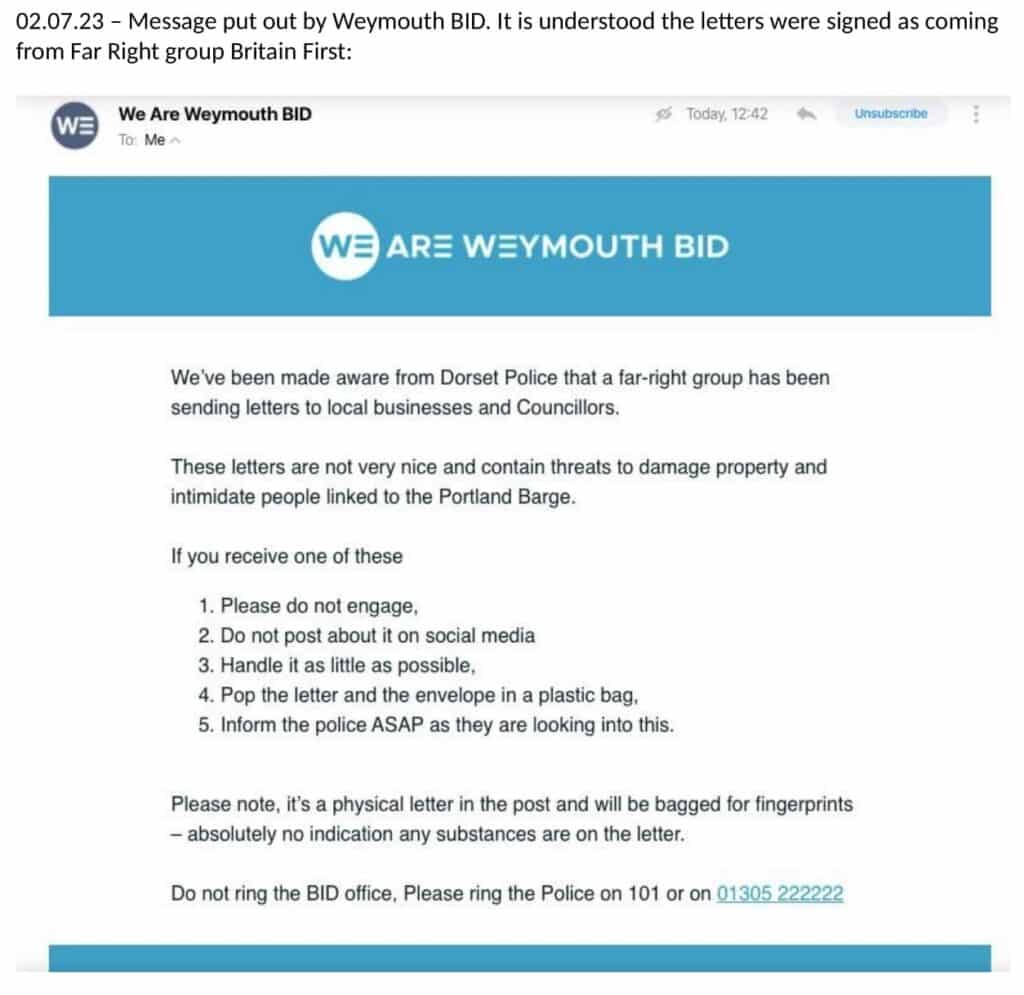
Page 3 – Britain First – the recent threatening letters sent to businesses and Councillors were signed from Britain First.  The fascist group have denied involvement.

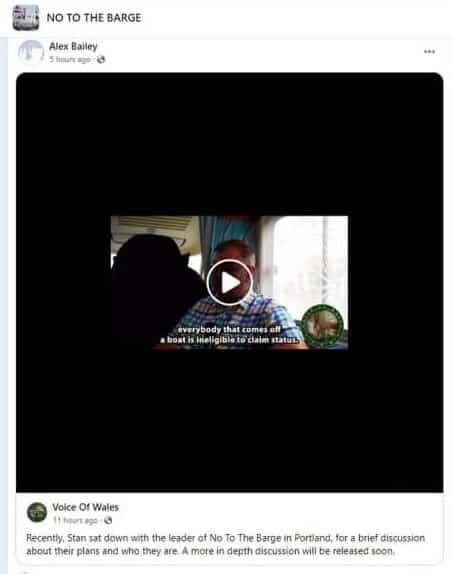
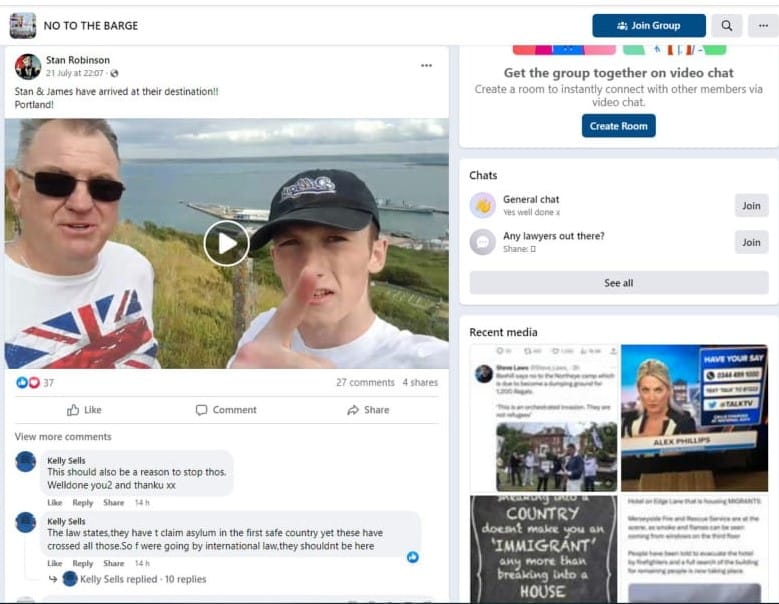
Page 4 – Voice of Wales – there has been loads of interaction between them and NTTB/Alex Bailey.  Stan Robinson and James Harvey (two VoW leaders) came to Portland for several days and met with, and interviewed, Bailey.  They have since conducted a second interview.  Robinson is posting on the NTTB group.

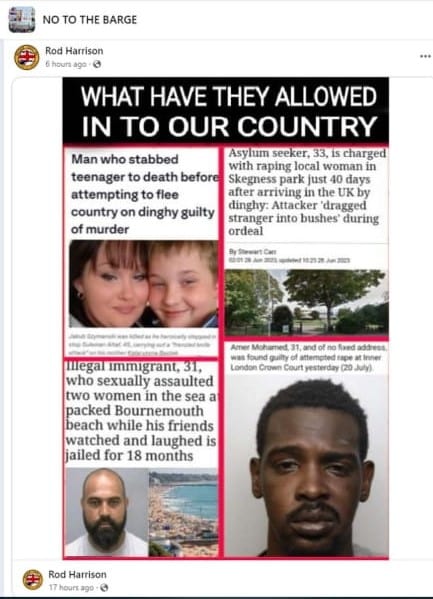
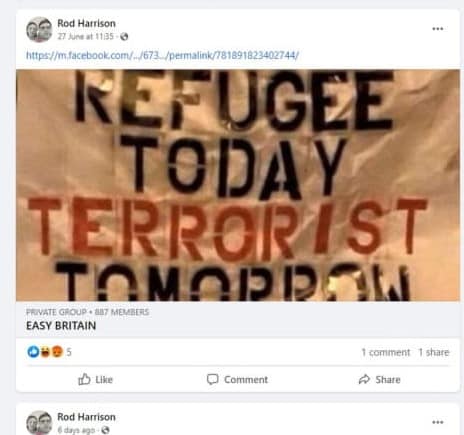
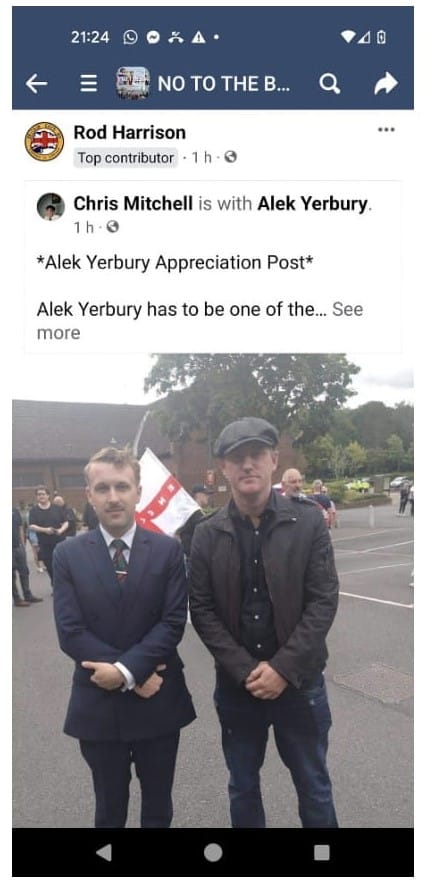
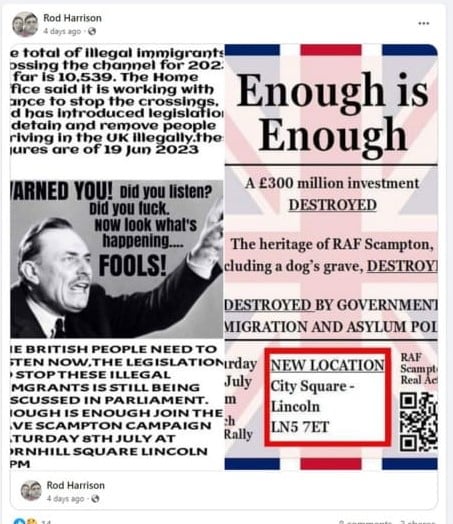
Page 5 – Alek Yerbury – Fellow Far Right activist Rod Harrison has been posting on the NTTB group for weeks and now Yerbury is posting.  Yerbury has also posted the NTTB group link on another Far Right group.  How sad that a proud military town is now giving any credence to a man who styles himself on Adolf Hitler!

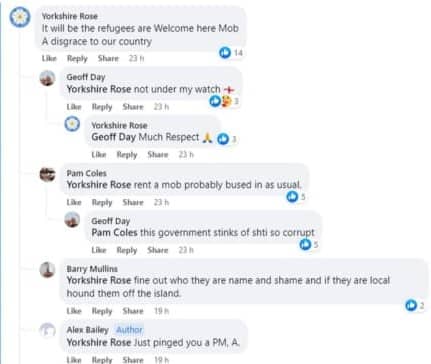
Page 7 – Amanda Smith (aka ‘Yorkshire Rose’) – posted to the NTTB group recently and Alex Bailey commented underneath that he had sent her a Direct Message.

NTTB members have posted links to, and articles and videos from, at least 16 different Far Right and extremist groups.  I will not name them here.  However, by example:

Mike Croley posted David Lane’s ’14 Words’, the most popular White Supremacist slogan in the world.  He also describes Far Right Patriotic Alternative as ‘Awake, not woke!”

Aly Carroll posted links to, and content from, several Far Right groups

Chris Leggy Legg posted a video of Stephen Yaxley Lennon (aka Tommy Robinson)

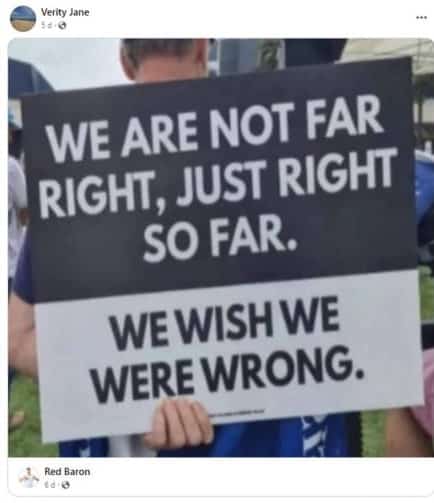
Verity Jane posted several Britain First videos…. and Alex Bailey and Darren Reynolds also posted one

Joanne Barlow, Andy Long, Elaine Bearne and others posted racist Far Right videos

Julie Button posted from a Far Right group and Lisa Flann and Elaine Bearne shared posts by Alek Yerbury

NTTB Campaign admin Steve Coggins’ Facebook ‘likes’ include the Anti-Islam Alliance

Stephen Cobb states that he’s heard ‘Tommy Robinson’ is bringing a bus load of people to the NTTB protest (he didn’t) and then stated: “Shame Tommy Robinson has not got time to visit us”

Along with other new members, Far Right activist Rod Harrison is invited to the NTTB protest by Steve Coggins.  After joining the group, Harrison posts 19 times in one week – the most prolific poster.  He regularly reposts Alek Yerbury posts from Far Right groups

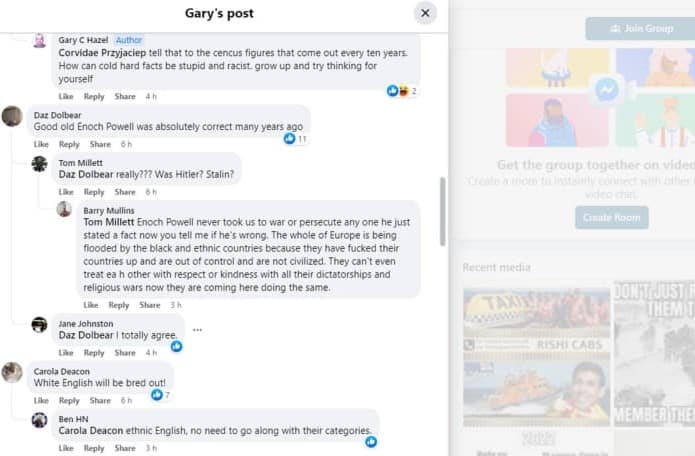
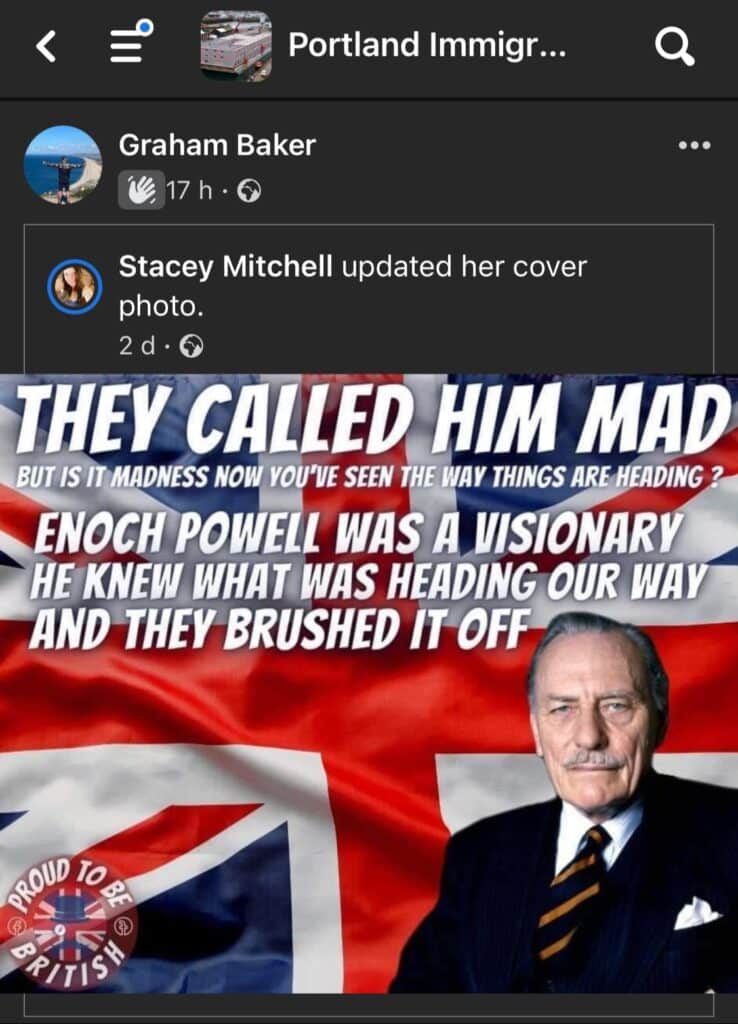
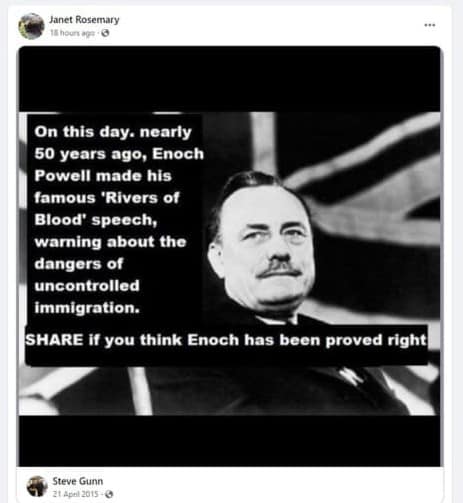
Janet Rosemary celebrates Enoch Powell’s ‘Rivers of Blood’ speech

Gary C Hazel posts about the Far Right ‘Great Replacement Theory’, the “genocide of the British People” and calls for “Civil War”

Mike Croley, Kim Gray, Robert House, Kevin Samuel Furniss and others post about the Far Right ‘Kalergi plan’.  There are lots of Far Right conspiracy theories around ‘Great Replacement’, ‘Agenda 2030’ and secret UN/WEF plans for a ‘New World Order’ – all relating to the ‘replacement of white people’

Along with other new members, Steve Coggins welcomes Hitler-wannabe Alek Yerbury to the group.  His first comment is to attack Stand Up To Racism

Stan Robinson from Far Right Voice of Wales posts regularly to the group

Anti-migrant campaigner Katie Elizabeth Rye from Dover encourages NTTB to join forces with other anti-migrant groups online, saying: “form yourselves into a much larger and much more threatening identity”

Facebook even joins in.  Based on NTTB’s strong links with Far Right groups, it suggests to me that I ‘might like’ a Far Right group where Yerbury is an admin.  I don’t!

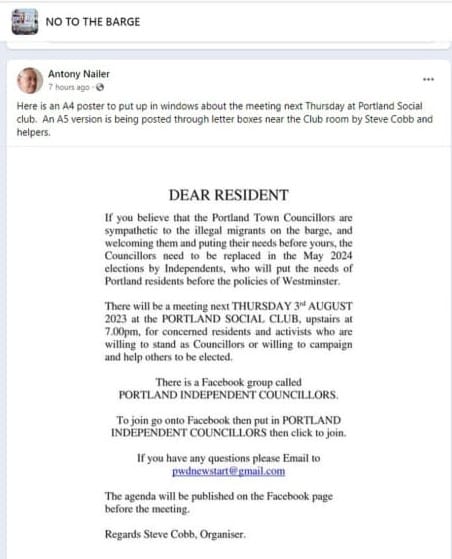
Worryingly, given their racism and proximity to the Far Right, the NTTB campaign has begun recruiting candidates to ‘replace those Councillors who they feel have not supported them.’  It is no coincidence that they have abused Councillors and misrepresented their words and actions to aid their electoral ambitions.  They say they are looking for people who will “help them to achieve their goals.”  I trust my fellow Portlanders will reject hate at the ballot box.

Gallery 4:

Alex Bailey

The NTTB campaign’s main leader so far has been Alex Bailey.  Whether he has aspirations to be a Far Right activist is unclear, but his willingness to be close to the Far Right is now evident.  His running of the NTTB campaign bears a very close comparison to Hope Not hate’s description of Patriotic Alternative’s modus operandi. 

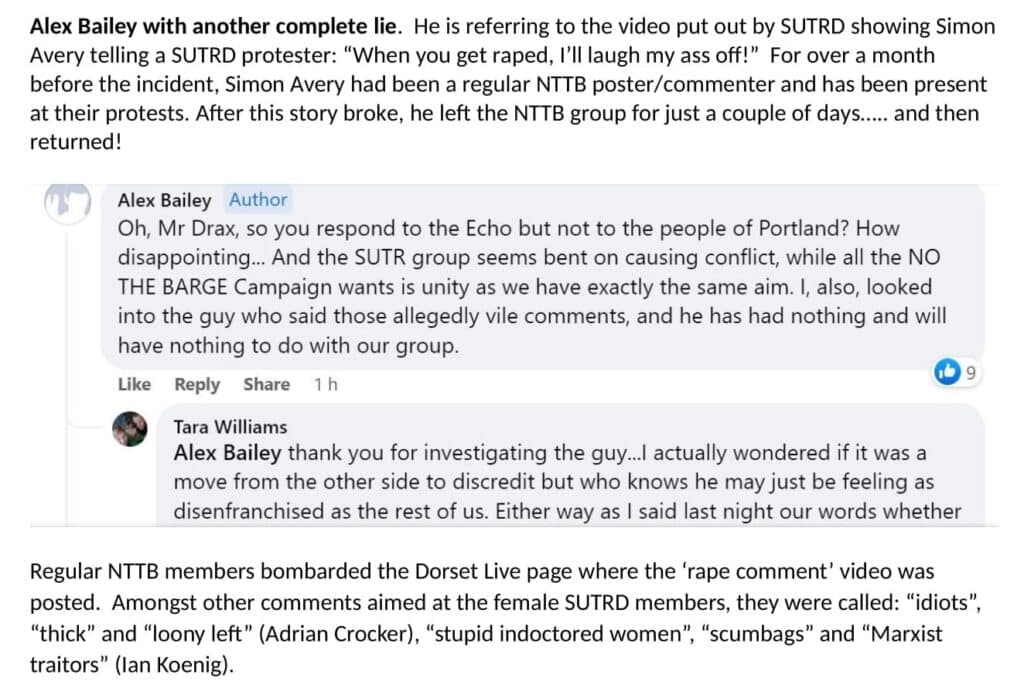
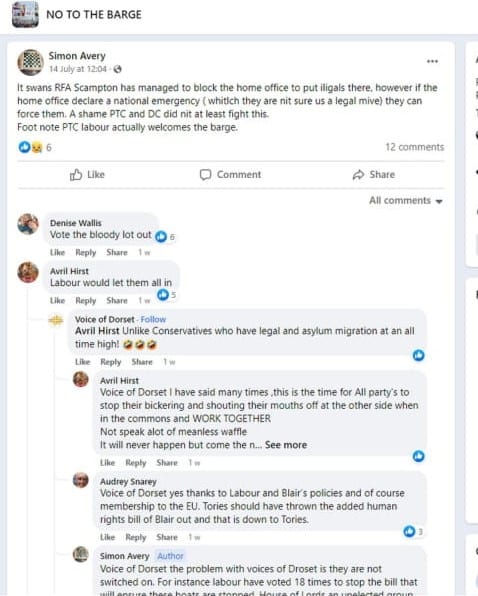
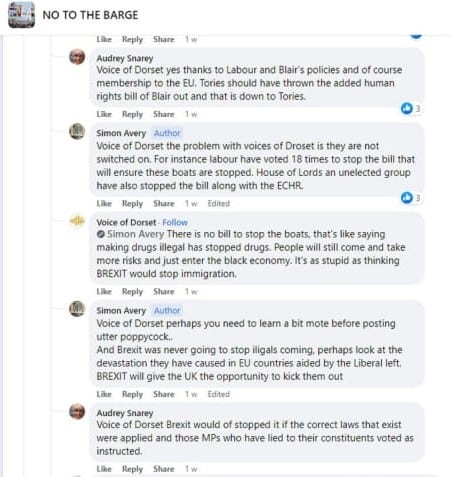
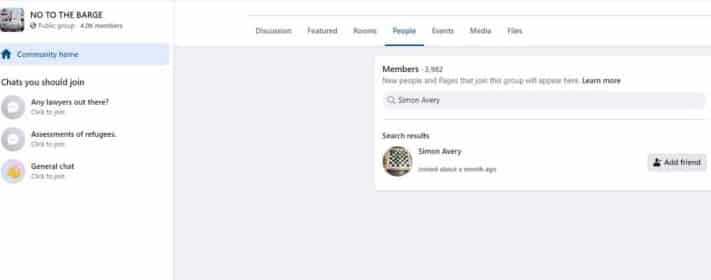
He appears to be a keen liar, deliberately and constantly referring to the local Stand Up To Racism group as ‘the racism group’ and a ‘hate group’ and claiming their protesters are ‘bused in!’  When NTTB regular Simon Avery told a SUTRD protester; “When you get raped, I’ll laugh my ass off”, the comment was caught on film and went around social media to widespread condemnation.  Bailey declared that he’d ‘looked into the man and he was nothing to do with their group!’  Avery had been a member of NTTB for over a month, had posted regularly and was at their protest!  Avery left the group for two days….. and then returned.

When Bailey had a falling out with Julie Croley, she declared publicly that he ‘was Far Right’ and intends to use the campaign to gain support for when he stands as an electoral candidate.  He then kicked her out of the group and told everyone she was unable to continue due to illness.  Bailey certainly has a politician’s knack for narcissism, deceitfulness, and self-promotion.  One would hope the electorate has had enough of that!

Interestingly, it seems there is further dissent within the ranks.  NTTB candidate organiser Antony Nailer recently criticised Bailey for not attending their first meeting (because he was being interviewed by a Far Right group), for deliberately pushing his post down their page and for his ‘self-aggrandizement.’  There are growing whispers that the people of Portland are cottoning on and feel he has been using them for his own ends.  Whilst not living on Portland, he constantly says he is ‘giving us our voice.’  It remains to be seen how long we’ll believe him.

The backlog of asylum cases that has created the problem in the first place is a (conceivably deliberate) failure of government.  Poor people escaping war, persecution, imprisonment, and torture are not to blame.  The blame lies squarely with a government who care for refugees about as much as they care for our communities.

When I stated at the start that our community had been ‘radicalised’ through fear, grievance and hate, there is some truth to that.  How else would a community so proud of fighting fascism in WWII be openly greeting fascists and their dangerous ideas?  However, the fact is that it is actually just a very small section of our community.  Most people on Portland (and in Weymouth) are not racist and the community at large has been doing amazing things to welcome and support refugees.  The majority of people, including those in the NTTB Facebook group, are decent, kind, charitable and welcoming and believe that refugees are human beings who, like all of us, deserve to live in safety.

Gallery 5:
Liz Bladon

Please SUPPORT US where you can: Award Winning Independent Citizen Media Needs Your Help. PLEASE SUPPORT US FOR JUST £2 A MONTH

Dorset Eye wins big at Independent Media Awards

Ten years after its launch, Dorset Eye has won the Independent Media Awards for Citizen Media, Regional/Local Outlet of the Year and Political Reporting of the Year. The awards which were officially announced on 26th March where some of the hundreds of independent media were recognised for their tenacity in bringing to the public’s attention many of the news… stories that the corporate media either seeks to ignore or distort.

Dorset Eye was a founding member of The Media Fund which has since morphed in to the Independent Media Association. Both were set up to create a cooperative culture within the media and to raise vital funds to help all members to grow and to be sustainable. Many have now joined the regulatory organisation IMPRESS created out of the aftermath of the Leveson Inquiry.

IMPRESS is the Independent Monitor for the Press and is an independent press regulator in the UK. It was the first to be recognised by the Press Recognition Panel. Unlike the Independent Press Standards Organisation (IPSO), IMPRESS is fully compliant with the recommendations of the Leveson Inquiry.

As a result of membership of both the IMA and IMPRESS Dorset Eye is fully compliant with the standards of media content in the UK and along with all other members is held to a higher standard than the corporate media are under the IPSO.

The recognition bestowed on Dorset Eye as a leading Citizen Media, in which the public are empowered and respected for their voice, is part of our journey to hopefully becoming normalised across the UK and beyond. Unlike the top down corporate media model that tends to propagandise and distract, citizen media is the only route to democracy in its definitive sense.

Citizen Journalism - Independent Media Association

We all experience information and we all impart our own prerequisite conditioning on to our perceptions and narrative. This must be understood as a given. For those who denigrate citizen media it is vital to remember that humans are not and never will be above subjective interpretation. Citizen media accepts that interpretation in all its complexities is the norm and does not seek to deny this. It also accepts that by publishing news and other content it is up to the reader to do their own research and that this is merely a starting gun for more knowledge and enlightenment.

We are also exceptionally proud to be recognised for our award as Regional/Local Outlet of the Year. Approximately half of all of our content comes from local people and local places and with nearly eight thousand contributors signed up to the site we consider that our first ten years has been a remarkable success.

Regional Local Outlet of the Year Award

At a time when the corporate regionals are struggling in terms of revenue and the quality of their provision the independent sector is very much on the rise. We are extremely grateful to the local people and organisations who are supporting us in ever increasing numbers. Their dedication to being part of the news media in a proactive sense is changing the landscape in a very positive way. The dramatic fall in sales of corporate newspapers reflects a culture in which many people refuse to be ignored and silenced.

Dorset Eye is also very proud of its recognition for political reporting and helping to uncover many of the clandestine elements of society that powerful figures and again the corporate media attempt to hide or obfuscate. A significant amount of our content is about political enlightenment and helping people to remove the smokescreen.

Dorset Eye also have a TV channel that celebrates its first anniversary in April in which it delves in to local, national and international issues with those in the know. Entitled ‘Ten By Six’ it explores those issues that the corporate media tend not to.

However, besides of all the positive news the main obstacle is funding. The government and the establishment generally perceive independent media as a threat to their grip on power and people’s consciousnesses and therefore financial support is very much more hard to come by than for the corporate media. With this in mind we reluctantly accepted advertising on the site but going forward we would much prefer to be a publicly funded non advertising experience. This leads us to finding ways of raising funds. We very much need to get to a thousand people who are prepared to support us by donating £2… a month. If we can get ten thousand people supporting us we can set up a news desk, training courses and many of the other exciting projects.

Finally we would like to say a Big Thank You to our readers and contributors. The effort and energy that they put in to creating content in particular helps shape what little democracy the state allows us. Without you we are nothing xx

The Dorset Eye Team

Please join us on social media:

Twitter: @dorset_eye

Facebook: https://www.facebook.com/TheDorsetEye

Instagram: Dorset Eye

Which Financial Markets Are Least Affected By the Pandemic?

We have finally seen off 2020 — a milestone most around the world will welcome — and we’re beginning to see light at the end of the coronavirus tunnel. That doesn’t mean we’ve reached the end of this international nightmare just yet. But vaccines appear to be on the way (yes, really this time), and that’s something!

We reported on the ‘UK Government Seriously Considering a Compulsory COVID-19 Vaccination Program’ and that will certainly spark fresh debate, and unease among those who don’t trust the vaccine. But that’s a bridge we can cross when we arrive at it. The mere fact that the government has reason to consider something like this is a positive sign that citizens will be able to be vaccinated before too long — possibly in the spring of 2021.

Naturally, the best part of all this is that we may be able to safely return to something resembling ordinary life. But another positive result might just be an economic uptick. It goes without saying that the global recession we in the UK have gotten more than a little caught up in was caused by the pandemic itself. And while the easing of that pandemic won’t automatically turn around major world economies, it should help in some regards. Widespread vaccinations and ongoing precautions will lead to more ordinary life; more ordinary life will lead to greater optimism and consumer activity; and optimism and consumer activity can lift an economy out of a difficult time.

If this all plays out more or less as described, it’s also likely to bring about an uptick in investment. But the interesting question is going to be which markets people are confident putting their money in. Understandably, the market collapses we saw back in the spring of this year left many feeling skittish about conventional investment. And hopefully those sentiments ebb away when it’s appropriate for them to do so! But in the meantime, as we look ahead to that light at the end of the tunnel, it’s worthwhile to consider which investments people may favour when they do start to invest again.

It may well be that the ones people gravitate toward will be those that have actually been least negatively affected by the pandemic to begin with. Following this line of thinking, three popular investment markets stand out.

Cryptocurrency

A year ago, cryptocurrency still seemed like a little bit of a fringe market. There was plenty of value going around, and plenty of investors got wealthy trading assets like bitcoin, ethereum, and the like. But the average person looking to establish a portfolio and build wealth still looked at cryptocurrency as something undefined, uncertain, and risky.

It may still be those things, but it is also — undeniably — among the trading markets that functioned best during the worst of the pandemic. While cryptocurrency prices did fall when the market all around the world first dropped off, the major coins bounced back rapidly and then kept climbing cryptocurrency has proven that it can withstand a recession, and some of the top assets in the category are now trading near all-time highs.

Forex

Forex is almost a difficult market to assess in broad strokes, because it is comprised of major currencies from all around the world. Clearly, we’ve seen some of those currencies struggle more than others during the pandemic and recession, such that investing in one currency might not have been as productive as investing in another. In forexthough, that’s not so different from ordinary circumstances.

In FXCM’s examination of forex trading, a section on how to make money in the market points out that because of the market’s depth and liquidity, “it is possible to implement almost any viable strategy” and find success. It also points out that traders can profit by being long or short on a given asset — essentially meaning currency value gains and losses can yield profits. Given these general conditions, it’s fair to say that fundamentally, the forex market has remained relatively unchanged.

Housing

This one has been baffling some analysts (as well as casual observers) for months. But it’s a simple fact at this point that the UK’s housing market has somehow avoided any sort of meaningful struggle throughout the difficult circumstances of 2020. In fact, when The Guardian looked into the housing market just recently, it determined that house prices actually jumped at the “fastest rate in four years.”

To be clear, some still expect to see a belated effect. Additional COVID-related controls this winter could slow down the market. And if this happens and we don’t see a return to normal as soon as we’re beginning to hope for, that slowdown could persist. In other words, keep a close eye on housing, as it could conceivably suffer a sort of late-stage pandemic effect. But for now, housing has to be mentioned among the investment markets that have withstood the year’s complications.

Beyond these markets, there’s considerably more uncertainty. Commodities have been all over the place (gold thriving, oil crashing, etc.), and need to be considered individually. Stock markets have largely recovered and according to BBC are soaring in the hopes of a vaccine, but could always turn at a moment’s notice in a time like this. But cryptocurrency, forex, and housing investment look to be relatively stable alternatives.

That does not mean that putting money into these markets will automatically net returns as we crawl our way out of this pandemic. Investing always involves risk, and in a time like this any piece of news can turn a market upside down in a hurry. If things do begin to turn around though, and people gravitate toward the markets that acquitted themselves well through the worst of 2020, these are the ones that will stand out.

Which Financial Markets Are Least Affected By the Pandemic?

PLEASE SUPPORT US FOR JUST £2 A MONTH

https://dorseteye.com/donate/

Not The News with Jolyon Rubinstein

Independent media are collaborating on a weekly series that will bring the investigative journalism so often missing from the corporate media.

Dorset Eye is part of the Bywire™ News Network @bywirenews and we are all collaborating on trying to uncover the real news as opposed to the manufactured news agenda delivered by the corporate mainstream.

As part of this ‘Not The News’ with Joylon will be a weekly investigation in to how those who hold the puppet strings intend to obfuscate and shroud us from reality.

Joylon will bring what you only rarely see on our TV’s and newspapers.

Jason Cridland

Man With Serious Injuries Following Collision in Poole

Officers are appealing for witnesses or anyone with dashcam footage to come forward following a serious injury collision in Poole.

Dorset Police received a report at 5.37pm on Monday, 20 April 2026, of a collision in Blandford Road involving a green Nissan Micra and an electric bike.

The rider of the bike – a man aged in his 50s – has been taken to hospital by the ambulance service with serious injuries.

A road closures is in place to allow emergency services to safely deal with the incident and to carry out an examination of the scene.

Police Sergeant Dan Yates, of the Roads Policing Team, said: “I am appealing to anyone who was in Blandford Road and saw what happened to please come forward.

“If you were driving in the area and captured anything of relevance on dashcam footage, please get in touch.

“I know the road closure is impactive at a busy time of evening and I would like to thank everyone for their patience while it is in place.”

Anyone with information is asked to contact Dorset Police online, via email at [email protected] or by calling 101, quoting incident number 20:428. Alternatively, independent charity Crimestoppers can be contacted anonymously online using its website or by calling Freephone 0800 555 111.

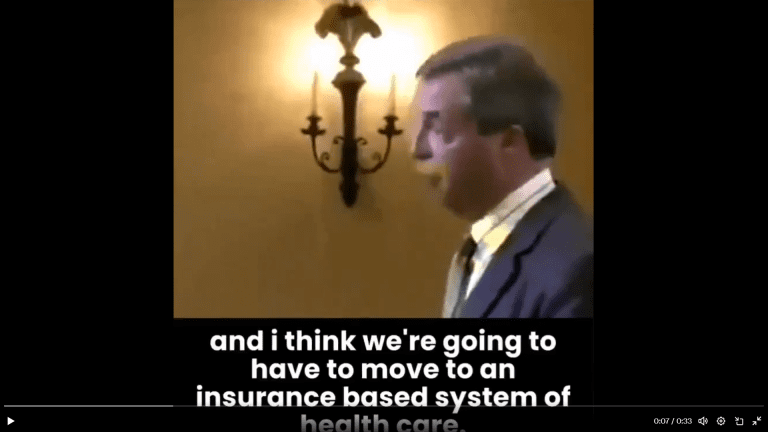
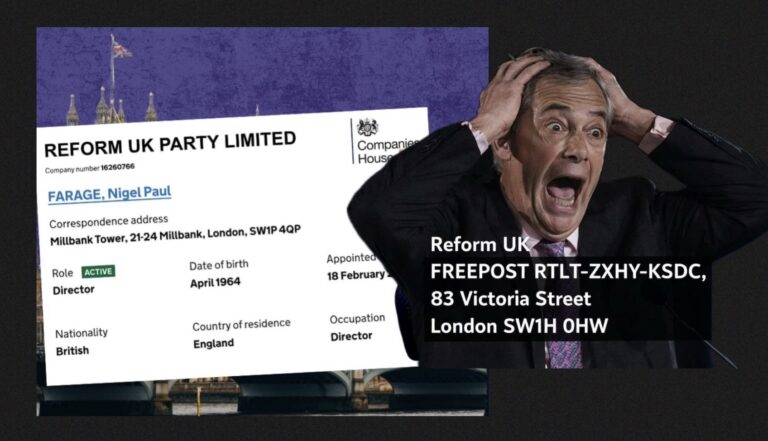
Following Nigel Farage’s Admission, How Much Would it Cost to Get Medical Treatment if Reform UK Gets Power?

The debate over the future of Britain’s healthcare system has been reignited by comments from Nigel Farage, who has suggested that an insurance-based model, closer to that used in the United States, could offer an alternative to the current structure of the National Health Service. While such proposals are often framed as pragmatic reform, they carry profound implications for patients, particularly those least able to absorb additional costs.

Farage’s argument rests in part on headline figures: £129 for a GP visit, £1,368 for an A&E visit, and nearly £72,000 for heart surgery. These numbers have been widely challenged, but their real significance lies in what they represent, a shift away from universal access toward a system where healthcare is mediated by ability to pay or insurance coverage. For many patients, that shift would fundamentally alter when, and even whether, they seek treatment.

To understand the potential impact, it is useful to consider a hypothetical price list for common treatments if a US-style, insurance-based system were introduced in the UK. While exact costs vary widely in America, the following figures, converted and simplified, illustrate the scale of charges patients could face:

  • GP appointment: £100–£200
  • A&E visit (without admission): £1,000–£2,000
  • Ambulance call-out: £500–£1,200
  • Broken bone treatment: £2,500–£10,000
  • Childbirth (standard delivery): £8,000–£15,000
  • MRI scan: £1,000–£3,000
  • Cancer treatment (annual): £50,000+
  • Heart bypass surgery: £60,000–£100,000

Even in systems where insurance covers a portion of these costs, patients are often responsible for premiums, deductibles, and co-payments. The result is that healthcare decisions become financial calculations. Someone experiencing chest pain might hesitate before calling an ambulance, a parent might delay taking a child to A&E, and a patient with early symptoms might postpone a GP visit until their condition worsens. These delays can have serious, even fatal, consequences.

Supporters of the current NHS model argue that such scenarios are precisely what the system was designed to prevent. Under the Labour government, ministers have pointed to measurable improvements, including a reduction of 405,000 in waiting lists and faster ambulance response times for heart attack patients. While challenges remain, particularly around waiting times and workforce pressures, these are framed as problems to be solved within the existing framework, not by replacing it.

Critics of Farage’s position warn that an insurance-based system risks entrenching inequality. In the United States, those with comprehensive insurance often receive faster and more extensive care, while uninsured or underinsured individuals face significant barriers. Translating such a model to the UK could create a two-tier system, where access to timely treatment depends increasingly on income.

There is also the question of administrative overhead. Insurance-driven healthcare systems require complex billing infrastructure, claims processing, and dispute resolution mechanisms. This bureaucracy comes at a cost, one that is ultimately borne by patients through higher premiums or reduced coverage. By contrast, the NHS’s single-payer structure is comparatively efficient, directing a greater proportion of funding toward patient care.

Personal experiences further complicate the debate. While some patients cite long NHS waits as evidence of systemic failure, others emphasise the security of knowing that treatment will not result in financial hardship. For many, that peace of mind is not easily quantified but remains central to the value of the system.

The implications of Farage’s proposal are therefore not abstract. They would be felt in everyday decisions: whether to seek help, how quickly to act, and how much financial risk to accept. An insurance-based model does not simply change how healthcare is funded—it changes how it is experienced.

Ultimately, the question is one of priorities. A move toward a US-style system would represent a shift from healthcare as a universal right to healthcare as a conditional service. For patients across the UK, particularly those already vulnerable, that is not just a policy debate, it is a matter of access, security, and, in some cases, survival.

Diane Abbott’s Intervention Leaves Starmer as PM in Name Only

Let’s be clear: the reason Mandelson was appointed by Keir Starmer’s government was because of the government’s alignment and, many would argue, control by outside forces.

However, besides that, Starmer has nowhere to go now. He will ride it out until Labour is trashed in the local elections, and then there will be a leadership contest.

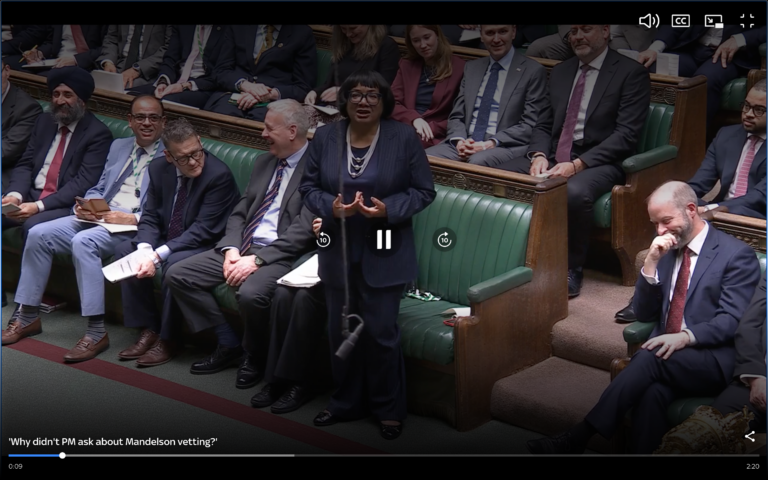
Following this intervention by Diane Abbott, he is prime minister in name only now.

The issue then will be who the external forces will choose for our next PM. I guarantee it will be from the Labour Friends of Israel or someone who is their clandestine puppet.

Mobile Phone Ban in Schools to be Enshrined in Law

The UK government’s decision to make school phone bans a legal requirement marks a significant shift in how classrooms are managed, moving from guidance to enforcement. Under proposals from the Department for Education, schools in England would no longer have discretion over whether to prohibit mobile devices; instead, the ban would carry statutory weight. While the majority of schools already restrict phone use, formalising the rule raises important questions about both its benefits and its potential drawbacks.

Supporters of the policy argue that banning phones can have an immediate and measurable impact on learning. Mobile devices are a well-documented source of distraction, from social media notifications to messaging apps, and their removal from classrooms may help improve focus and academic performance. Teachers often report that lessons proceed more smoothly when students are not tempted to check their screens, and a statutory ban could provide clarity and consistency across all schools, removing ambiguity from existing guidance.

There is also a growing body of concern around the impact of smartphones on young people’s mental health. Excessive screen time, exposure to online bullying, and the pressures of social media are frequently cited as contributing factors to anxiety and low self-esteem. By enforcing a phone-free environment during school hours, proponents believe pupils may benefit from more face-to-face interaction, healthier social development, and a break from the constant connectivity that defines much of modern life.

However, critics of the proposed law argue that a blanket ban may be too rigid. One of the key objections is that mobile phones can serve legitimate educational purposes. Many schools have integrated technology into learning, using apps, online research tools, and digital collaboration platforms. A statutory ban could limit teachers’ flexibility to incorporate these resources into their lessons, potentially hindering innovation in the classroom.

There are also concerns about student safety and communication. Parents often rely on mobile phones to stay in contact with their children, particularly for travel arrangements or emergencies. While schools typically provide alternative means of communication, a total ban could create anxiety for families who feel reassured by direct contact. In rural areas or for students with longer commutes, this issue may be especially pronounced.

Enforcement presents another challenge. Turning guidance into law does not automatically ensure compliance, and schools may face practical difficulties in policing the ban. Confiscation policies, storage arrangements, and disputes with students could place additional strain on already stretched staff. There is also the question of proportionality: whether legal enforcement is necessary for an issue that many schools are already managing effectively on their own terms.

Ultimately, the move to make phone bans statutory reflects a broader debate about the role of technology in education. While the advantages—improved concentration, reduced disruption, and potential mental health benefits—are compelling, the disadvantages highlight the need for flexibility and nuance. A one-size-fits-all approach may not account for the diverse needs of schools and students. As the legislation progresses, its success will likely depend on how well it balances consistency with the practical realities of modern education.

Employing Children Without a Work Permit is Illegal

Part-time work for young people can be a fulfilling introduction to working life, offering an opportunity to gain experience and start earning money of their own.

With April being Child Employment Month, employers, parents, carers and young people are being reminded about the legal protections in place for school-age children who work part‑time.

One of the most important legal requirements is that every school-age child who works must have a valid work permit.

It is the employer’s responsibility to apply for the permit before a young person starts work. The permit is free of charge.

See how to apply

Work permits are issued by us and help make sure jobs are suitable, hours are safe and education is not affected. They are not intended to disrupt business, but to ensure the employer is protected. We aim to process applications within 21 days.

The law covers all young people from the age of 13 until the last Friday in June of Year 11, when they are aged 15 or 16.

Children within this age range can only work if strict rules are followed to keep them safe, healthy and treated fairly by their employer.

Cllr Clare Sutton, Dorset Council’s Cabinet Member for Children’s Services, Education and Skills, said:

“Part‑time work can be a really positive experience for young people, helping them build confidence, learn new skills and get a first taste of the workplace.

“It can also be hugely rewarding for employers, who often tell us that young people bring fresh ideas, energy and enthusiasm to their teams, while helping to build a future workforce with the right skills and attitudes.

“Work permits are not about red tape; they’re about protecting children, supporting employers to do the right thing and making sure education always comes first.”

As part of the process, we check the job details to ensure they meet child employment law. The young person’s school and parents or carers are also asked for input before a permit can be issued.

Employing a child without a permit is illegal. Employers who do so risk prosecution, and their Employers’ Liability Insurance may be invalid.

This means that if an accident happens while a young person is working illegally, there may be no insurance cover in place.

Reform UK Ltd Unmasked Starts Today

It has come to a time when Reform UK Ltd is exposing itself so frequently and the billionaire corporate media is doing its best to hide it from the public that the independent media has to lead the way in exposing them. Many individual articles have been published over the last few of years, but we believe that a more aggregated response is required. Hence, Reform UK Ltd Unmasked starts today.

The individual articles will continue, but each week needs a presentation to the public of exactly what type of people represent Reform UK Ltd and what exactly they are up to. After all, if the public chooses to put them in power, then they must not be able to claim they were ignorant when everything spectacularly falls apart. And it will.

We also need your help. We only have a comparatively small number of pairs of eyes and ears. Whereas the public have 70 million between them, of which just over 50 million are adults. The latest polling suggests less than a quarter are considering voting for Reform UK Ltd., which means three quarters of the voting age population does not want them.

Therefore, please send anything you want published to us at [email protected] and help us to unmask a party set up and funded by billionaires, many of whom are based in other countries.

Let’s start with a biggy from last month:

  1. Convicted Paedophile Was Chosen as a Parliamentary Candidate by Reform UK

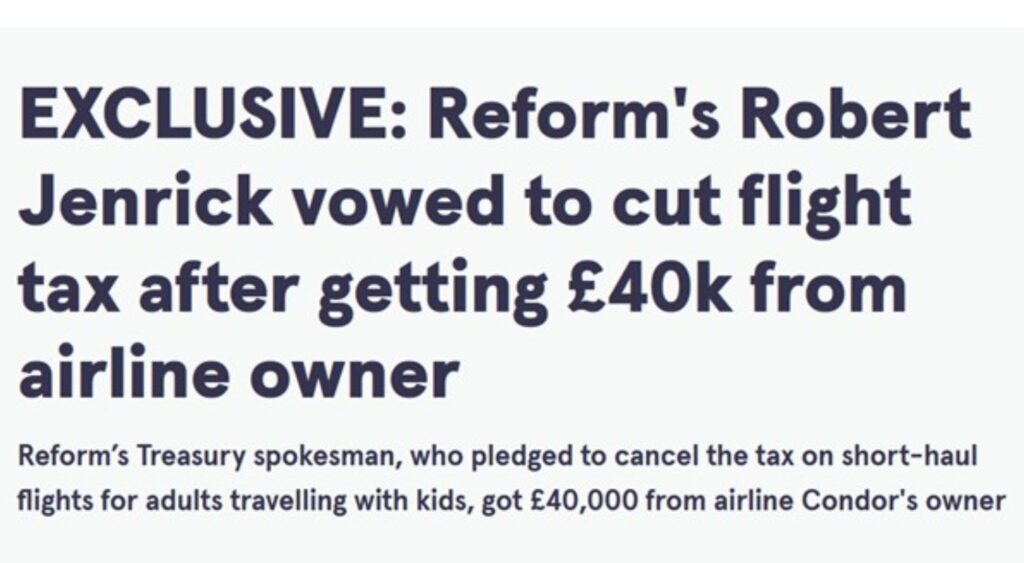
2. Who is Robert Jenrick really working for?

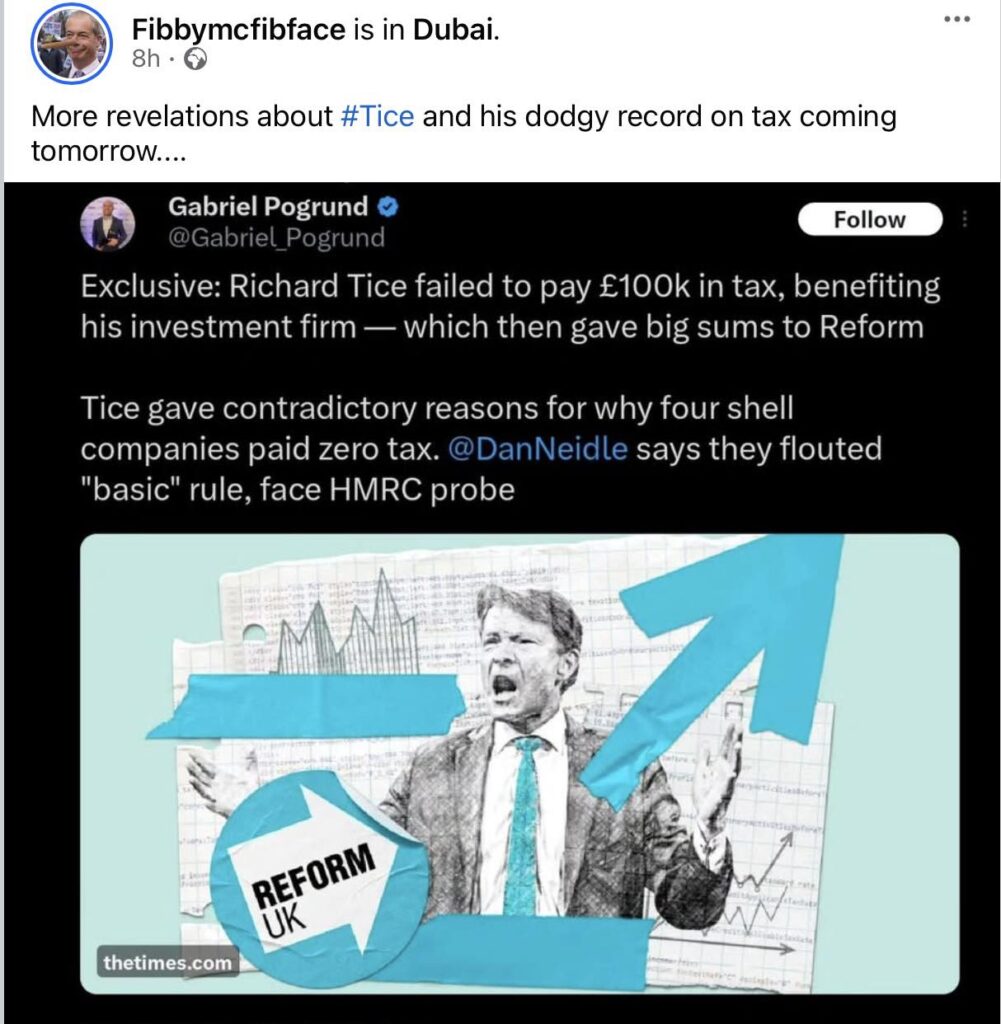
3. Richard Tice and the ‘missing’ £100,000 in corporation tax.

Screenshot

4. How any person with their cerebral cortex attached should respond to Reform UK canvasser

Hi, just checking if you are thinking of voting Reform UK at all?

No, I would rather w**k with a razor.

5. Reform UK promised not to raise council taxes and then raised council taxes

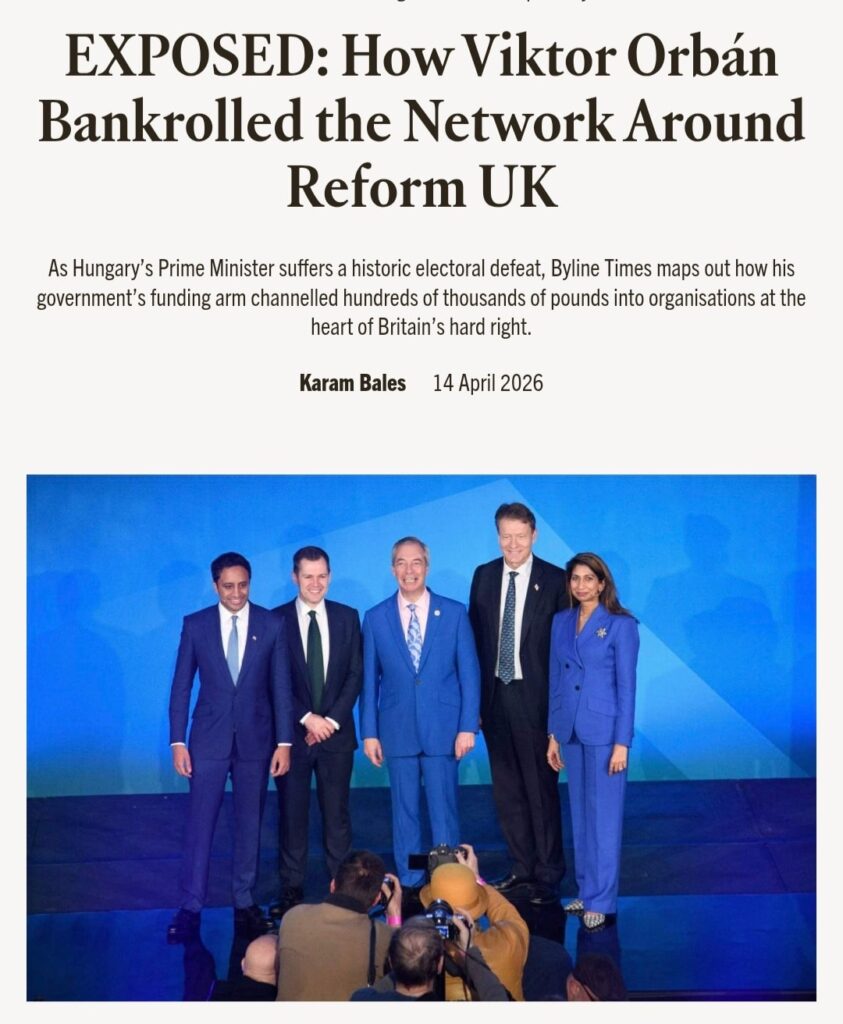
6. Following the Hungarian elections and national and international polling those who Reform UK are parrotting and supported by have and will be exposed and kicked out….

Viktor Orbán’s government pumped hundreds of thousands of pounds into a network of organisations intimately connected to Reform UK’s senior figures. The Hungarian prime minister, who just suffered a historic electoral defeat, used his state‑funded Mathias Corvinus Collegium to channel more than £512,000 into the Roger Scruton Legacy Foundation, where Reform’s head of policy James Orr is a trustee. That money accounted for over 90 percent of the foundation’s total funding.

Orr also chairs the Edmund Burke Foundation, which runs the National Conservatism conferences that have repeatedly held up Orbán’s illiberal regime as a model for British conservatives. The same network overlaps with the Free Speech Union, the Academy of Ideas, and a roster of figures who now populate Reform UK’s shadow cabinet. Toby Young, Douglas Murray, Matthew Goodwin, Suella Braverman, Michael Gove. All have spoken at NatCon. All orbit the same Orbán‑backed infrastructure.

This is not a conspiracy theory. It is a mapped network of financial flows and personal connections, laid out in Byline Times. And it raises a simple question. When Nigel Farage rails against foreign interference, why is his party’s policy chief sitting at the heart of a web woven by a foreign autocrat? The answer is not complicated. The network does not care about national sovereignty. It cares about power. And it has been buying influence in Britain for years.

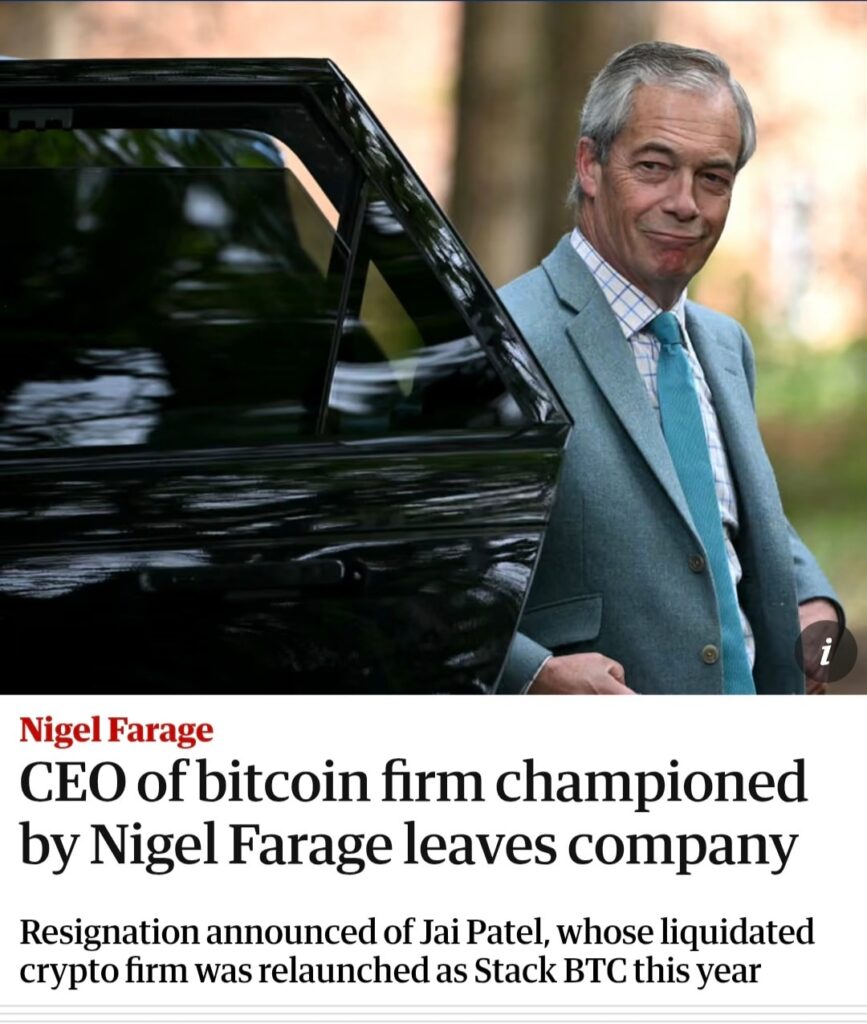
7. The chief executive of Nigel Farage’s pet bitcoin company has quit.

Stack BTC, the crypto venture that Farage and Kwasi Kwarteng launched with great fanfare just last month, is already haemorrhaging credibility. The company’s previous iteration, Kasei Investment Holdings, was liquidated last year after burning through millions of investors’ cash. Now its founder and CEO, Jai Patel, has walked away. The renamed venture promises “long‑term value”. The evidence suggests otherwise.

Farage invested £215,000 and has already seen a paper gain of more than £200,000. That is the beauty of crypto. You do not need to build anything. You just need to persuade enough people to buy in before you cash out. The company’s new CEO is a former real estate executive with no obvious crypto expertise. The old CEO has been shuffled off but remains a “significant shareholder”. The whole thing has the unmistakable whiff of a PR stunt dressed up as a business plan.

One industry expert put it bluntly. “The fact it’s got Kwasi and Farage tells people like me: ‘Don’t invest in it.’” Another noted that Farage is simply following the Trump playbook, using crypto to court donors while pretending to be a champion of innovation. The only thing missing is a branded hat and a promise to make everyone a millionaire. But give it time. The grift is still young.

8. Nigel Farage seems to think he can just say “I didn’t say that”, even when there’s video of him saying it, and people will forget.

The NHS isn’t safe in Reform UK hands.

9. Reform UK’s purpose is merely to harvest anger and convert it into donations

Forget the Country Needs a Reform. Reform UK Is the One That Needs Fixing

Let us get one thing straight from the outset. The slogan “Reform Will Fix It” is one of the most unintentionally hilarious pieces of political marketing since someone decided that “Strong and Stable” sounded like a description of a garden shed rather than a prospective prime minister. Because here is the thing. The country might need reform. It probably does. But Reform UK, the party of Nigel Farage, the vessel for every disgruntled pub bore and online conspiracy theorist from Clacton to Carlisle, is not the vehicle to deliver it. Reform UK itself is the project that needs fixing. It is a leaking, spluttering, backfiring banger of a political movement held together with duct tape, optimism, and the desperate hope that nobody looks too closely at the accounts.

The Man at the Top

Let us start with the obvious. The party is led by Nigel Farage, a man who has been a professional politician for over two decades but still somehow manages to present himself as an anti establishment outsider. This is the political equivalent of a man who has spent thirty years working for the railway company complaining that the trains are always late while standing on the platform in full uniform holding a season ticket. Farage has been an MEP, a GB News presenter, a reality TV contestant, and now an MP. He has drawn a salary from the European Parliament, a salary from a television channel, and donations from mysterious offshore billionaires. He is not a revolutionary. He is a career politician who has simply found a more lucrative niche than the one he started in.

And his record on actually fixing things is, shall we say, unimpressive. He spent years campaigning for Brexit, got it, and then promptly disappeared to appear on I’m A Celebrity, leaving the rest of us to deal with the consequences. He has been trying to become an MP since 1997. He finally succeeded in Clacton, a seat that was previously held by a UKIP MP who defected from the Conservatives, which tells you everything you need to know about the calibre of the competition. He is the human equivalent of a timeshare salesman. Charismatic, plausible, and absolutely not someone you want to be left alone with your savings.

The Membership

Then there is the membership. Reform UK has successfully positioned itself as the party of the angry, the disenfranchised, and the vaguely racist. But a quick glance at its internal workings reveals a party that is less a serious political force and more a fan club for one man. Farage owns the company behind the party. He is not just the leader. He is effectively the sole shareholder. The party has no real internal democracy. Dissent is not tolerated. Anyone who steps out of line is either purged or resigns in a huff, usually taking their grievances to the press, where they are greeted with the same level of interest as a mildly damp firework.

The membership numbers, while impressive on paper, are notoriously flaky. Many of the party’s supposed supporters are actually disaffected Tories who have temporarily parked their loyalty elsewhere. They are not true believers. They are voters who are cross about the state of the NHS and the cost of living and have decided that the answer is to vote for the man who spent years telling them that the European Union was the source of all their problems. The moment the Conservatives get their act together, or the moment Farage says something particularly indefensible, these voters will drift back. They are not a movement. They are a weather vane.

The Policies

What does Reform UK actually stand for? This is a harder question to answer than it should be. The party’s manifesto, such as it is, reads like it was written by a committee of people who have just discovered the internet. There is a lot about cutting taxes, a lot about stopping the boats, a lot about taking back control. There is very little about how any of this will be achieved without bankrupting the country or violating international law. The party’s economic policies have been described by credible economists as “a lottery ticket masquerading as a savings account”. Its immigration policies are unworkable. Its foreign policy seems to consist of being friends with Donald Trump and Vladimir Putin simultaneously, which is a bit like trying to be friends with both the Hells Angels and the police.

The party’s flagship slogan, “Reform Will Fix It”, is so vague that it could be applied to absolutely anything. Broken toaster? Reform will fix it. Leaky tap? Reform will fix it. Existential dread about the state of modern politics? Reform will definitely, absolutely, without a shadow of a doubt fix it. The slogan is a masterpiece of empty branding, the political equivalent of a shampoo bottle that promises “volume and shine” without explaining how. It means nothing. That is its genius. It cannot be disproven because it makes no testable claims.

The Scandals

And then there are the scandals. No self respecting populist party is complete without a few scandals, and Reform UK has delivered in spades. There was the candidate who had to be disowned after it emerged he had made a string of offensive comments online. There was the donor who turned out to be a mysterious offshore billionaire with a changed name and a fondness for cryptocurrency. There was the councillor in Worcestershire who had to apologise after it emerged that the party’s tax cutting promise had somehow resulted in the largest council tax rise in the area. It is almost as if populism is easier to promise than to deliver. Who could have guessed?

The party’s relationship with the truth is, shall we say, flexible. Farage has spent years railing against the “fake news” media while simultaneously building a media empire of his own on GB News, a channel that makes the Daily Express look like the Economist. The party’s social media presence is a swamp of conspiracy theories, misleading statistics, and outrage bait. It is a machine designed not to inform, but to enrage. And it works. Anger is addictive. Outrage is profitable. Reform UK has built a business model on the back of other people’s misery. It is not a political party. It is a content farm with a mailing list.

The Verdict

So here is the truth that nobody at Reform UK wants to hear. The country does not need Reform. Reform UK needs reform. It needs a leader who has not spent three decades in the political establishment pretending to be an outsider. It needs a membership that is more than just a collection of temporarily embarrassed Tories. It needs policies that go beyond slogans and vibes. It needs to stop treating its donors like ATMs and its supporters like fools. It needs to grow up. It needs to get serious. It needs to realise that running a country is not the same as winning an argument in a pub.

But of course, that is not going to happen. Because Reform UK is not designed to fix anything. It is designed to complain. It is designed to oppose. It is designed to harvest anger and convert it into donations. The moment it actually had to govern, to make difficult choices, to balance budgets and negotiate treaties and deal with the messy reality of running a modern nation state, the whole thing would collapse. It would be like asking a TikTok influencer to perform open heart surgery. The results would be entertaining, briefly, and then catastrophic.

So by all means, vote Reform if you want to make a point. If you want to stick it to the establishment. If you want to feel, just for a moment, that your anger has found a home. But do not expect them to fix anything. Because the only thing that needs fixing is them. And frankly, that is a job for a much better class of mechanic.

10. Exposing 30p Lee Anderson on a walkabout

11. The Brexit nightmare Reform UK will not admit to

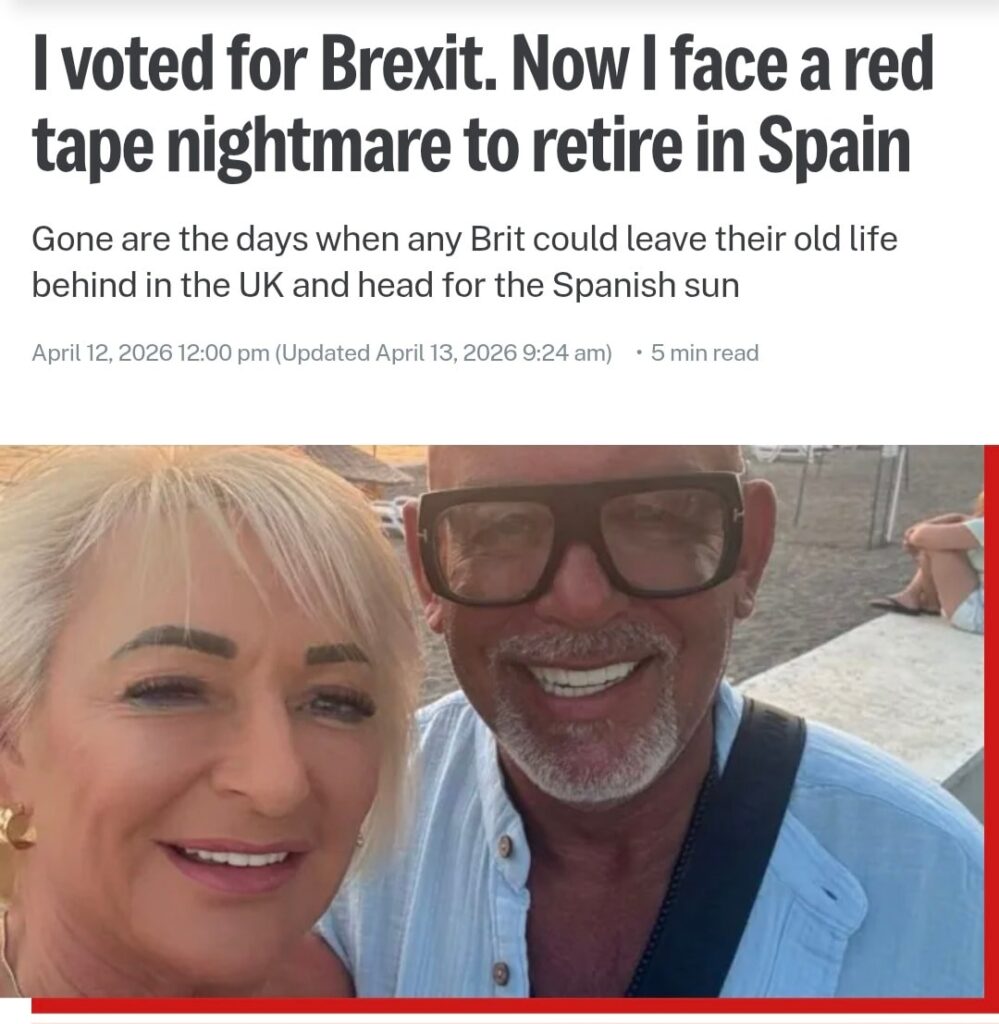
Neil Harrington voted for Brexit. Nearly a decade later, he is approaching retirement and hoping to spend it in Spain. His father did exactly that in the late 1990s, selling his house and moving to a new home the next day, no forms, no visas, no fuss. Neil now faces a bureaucratic nightmare that did not exist when he cast his vote. The 90‑day limit, the €500 visa fee, the €28,800 income requirement, the private health insurance, the criminal record check, the WHO disease screening. The dream of retiring to the sun is now reserved for the wealthy.

Harrington admits responsibility. “It is what it is,” he says, with a resignation that will sound familiar to millions who believed that leaving the European Union would simplify their lives. Instead, the red tape has multiplied. The freedom of movement that once allowed any Brit to pack up and go has been replaced by a system that filters by income and luck. The irony could not be sharper. The man who voted to take back control has discovered that control now belongs to the Spanish visa office. And the country he wanted to free from Brussels has left him trapped in paperwork.

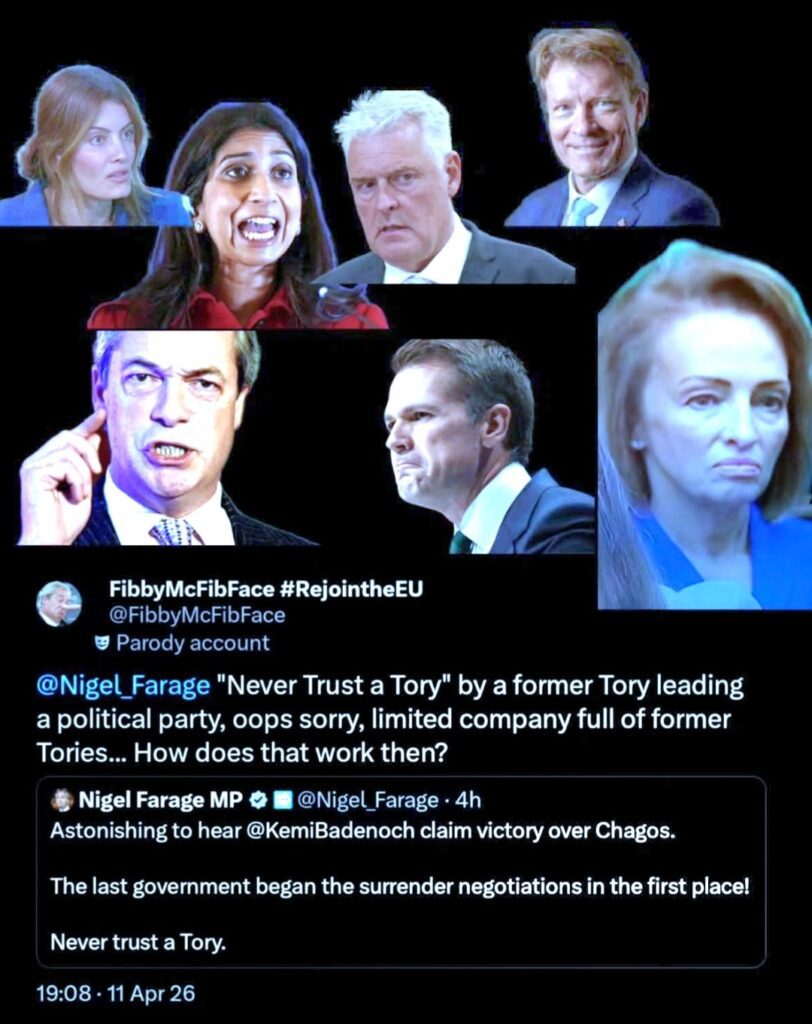
12. Apart from Farage, all apart from one were in the last government and supported the deal

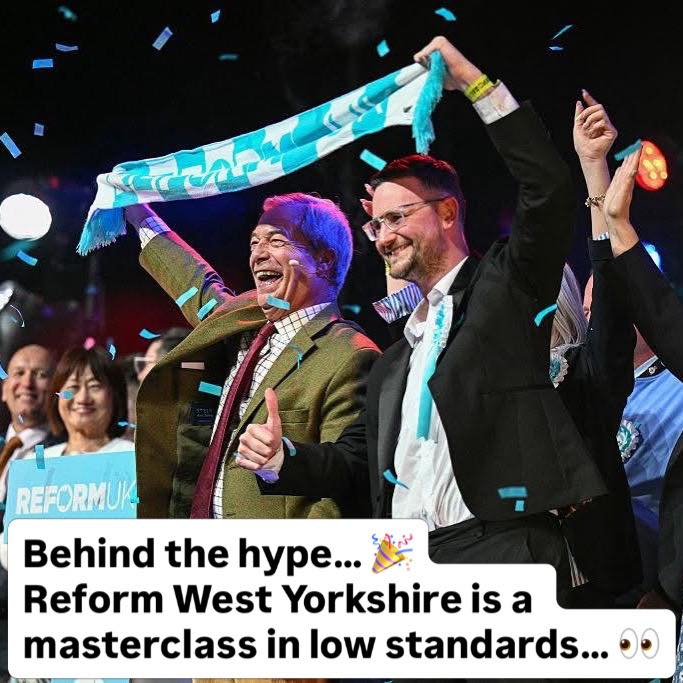
13. Reform UK are a masterclass in low standards

Reform rolled into Leeds recently claiming they’re inevitable, unstoppable, the future of Yorkshire politics.

Sounds great on stage. Reality looks very different.

Let’s start with vetting, because it’s clearly not working.

Reform have a candidate in Middleton Park – James Kendall – who is currently facing an individual voluntary arrangement for insolvency. That raises a simple question: how can someone be trusted to make decisions about public finances when they can’t manage their own? It’s not personal, it’s about judgment and responsibility.

And it’s not just one case.

In Bradford, candidate Daniel Devaney has faced backlash over past posts, including comments about “blasting” followers of Islam and calling Muslims offensive names. That’s exactly the kind of thing proper vetting should catch.

Then there’s what’s happening behind the scenes…

Insiders tell us they have raised repeated concerns about how Reform is being run in West Yorkshire, describing a dysfunctional operation with allegations of bullying, toxic culture, lack of transparency, and people acting without accountability.

These concerns were escalated. More than once.

And seemingly ignored.

Worse still, there are claims some individuals were shielded from scrutiny, whilst those who spoke up? They’re no longer around. 🚪

If that sounds familiar, it’s because former Reform members in other branches have described the same pattern.

So while Reform talks about momentum in Leeds, serious questions remain about standards, accountability, and integrity.

Reform can sell the story. But buyer beware.

14. Don’t earn more money by going to university says Reform UK’s Suella Braverman

Suella Braverman doesn’t think university is for everyone. Fair enough, that’s a debate worth having.

But it’s a bit rich coming from someone who went from an elite private school to Queens’ College, Cambridge, then on to Panthéon-Sorbonne University. That’s not just “went to uni”, that’s the gold-plated academic route 

And now the message is that maybe university isn’t the right path for most people. Of course not. 

Except on average, men who go to university are expected to be £130,000 better off, and women £100,000 better off over their working lives, after taxes and student loan repayments.

There is a real conversation to be had about apprenticeships, skills, and alternatives, but it only works if those routes are properly funded and treated as equal, not quietly positioned as second best.

Otherwise it starts to feel like the classic ladder-pulling move. Get to the top, then tell everyone else to aim a bit lower 

So when the leaders of parties like Reform UK say they’re on your side, it’s worth asking a simple question…

Are they actually expanding your options, or just narrowing them while dressing it up as “common sense”? 

See you next week.

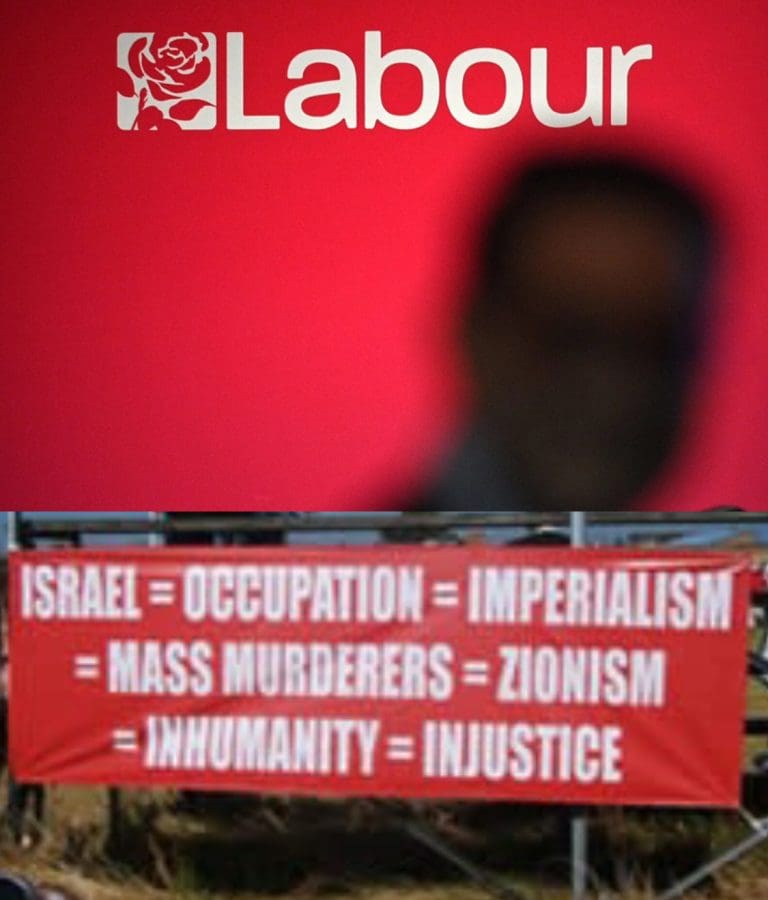
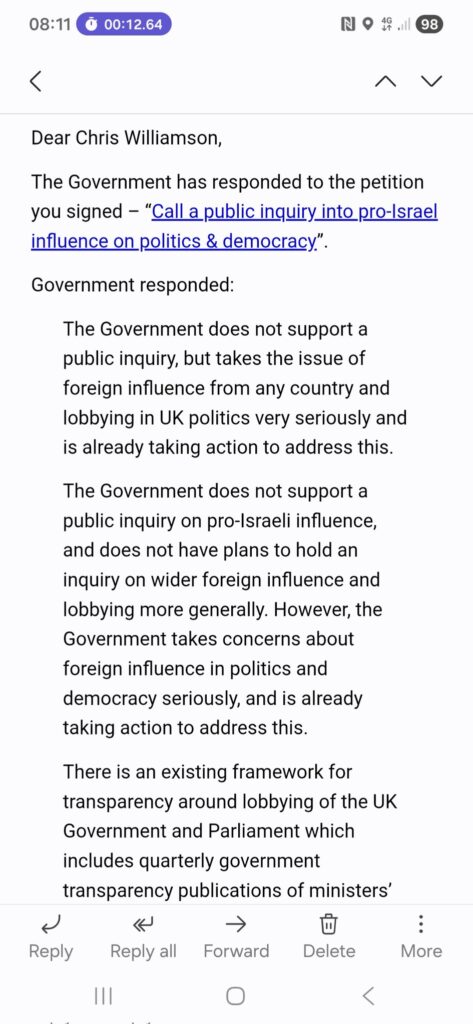
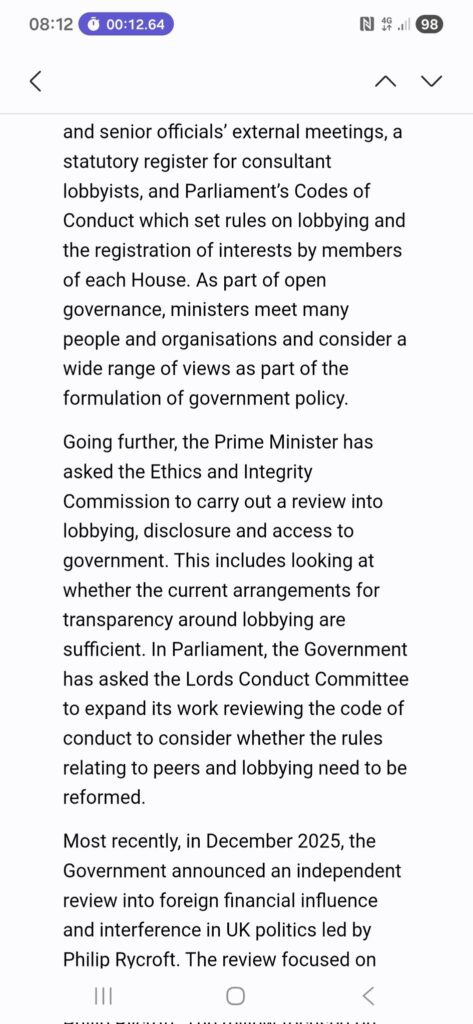
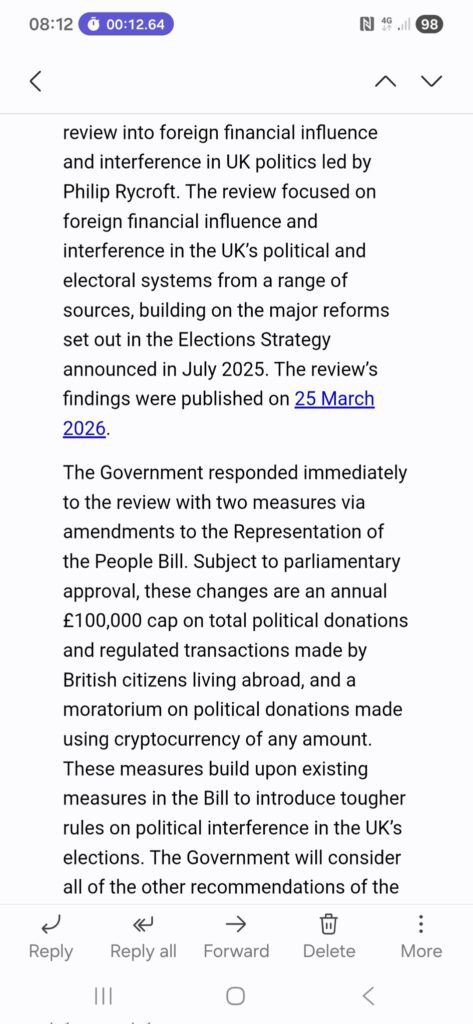
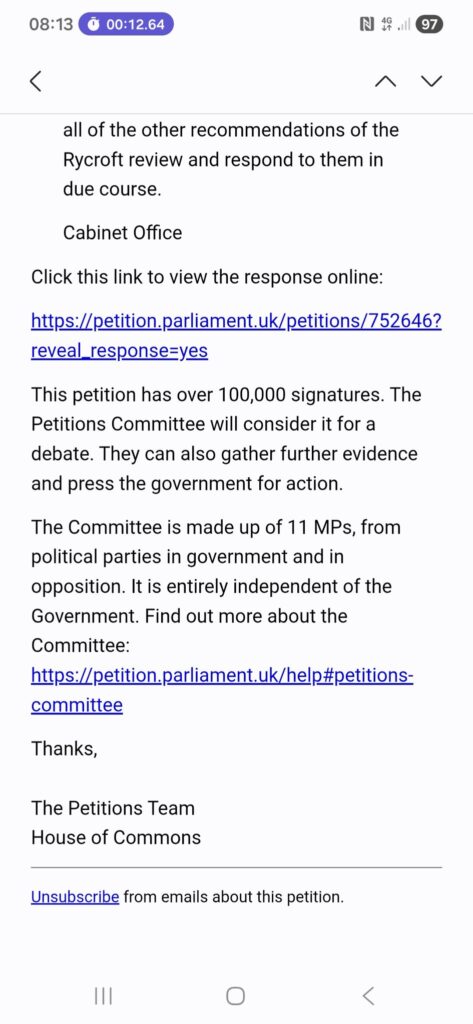
Zionist Labour Government Rejects Public Inquiry into Pro-Israel Lobbying Despite 113,000 Signatures

Those of us who describe the current Labour government as “Zionist” are usually pointing to its consistently strong alignment with the state of Israel in rhetoric and policy under Keir Starmer. This includes firm support for Israel’s right to defend itself, reluctance to impose meaningful sanctions over actions in Gaza or the West Bank and a broader effort within Labour to distance the party from the more critical stance it held under previous leadership. The leadership has also taken a hard line against pro-Palestinian voices within the party, which opponents argue reflects an ideological shift toward prioritising pro-Israel positions in both domestic politics and foreign policy.

Thus, the refusal by the UK government to launch a public inquiry into alleged foreign-linked influence in British politics is not surprising and increasingly looks less like confidence in existing safeguards and more like an unwillingness to test them. When Andy Kalil launched his petition in January 2026, he pointed to concerns about the role of pro-Israel lobbying and funding networks in shaping UK policy during the ongoing crisis involving Israel, Gaza, and the West Bank. The government’s rejection on April 17, citing transparency rules and reforms such as those stemming from the Rycroft Review, has done little to settle those concerns.

Critics, including former MP Chris Williamson, argue that the real issue is not whether donations are declared but whether their cumulative effect shapes political behaviour. UK electoral law already requires that donations come from permissible UK sources, meaning direct foreign state funding is prohibited. However, this does not prevent UK-based individuals, companies, or advocacy groups with strong political affiliations or foreign policy interests from making significant contributions.

An inquiry, if held, would likely examine several well-documented areas. One is the role of established lobbying and advocacy organisations such as Conservative Friends of Israel and Labour Friends of Israel, both of which maintain close relationships with MPs, organise delegations, and facilitate engagement with Israeli officials. Their activities are not secret, but the scale of their access and influence could come under closer scrutiny in a formal investigation.

It would also likely look at high-profile political donors who have publicly supported pro-Israel causes alongside their contributions to UK parties. Figures such as Trevor Chinn, a longstanding donor to Labour and supporter of pro-Israel initiatives, and Poju Zabludowicz, who has contributed to Conservative causes and Israel-related organisations, are often cited in discussions about the intersection of political funding and foreign policy interests. Any inquiry would not assume wrongdoing but would examine patterns: how frequently such donors contribute, to whom, and whether those contributions correlate with access or policy alignment.

Beyond individuals, scrutiny could extend to think tanks and policy institutes that help shape the intellectual climate around foreign policy. Organisations like the Henry Jackson Society have been influential in debates on security and Middle East policy, and questions have occasionally been raised about funding sources and ideological alignment. Again, these are matters of public record, but not always of public understanding.

Crucially, an inquiry would not be limited to one country or political cause. It would likely place pro-Israel advocacy within a broader ecosystem of foreign policy influence, comparing it with lobbying linked to other states and interests. The key issue would be transparency versus impact: whether the current system, while technically compliant, allows well-connected networks, of all kinds, to exert disproportionate influence over political discourse and decision-making.

The government insists that mechanisms such as donation caps, disclosure requirements and lobbying registers are sufficient. But those tools primarily track what is legal and declared. They are less effective at illuminating how influence actually works in practice, through relationships, access, and sustained engagement over time.

That is the gap an inquiry would attempt to fill. And it is precisely that deeper level of scrutiny, mapping influence not just as a set of transactions but as a system, that makes the government’s refusal so politically charged. The concern is no longer simply about what an inquiry would examine but about whether the current system can withstand that level of examination at all.

The Government’s Response

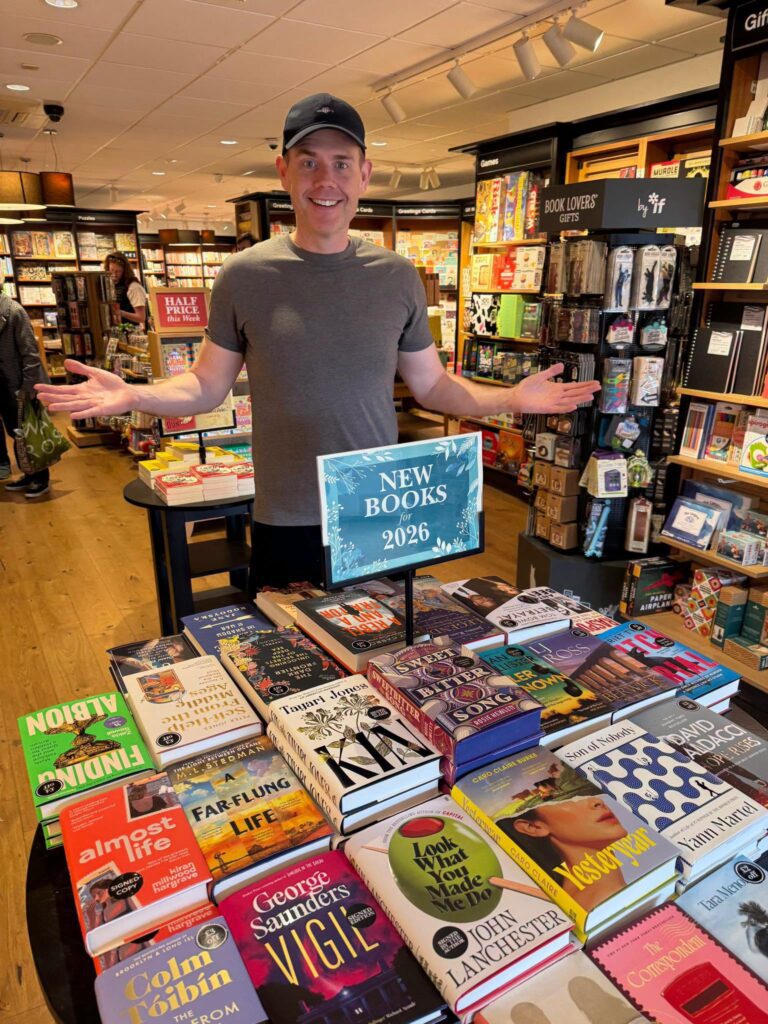
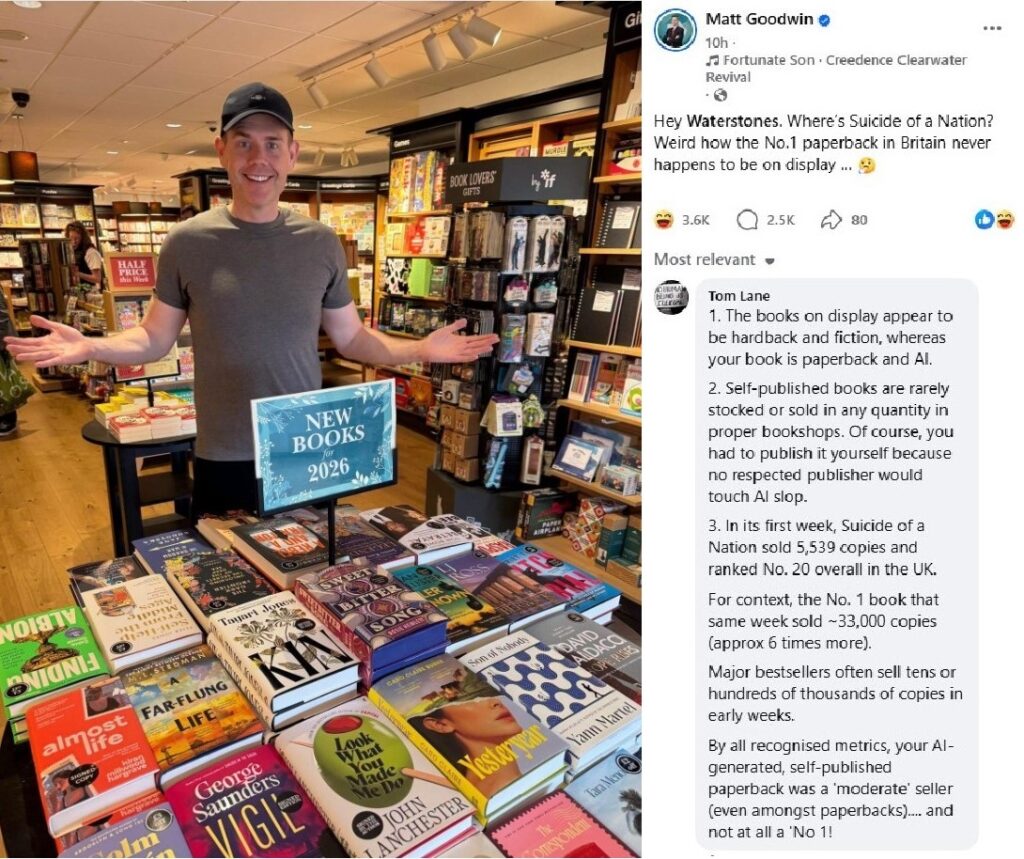
Matthew Goodwin Cannot Find His ‘AI-Generated Self-Published Book’ in Waterstones and the Comments are Hilarious

Let us start here to set the scene.

If one stands in Waterstones appealing to people who can only read short words written in big print, then is it any wonder that intelligent people will make mincemeat of you? Of course not.

Jack Dart

‘Look for the AI section; it’s probably there.’

Stewart Osborne

“Why isn’t an allegedly non-fiction paperback included in this display of fiction hardbacks?”

“Is this your first time in bookshop?” 

Joey Palmer

“Hello, I know you may think that as a reform voter I am illiterate, but actually I would very much like to read Matt Goodwin’s new AI-written book, ‘Mein Kampf for Dummies.'”

Caroline Ni Chinneide

“No thanks, I can read ChatGPT-generated slop off my own phone without spending money.”

Phill Smith

“Does someone want to tell him he’s standing by the hardback section, so he probably won’t find his paperback there?”

Paul Boland

“I’m surprised you didn’t just ask ChatGPT.”

Two Mugs, A Brew, And Some Geese

“I applaud any company that takes a stand against AI slop.” 

John John

“Try looking in the fiction section”.

Stewart Osborne

“…Remember the old adage: never interrupt your enemy when he is making himself look like a massive bellend”. 

Kevin Michael McEvoy

“1- it isn’t the number 1 paperback

2 – Waterstones don’t put books written by AI on shelves

3- You are standing in the hardback section”.

Matthew Smith

“The last time I checked, Waterstones doesn’t sell toilet paper.”

Julia Gti

“It reminds me of that JR Hartley advert.”

Richard Briant

“I’m sure they prefer books written by humans.”

James McRobert-Thompson

“I smell a pulping coming along.”

And so it continues into infinity…

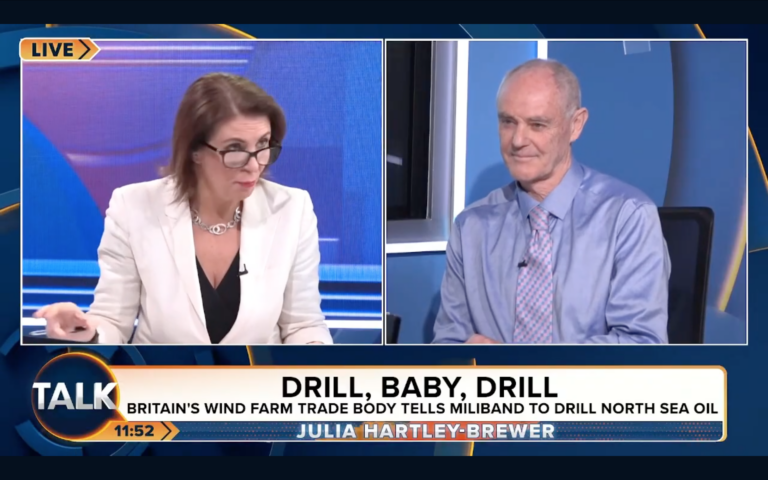
Julia Hartley-Brewer is a Stooge For Fossil Fuel Companies and Her Arguments are Six Decades Out of Date

I TOLD JULIA HARTLEY BREWER THAT “YOUR ARGUMENT IS FROM THE 1960’S !

YOU WANT TO KEEP US ADDICTED TO AN OIL ECONOMY THAT THREATENS BRITAIN’S NATIONAL SECURITY!”

As director of the Climate Media Coalition, I was invited onto Talk TV’s Jullia Hartley Brewer’s show to discuss Ed Miliband’s call for a faster clean energy transition in light of the Israeli war on the Iran oil crisis.

(Please do not forget to sign our petition to get rid of billionaire media – see note/link at the end!)

Hartley Brewer hilariously claimed, “Ed Miliband is taking us back to the caves with solar and wind”.

Brewer pointed out that the Renewables UK spokesperson said the fossil fuel price crisis indicated we should drill more.

I replied, pointing out that this spokesperson was a former Shell lobbyist and the huge oil corporation Statoil/Equinor is on her board in Britain.

I said Britain is being hammered again with an oil crisis and the urgent need to wean us off the addiction to oil is the lesson of these regular Israeli oil price crises.

Brewer intervened to say the lesson rather is we should do more oil drilling.

But I pointed out that the United States (and Norway) are self-sufficient in oil, but their drivers are still being hammered at the gas station as their oil costs also soar.

It is the oil corporations that profiteer hugely, and consumers pay the punitive prices in these crises, no matter whether the oil is drilled domestically or abroad.

I then stated that the cost to the Uk economy of the last oil crisis, caused by Russia, according to the UK’s Climate Change Committee was £100 billion.

£70 billion was the cost for taxpayers subsidising fossil fuels for consumers and £30 billion was the cost to the wider economy .

The Climate Change Committee says the cost of the clean energy transition investment would be £100 billion by 2050, i.e., the cost of just one Israeli oil price crisis!

But instead of the money being squandered subsidising burning fossil fuels. The money is instead invested in renewables that give free energy for decades and free us from oil market shocks.

I gently told Brewer that her argument is from the 1960s. She wants to keep us addicted to an oil economy that threatens Britain’s national security.

This is a fuel that has hammered us every 10 years with repeated oil crises in the Middle East.

North Sea oil peaked in 1989. It is an old mature field that now produces only expensive oil and gas.

It is a national disgrace that 1.5 million rural households in Britain are still dependent on oil 50 years after the first Israeli oil crisis.

These families are being hammered again because we have not switched them to electric heating.

I finished by saying “ I do not personally worry about an oil crisis because my home electricity is free due to the solar and battery system I have invested in. For 10.5 months it is also free at night due to my battery. I want that for every household in the UK.”

We need an inflation-proof clean energy system.

And that is what Ed Miliband is advocating for. (On renewables and storage, that is, not on his mad nuclear and carbon storage Tory proposals, which are riven with inflation and technical impossibilities!!).

Please tap the YouTube Subscribe button to join our You Tube Channel and get notified when we post our next videos.

END BILLIONAIRE MEDIA!!

The billionaire media are in a frenzied propaganda campaign to stop the oil crisis accelerating the clean transition that UK consumers need to protect them from future oil shocks.

They are screaming, in effect, “Drill Monsters Drill!”

Help us end billionaire media!

Please sign and share our Parliamentary Petition to ban billionaire media:

Yes, We Can!!

Love and courage

Donnachadh x

Racists are Rushing to Judgements on Asylum Seekers that are not Backed up by Facts, Police Say

Don’t let those who spread fake news for their own ends poison the debate or our society

‘That whole Epsom situation is a clusterfuck, and the far right really needs to stop using these sorts of crimes as fuel for public piss-ups and to target brown people and asylum seekers.

I hope the woman who reported it is ok, and I really hope the actions of Fanny Dumbo and the rest of his ilk didn’t jeopardise any investigation. Whether there was an attack or not, I’m not even sure myself, tbh; that’s the main reason I haven’t mentioned anything about it on the page until now.

The comments I’m seeing from dickheads across social media are absolutely insane. Not even a rough description had been released, but of course immigrants were being accused. It’s as if white men in the news daily being sent down for attacking women is not a thing and is being willfully ignored.

Every day, I see a 10/1 White man/immigrant of some description being jailed for some heinous shit, and this is not just UK news; it’s worldwide. Why do white people get so much leeway and little outrage for their crimes and wrongdoings, but when it’s a brown person, the whole community is blamed? All these “black fatigue” comments and shit like that when it’s white people who have been fucking the planet up and ruining everyone’s shit and instigating wars for millennia?

Jokers.’

The rush to judgement following reports of serious crime is as predictable as it is damaging. In the wake of a police investigation in Epsom, where a woman in her 20s alleged she had been raped outside a church, a familiar and troubling pattern has emerged: speculation, rumour, and the rapid targeting of asylum seekers and immigrants as presumed culprits, despite no evidence to support such claims.

Surrey Police have been clear. After reviewing CCTV, interviewing witnesses, and conducting forensic enquiries, officers have stated that they have not found evidence to support the offence as reported. Crucially, they have also explicitly confirmed there is no evidence linking asylum seekers or immigrants to the alleged incident. Yet they say this has not stopped a wave of online misinformation or the mobilisation of protestors driven by little more than suspicion and prejudice.

What unfolded in Epsom this week is not an isolated reaction but part of a broader societal problem. In moments of uncertainty, particularly involving allegations of violent crime, there is a segment of public discourse that defaults to blaming already marginalised groups. This instinct is not rooted in fact but in bias. It reveals how quickly fear can be weaponised and how easily narratives can be shaped by those with ideological agendas rather than evidence.

The protest itself, reportedly promoted by figures linked to far-right activism, underscores how these situations are often exploited. Demonstrators gathered, roads were blocked, and tensions escalated—not in response to confirmed details, but to rumours circulating online. The absence of verified information became a vacuum filled by assumption, and that assumption disproportionately targeted migrants. This is not accountability; it is scapegoating.

Such reactions carry real consequences. They deepen divisions within communities, foster hostility, and place innocent people at risk of harassment or worse. Asylum seekers, many of whom have fled violence and persecution, are too often recast as threats based on nothing more than their status or background. When public discourse leaps ahead of facts, it undermines not only those individuals but also the integrity of justice itself.

There is also a broader danger in eroding trust in due process. Police investigations take time, particularly in complex or sensitive cases. The demand for instant answers, coupled with suspicion of official statements, creates fertile ground for misinformation. When people choose to believe speculation over verified updates, it weakens the role of evidence in public life. Justice cannot function in an environment where conclusions are drawn before facts are established.

None of this is to diminish the seriousness of the original allegation. Claims of sexual assault must always be treated with gravity and care. But seriousness also demands responsibility, responsibility in how information is shared, how communities respond, and how narratives are formed. Jumping to racially charged conclusions does nothing to support victims or aid investigations. Instead, it distorts the situation and diverts attention from the truth.

What is needed is restraint, critical thinking, and a commitment to fairness. Waiting for verified information is not weakness; it is the foundation of a just society. Condemning entire groups based on unproven claims is not vigilance; it is prejudice.

The events in Epsom should serve as a stark reminder: when fear overrides fact, the consequences extend far beyond any single incident. If we are serious about justice, we must be equally serious about rejecting the knee-jerk racism that too often accompanies it.

The Top 15 Facts that Anti-Immigration Campaigners Get Wrong:

“Most immigrants are here illegally.”
In reality, the majority of immigrants in the UK arrive through legal routes e.g. work visas, student visas, or humanitarian protections.

“Asylum seekers get luxury treatment.”
Asylum seekers typically receive very basic support, often below the standard welfare level, and are not allowed to work while their claims are processed.

“Immigrants take jobs from locals.”
Evidence generally shows immigration has little to no negative impact on overall employment. In many cases, migrants fill labour shortages.

“Immigration drives down wages.”
Any downward pressure tends to be small and limited to specific low-wage sectors, not the workforce as a whole.

“Immigrants don’t pay taxes.”
Most migrants pay income tax, VAT, and national insurance, contributing significantly to public finances.

“They come just for benefits.”
Studies consistently show that work, safety, and family are the main motivations, not welfare.

“Crime is higher among immigrants.”
There is no consistent evidence that immigrants commit more crime than native-born citizens; in some cases, rates are lower.

“The UK takes more than its fair share of refugees.”
Compared to many countries, especially those bordering conflict zones,

the UK takes a relatively modest number.

“Asylum seekers can choose any country they want.”
In practice, people often have limited choice due to routes, family ties, language, or immediate safety.

“Most asylum claims are fake.”
A significant proportion are accepted at initial decision or on appeal, showing many claims are legitimate.

“Immigrants don’t integrate.”
Over time, most migrants learn English, work, and become part of their communities.

“They strain public services without contributing.”
While population growth does increase demand, migrants also work in and support those same services—especially in healthcare and social care.

“Stopping immigration would fix housing shortages.”
Housing issues are largely driven by supply constraints and policy decisions, not immigration alone.

“Small boat arrivals are the majority of immigrants.”
They make up a small fraction compared to those entering through legal visa routes.

“Immigration is uniquely out of control.”
Migration levels rise and fall over time and are influenced by policy choices, global events, and economic needs—not simply a lack of control.