

Check out Iris. A perfect embodiment of someone who finds reality too hard to swallow and prefers the lies and fiction of right-wing ‘populism’.
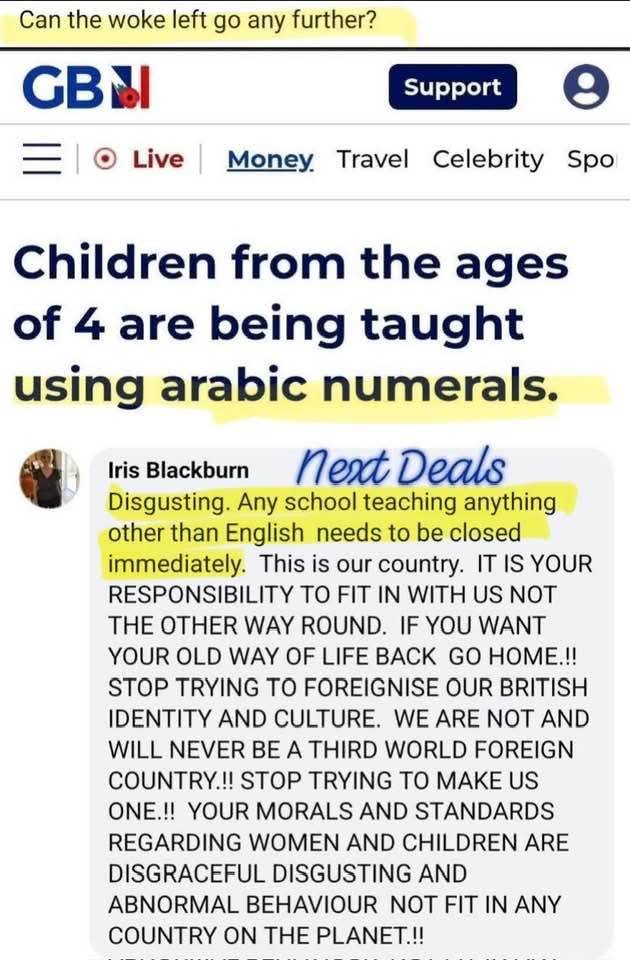
To take Iris’ demands to their logical conclusions, that would be every school in the country and across the world too (the ones where British immigrants learn).
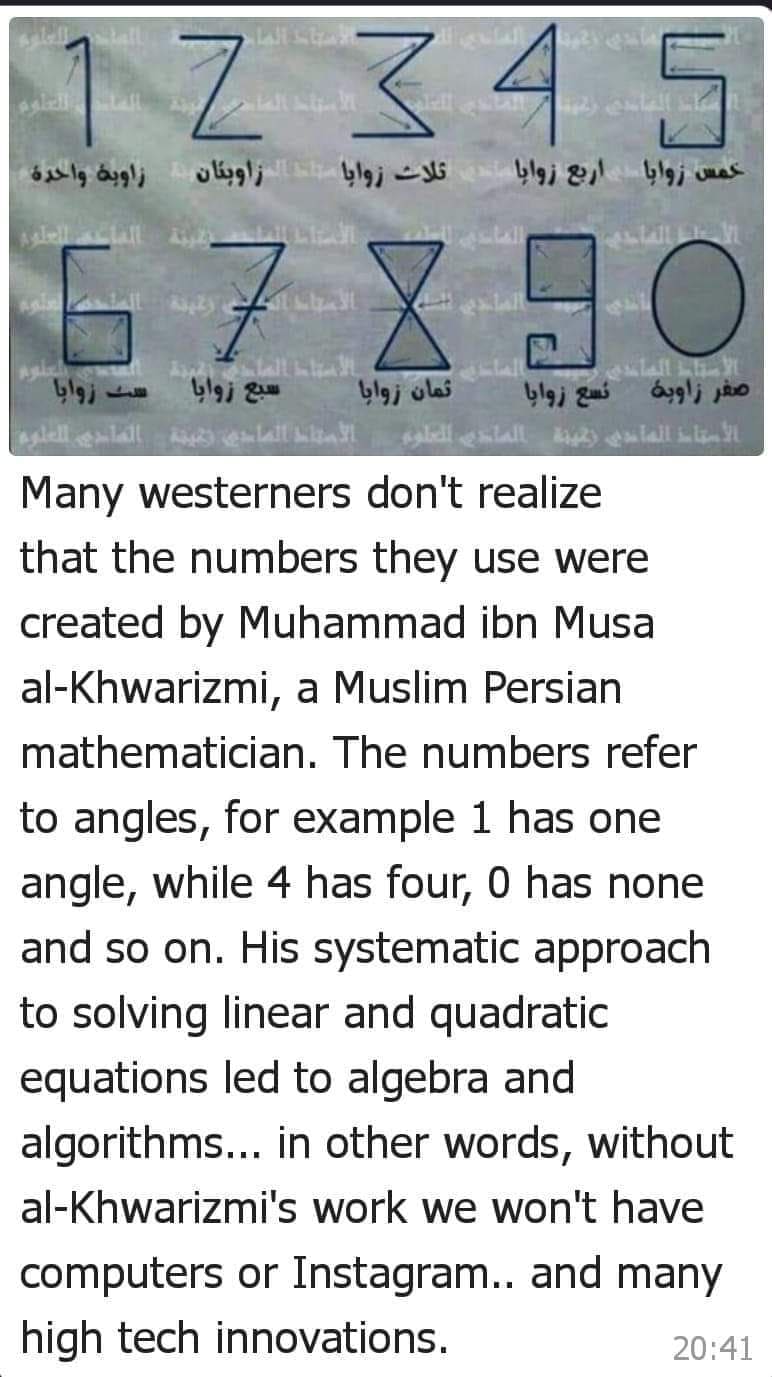
For Iris and all those similar to her, let us have a quick lesson in the origins of numbers.
The number system we use today, often called the decimal or base-10 system, has its deepest roots in ancient India. As early as the first millennium CE, Indian mathematicians developed a sophisticated way of writing numbers using place value, where the position of a digit determines its value (units, tens, hundreds, and so on). Crucially, they also formalised the concept of zero as both a placeholder and a number in its own right. Scholars such as Brahmagupta played a key role in defining arithmetic rules involving zero and negative numbers, making calculations far more powerful and flexible than earlier systems.
This Indian numeral system spread westward through trade and scholarship, particularly during the Islamic Golden Age. Mathematicians in the Abbasid Caliphate translated Indian mathematical texts into Arabic and expanded upon them. One of the most influential figures in this process was Al-Khwarizmi, whose works helped standardise and disseminate these numerals across the Islamic world. Because of this transmission, the numerals became known in Europe as “Arabic numerals,” even though their origins were Indian. The system’s efficiency, especially compared to cumbersome Roman numerals, made it invaluable for commerce, science, and engineering.
The system finally reached widespread use in Europe during the late Middle Ages, aided by scholars and merchants who recognised its advantages. A key figure in popularising it was Leonardo of Pisa (Fibonacci), whose 1202 book Liber Abaci introduced the Hindu-Arabic numeral system to a broader European audience. Over time, this system replaced older methods and became the global standard for mathematics and everyday counting. Today, it underpins everything from basic arithmetic to modern computing, demonstrating how ideas developed across different cultures combined to shape one of humanity’s most essential tools.
That is my pleasure, Iris…







